
Best Knitting Kits for Beginners: 10 Starter Sets Worth Your Yarn Money
Picking your first knitting kit should feel exciting, not overwhelming. We went through ten popular starter sets, looked at what actually matters when you are learning, and sorted them by who they suit best.
Jump to a section
Start knitting without the shopping spiral
Walk into a craft store with zero knitting experience and you will see the problem within about thirty seconds. There are straight needles, circular needles, double-pointed needles, bamboo, aluminum, wood, plastic, a dozen yarn weights, and a wall of gadgets with names you cannot pronounce. Most people leave with the wrong needles, a yarn that splits every third stitch, and a lingering feeling that maybe knitting just is not for them.
A good beginner knitting kit solves that in one box. Somebody has already matched the needles to the yarn, picked a project that suits a first-timer, and tossed in the little tools you would not think to buy. You open the package, follow the instructions, and you are knitting the same afternoon. That is why kits have become the default recommendation from knitting teachers, library craft groups, and the friend who finally got you to try this hobby.
Below, we compare ten kits that regularly come up for new knitters: the MaconGoods Grandma’s Knitting Kit, the CraftLab Knitting Kit for Beginners, the mindfulknits Beginner’s Knitting Kit, the Granny Squirrel Complete Knitting Kit, the Kitcroet Knitting Kit, the Aeelike Knitting Kit for Beginners, The Spinning Hand Learn to Knit Kit, the mindfulknits Learn to Knit Chunky Beanie Kit, the Thoughtful Stitch dishcloth kit, and the Luckies of London Calm Club Comfort Blanket kit. Each one gets an honest look at what it is good at, where it might frustrate you, and who should buy it.
A quick honesty note: kit contents can change between listings and batches, so always check the current product page for the exact needle size, yarn amount, and accessory list before you order. We describe what each kit is designed to do, and you can confirm the specifics on the listing itself.
If you are still deciding whether to take the plunge at all, our walkthrough on how to start knitting covers the whole picture, from posture to your very first row. Kits and that guide work well together, so keep it open in another tab.
Why a kit is the easiest way into knitting
You can absolutely build your own starter bundle from individual pieces. Plenty of experienced knitters do. But for a true beginner, a kit removes three very specific headaches, and each one is a common reason people quit in the first week.
It removes the guesswork about matching tools
Yarn and needles are partners. A thick, fluffy yarn on skinny needles gives you tight, stiff fabric that hurts your hands. A thin, slippery yarn on fat needles gives you a floppy mess full of holes. Experienced knitters know the pairing by feel. Beginners do not, and the label on a yarn skein can be hard to decode when you have never knitted before. A kit hands you a combination that was chosen on purpose. If you want to understand the reasoning behind it, our explainer on what size knitting needles for beginners breaks down how needle thickness changes the way your stitches look and feel.
It gives you a finish line
Learning to knit without a project is like learning to drive without a destination. You make a long, wobbly strip of fabric, you are not sure whether it is good or bad, and the strip never becomes anything. Most beginner kits are built around a real object, such as a scarf, a beanie, a dishcloth, or a small blanket. Even if your first attempt is lumpy, you will have something to hold, use, or give away. That small win matters more than people admit.
It keeps the cost predictable
Buying piecemeal means yarn from one place, needles from another, a tapestry needle from somewhere else, and a pair of scissors you forgot you already owned. It adds up, and it is easy to overspend on gear that is wrong for your skill level. A kit gives you one clear price, and the better ones include instructions or video support so you are not paying for tools and then paying again for lessons.
When a kit is not the best idea
Kits are not perfect for everyone. If you already know you want to knit fine lace socks with sock yarn, a generic beginner kit will bore you. If you are very particular about natural fibers, you may find that many starter kits lean toward acrylic or blends, which are friendlier on the budget and easier to wash but feel different from wool. And if you have already learned the basics in a class, you may prefer to buy quality needles and a few skeins you love. For everyone else, especially those starting from nothing, a kit is the lowest-stress path.
Tip from the learning curve: choose the kit that matches what you would be genuinely happy to make. If you do not like wearing scarves, a scarf kit will feel like homework. Motivation is the most underrated knitting supply.
Want to see what is in stock right now? Browse popular beginner kits and compare current prices.
Browse Beginner Knitting Kits on AmazonWhat to look for in a beginner knitting kit
Not every kit labeled “for beginners” is actually friendly to beginners. Some are built to look pretty in a product photo, with little thought for the person holding the needles. Here is the checklist we used when we compared the ten kits in this guide, and the one we would use if we were shopping for a friend.
1. Clear, beginner-level instructions
This is the single biggest factor. A good kit explains how to hold the needles, how to make a slip knot, how to cast on, how to knit, and how to bind off, ideally with pictures. Even better are kits that link to video tutorials, because knitting is a physical skill and seeing hands move beats a diagram every time. If the listing says “includes step-by-step instructions” but shows no sample page or mentions of video, treat that as a yellow flag and read recent reviews.
You will also want to learn how to start and finish properly. Our guides on how to cast on and how to cast off are good companions to any kit whose written instructions feel thin.
2. Yarn that is easy to see and easy to knit
Beginners do best with a smooth, medium or chunky yarn in a light or medium color. Dark yarns hide your stitches, which makes mistakes harder to spot and fix. Fuzzy or heavily textured yarns look lovely in the skein, but the loops and fibers can disguise the stitch structure. A plain, slightly springy yarn that does not split when the needle tip slides in will save you a lot of frustration. If you want to go deeper on this topic, take a look at our picks for the best yarn for beginner knitting.
3. Comfortable needles
Needle material changes how knitting feels. Bamboo and wood needles have a little grip, so stitches are less likely to slide off while you are still learning. Metal needles are slick and fast, which experienced knitters love but beginners sometimes find too slippery. Plastic is lightweight and budget-friendly. None of these is wrong. Just know which one you are getting, and if you are a fidgety person who drops stitches constantly, lean toward bamboo or wood. If you are curious about standalone options, see our roundup of the best knitting needles for beginners.
4. A sensible project
The best first projects are made of straight, simple rows. Scarves, dishcloths, and basic blankets are perfect because they teach the knit stitch, tension, and finishing without demanding shaping. A beanie is a great second step. It asks you to work in the round or sew a seam, which is a gentle introduction to the next skill level. Be wary of kits that promise a complex garment with cables, colorwork, or lace for a first-timer. Ambitious projects are fine later, but they are a poor teacher on day one.
5. Useful accessories
A tapestry needle is non-negotiable because you will use it to weave in loose ends. Beyond that, stitch markers, a row counter, a measuring tape, a small pair of scissors, and a tote or storage bag are all nice. They are not essential, and a kit with fewer accessories but better instructions beats a kit stuffed with gadgets and weak guidance.
6. Honest value
Value is not the lowest price. It is the amount of yarn, tool quality, and support you get per dollar. A cheap kit with too little yarn to finish the project is no bargain. A pricier kit with excellent video lessons may save you money in the long run because you will actually finish it.
| Feature | Why it matters | What to aim for |
|---|---|---|
| Instructions | Determines whether you can learn without a teacher | Illustrated guide plus video access |
| Yarn color | Affects how easily you see your stitches | Light to medium, solid or gently variegated |
| Yarn weight | Controls speed and visibility | Medium or chunky for first projects |
| Needle material | Changes how slippery stitches feel | Bamboo or wood if you drop stitches |
| Project type | Sets your learning goals | Scarf, dishcloth, simple blanket, or beanie |
| Accessories | Saves extra shopping trips | Tapestry needle at minimum, plus markers and a counter |
What to expect from the price of a kit
Beginner kits cover a wide range of prices, from small dishcloth sets to larger collections with generous yarn and accessories. As a rule of thumb, cost tends to follow three things: how much yarn is included, how large the project is, and how much teaching support comes with it. A tiny cotton dishcloth kit will naturally cost less than a blanket kit with plush yarn. A kit tied to a teaching brand may cost a bit more because you are paying for lessons as well as materials.
Do not assume that the cheapest option is the best deal, and do not assume the most expensive one will teach you faster. What you want is enough yarn to finish, tools that feel pleasant in your hands, and instructions you can follow. Prices change often, so use the buttons in this guide to see the current price before you decide.
Ready to compare options against this checklist? Start with the most popular starter sets.
See Starter Kits With Yarn and NeedlesNeedles, yarn and extras explained in plain language
Before we look at specific kits, it helps to understand the three things inside almost every one of them. Once you know what each item does, you will read a product listing very differently, and you will know which details deserve a second look.
Knitting needles: the basics
Most beginner kits include a pair of straight needles, which are two long sticks with a point at one end and a stopper at the other. You hold one in each hand and move stitches from one needle to the other, row after row. A few kits include circular needles, which are two points joined by a flexible cable. Circulars can be used flat like straight needles, or in a loop to knit tubes like hats. Some beanie kits include them for that reason. Double-pointed needles, sold in sets of four or five, are for small circles such as the crown of a hat or a sock, and they are generally a step beyond a first kit.
Needle size is measured in millimeters. A larger number means a thicker needle and a looser, quicker fabric. Many beginner scarf and blanket kits use somewhere in the middle of the range, and chunky beanie kits tend to use thicker needles because the yarn is thicker. We will not claim an exact size for each kit here since listings differ, but you can always check the label and cross-reference with our needle size guide for beginners.
Yarn: weight, fiber, and color
Yarn “weight” describes thickness, not heaviness. Chunky and bulky yarns knit up fast and make you feel like a prodigy because the rows pile up quickly. Medium (often called worsted) is the all-purpose weight and is common in dishcloth and scarf kits. Finer yarns look elegant but ask more of your eyes and your patience.
Fiber matters too. Acrylic is budget-friendly, washable, and widely available in a rainbow of colors. Cotton is a favorite for dishcloths because it absorbs water and holds up to scrubbing. Wool and wool blends are springy and warm, with a little forgiveness built in when your tension is uneven. Some kits use soft chenille-style or fluffy yarns for blankets, which are cozy but trickier to see. When you review a kit, pay attention to the fiber because it affects how the finished item behaves, not only how it knits.
The small tools that make a big difference
- Tapestry (yarn) needle: a blunt needle with a large eye used for weaving in ends and sewing seams.
- Stitch markers: small rings or clips that flag a spot in your work, such as the beginning of a round.
- Row counter: a tiny dial that helps you keep track of which row you are on.
- Measuring tape: useful for checking the length of a scarf or the width of a hat.
- Scissors: a small, sharp pair that lives with your project bag.
- Project bag: keeps yarn clean and prevents the dreaded cat-and-cord tangle.
A kit does not need every item on that list to be great. What it does need is enough to finish the project it promises. If a listing includes dozens of tiny accessories but only a thin booklet, you may end up with plenty of gadgets and little guidance.
Pros of a bundled kit
- Tools and yarn are already matched
- One purchase, one clear budget
- A finished object at the end
- Great as a gift
Cons of a bundled kit
- Needles are usually basic
- Yarn quantity is fixed
- You may outgrow the project quickly
- Quality varies a lot between brands
How to read a kit listing like a pro
Product pages can be cluttered, but a few details tell you almost everything. First, look at the photos that show the contents laid out flat. They reveal how many skeins of yarn you actually get, what the needles look like, and which small tools are really in the box rather than just pictured as decoration. Second, scan the description for words like “step-by-step,” “video,” or “QR code,” which signal that a teaching resource exists. Third, check the listed needle size and yarn weight so you can judge whether they sound like a sensible pair.
Then go straight to the reviews and sort by the most recent. Look for comments from people who say they had never knitted before, because their experience is the closest match to yours. Pay special attention to repeated complaints. One person saying a needle felt rough is an anecdote, but five people saying it is a pattern. Likewise, a string of comments praising the instructions is a strong sign the kit will teach you well.
Finally, think about the packaging. A kit that arrives in a tidy box or bag is easier to store, easier to gift, and easier to pick up when you have only ten minutes to spare. It sounds small, but the habit of knitting often lives or dies on how easy it is to start.
Prefer to pick your own tools? Compare needle sets and starter yarn in one search.
Shop Needles and Yarn Sets on AmazonClassic all-in-one kits for learning the fundamentals
These first three kits take the traditional approach: yarn, needles, and the tools you need to learn the knit stitch and build a first piece of fabric. If you want a straightforward introduction without a lot of bells and whistles, this is the group to start with.
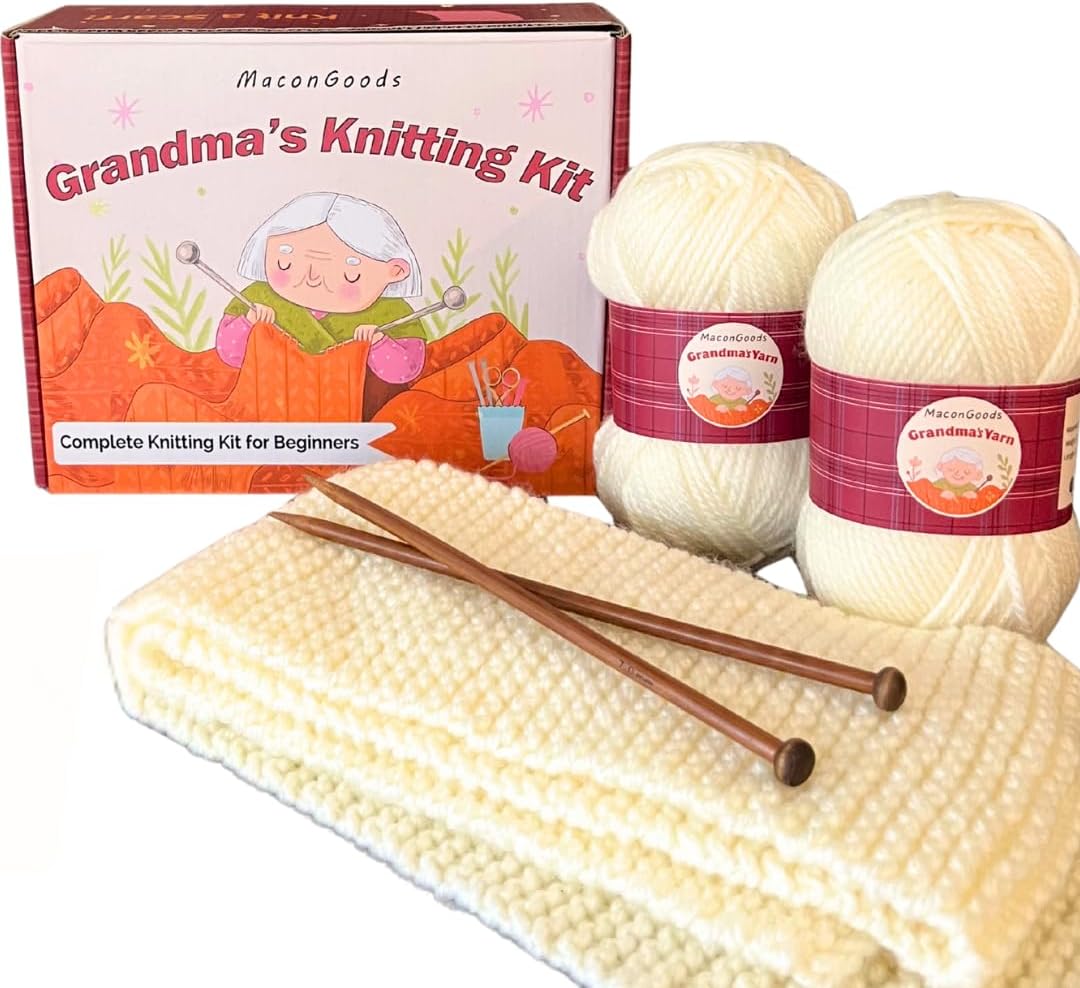
MaconGoods Grandma’s Knitting Kit
The name says it all: this kit is designed to feel like sitting next to a patient relative who shows you the ropes. It is aimed at people who have never held a pair of needles, and the whole package leans on simplicity. Instead of trying to impress you with a huge range of gadgets, it focuses on giving you what you need to practice the basics and get comfortable with the rhythm of knitting.
What we like is the beginner-first mindset. A kit like this works best when the instructions are written for someone who has to be told which hand does what, and this one is positioned exactly that way. It also makes a thoughtful gift for a parent, grandparent, or friend who has always said they wanted to learn.
Pros
- Beginner-first approach
- Warm, giftable concept
- Good for building confidence
Cons
- Fewer extras than some rivals
- Check the listing for yarn quantity

CraftLab Knitting Kit for Beginners
CraftLab has built a reputation around craft kits that come with a clear plan, and this knitting set follows that pattern. The kit is meant to take you from nothing to a finished first piece, and it tends to appeal to people who like to follow a sequence of steps rather than improvising. If you are the sort of person who reads the whole instruction sheet before you begin, this kit will feel comfortable.
The appeal here is the organized approach. You are not left wondering what to do after you finish a practice row, because the kit is designed to move you forward in a logical order. That makes it a nice option for anyone who has tried to learn from random videos and ended up confused about what to practice first.
Pros
- Clear progression
- Beginner-focused design
- Nicely packaged
Cons
- Less room for improvisation
- Confirm yarn color and needle size on the listing

mindfulknits Beginner’s Knitting Kit
mindfulknits is a brand built specifically around teaching people to knit, and that focus shows. The company’s approach pairs the physical kit with a teaching experience, which is exactly what many beginners need. Knitting is a hands-on skill, and being able to watch someone demonstrate a stitch in motion removes a huge amount of confusion that a printed diagram cannot.
This is the kit we would suggest to someone who says, “I tried reading instructions and my brain just melted.” The mindful part of the name also hints at the pace: slow, calm, and low pressure, which is a healthy mindset for a new knitter. If you tend to rush and get frustrated, this is a good match.
Pros
- Teaching-first brand
- Calm, confidence-building pace
- Great for self-taught learners
Cons
- You will want a device handy for lessons
- May be pricier than bare-bones kits
All three of these kits will teach you the knit stitch, and the differences come down to personality. Choose MaconGoods if you want a warm, simple introduction. Choose CraftLab if you like order and a clear path. Choose mindfulknits if video guidance is what you need to feel safe. Whichever you pick, spend your first session just getting the motion into your hands. Do not worry about how the fabric looks yet.
Setting up a comfortable knitting spot
Where you knit matters more than most beginners expect. Good lighting is the biggest factor, because you will be looking closely at small loops of yarn. A lamp positioned over your shoulder, or a bright window during the day, makes stitches far easier to read and reduces eye strain. Sit in a chair with back support and keep your elbows loosely at your sides rather than hunched up near your ears. Place your yarn in a bowl or bag on the floor beside you so it can unwind without tangling around your feet or your pet.
It is also worth taking short breaks. Every twenty minutes or so, put the needles down, shake out your hands, and roll your shoulders. Knitting is gentle, but repetitive motion can leave you stiff if you push through it. A relaxed body leads to relaxed tension, and relaxed tension leads to nicer fabric.
If you knit in the evening, pick a project and a spot that feel calm. Many people discover that a few rows before bed quiet a busy mind better than scrolling on a phone. That small ritual is often what turns a one-time experiment into a lasting hobby.
Pick your classic starter and get your first stitches going this weekend.
View the mindfulknits Beginner KitComplete sets packed with extra tools
This group is for the gear-loving beginner. Instead of a single small project, these kits give you a bigger toolbox: more accessories, more flexibility, and often more yarn to experiment with. They are especially useful if you already suspect knitting is going to stick and you want to avoid buying extras later.

Granny Squirrel Complete Knitting Kit
As the name suggests, Granny Squirrel markets this as a complete starter package. That usually means a generous mix of needles, yarn, and accessories that lets you practice several techniques rather than a single pattern. If you like the idea of opening one box and having everything within arm’s reach, including the odds and ends that most people forget to buy, this is the style of kit you are looking at.
The big advantage of a complete set is freedom. You are not locked into one pattern, so you can practice, tear out your work, and try again without worrying about running out of the one specific yarn that the project demands. For a nervous beginner, permission to make mistakes is worth a lot.
Pros
- Wide range of tools
- Room to practice freely
- Grows with you
Cons
- Can feel like a lot at first
- Less hand-holding than project kits
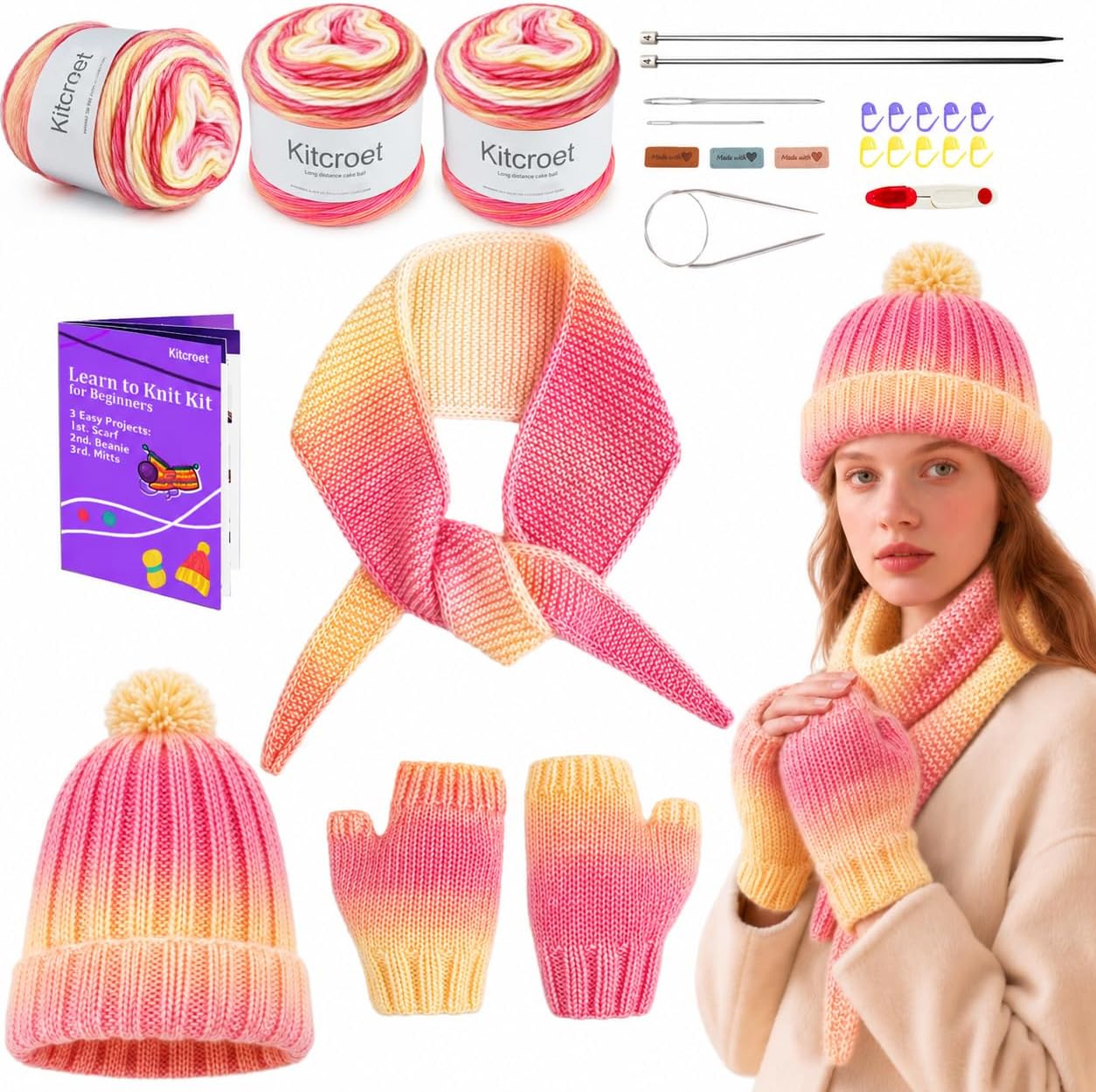
Kitcroet Knitting Kit
Kitcroet is a name many shoppers recognize from crochet and knitting accessory sets, and this kit sits in the same value-oriented lane. The idea is simple: give a new knitter a decent amount of materials and tools without a premium price tag. For someone testing the hobby, that matters. You do not want to invest heavily until you know you enjoy the feel of yarn sliding over your fingers.
With value-focused sets, the thing to check is the quality of the needles and the clarity of the instructions. They are the two places where lower-cost kits sometimes cut corners. Read recent customer comments about needle finish and whether the guide is easy to follow, and you will have a clear picture of whether this kit is the smart buy it appears to be.
Pros
- Accessible price range
- Good variety of materials
- Low-risk way to try knitting
Cons
- Check needle finish in reviews
- Instructions may be lighter

Aeelike Knitting Kit for Beginners
Aeelike’s beginner kit leans into the “everything you could want” philosophy. It is the sort of set that appeals to people who enjoy organizing their craft supplies and like the satisfaction of a well-stocked kit with a spot for every tool. If a tidy toolbox motivates you to sit down and knit, this kit is playing right to that instinct.
This type of kit works best when you use it as a learning toolkit rather than a one-and-done project. Start with a simple practice swatch, then move on to a scarf or dishcloth using the same supplies. If you want help planning that first long project, our walkthrough on how to start knitting a scarf is a natural next read.
Pros
- Plenty of accessories
- Good for ongoing practice
- Nice for gifting
Cons
- More tools than a first project needs
- Confirm instruction format before buying
A caution about big accessory sets: more tools do not make you a better knitter. Every craft hobby has a stage where people buy gear to feel like they are making progress. Resist it. The knitters who improve fastest are the ones who sit down for twenty minutes a day with a simple project, regardless of how many gadgets they own.
Love the idea of a well-stocked toolbox? Compare the complete sets side by side.
View the Granny Squirrel Complete KitProject kits: a scarf and a beanie you will actually wear
Some people learn best when there is a finished, wearable item waiting at the end. These two kits are built around exactly that idea. Instead of handing you a pile of tools and wishing you luck, they walk you through one specific project from the first stitch to the last.

The Spinning Hand Learn to Knit Kit (Rainbow Scarf)
A scarf is the classic first project for good reason. It is a long rectangle, which means you repeat the same simple motion over and over until the motion becomes automatic. The Spinning Hand’s rainbow scarf kit adds a splash of color to that formula, and color is a surprisingly strong motivator. When the yarn changes shade as you knit, you can see your progress in a way that plain yarn never shows.
A scarf also teaches the lessons that matter most early on: keeping an even tension, counting stitches so the edges stay straight, and handling the yarn without strangling it. If you want extra help planning your own version, we put together a full guide to starting a scarf that pairs well with this kit.
Pros
- Cheerful, motivating colors
- Simple, repetitive pattern
- A wearable result
Cons
- Scarves take patience
- Color changes can hide small mistakes
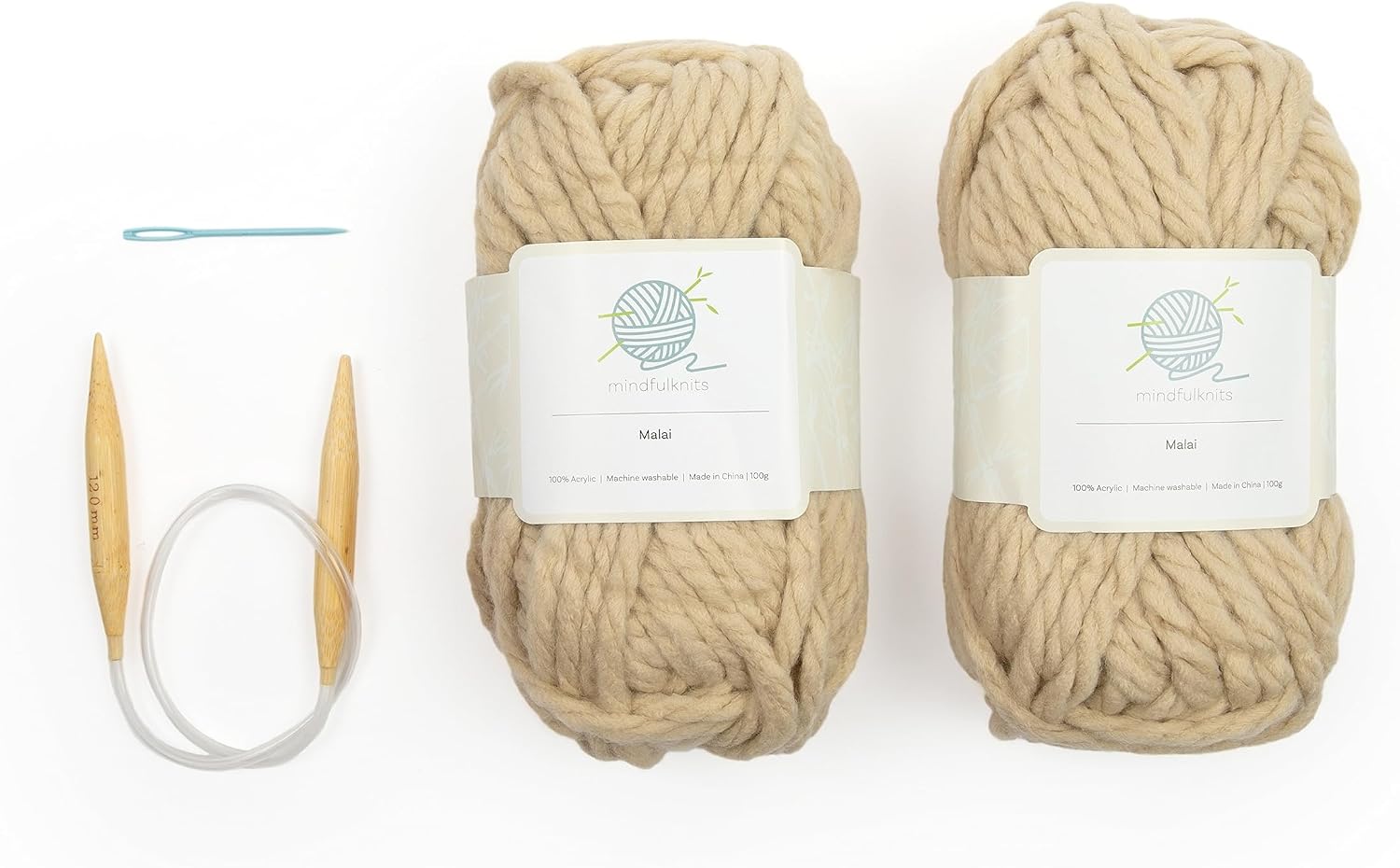
mindfulknits Learn to Knit Chunky Beanie Kit
Chunky yarn is a beginner’s best friend. The stitches are big, easy to see, and quick to make, so rows grow fast and you feel the thrill of progress almost immediately. A beanie made from chunky yarn can be finished in far fewer sittings than a scarf in thinner yarn, which makes this kit a good choice if you have a short attention span or a looming birthday gift deadline.
Hats also introduce a skill that straight-needle projects skip: shaping. Whether the pattern has you work in the round or sew a seam, you will learn how a flat piece of fabric becomes a three-dimensional object. That is a real step up, and a beanie kit lets you take it with plenty of support from a brand that specializes in teaching.
Pros
- Chunky yarn is easy to see
- Quick to finish
- Teaches basic shaping
Cons
- Hat fit depends on your head size
- Seaming may feel new
Scarf or beanie: which should you choose?
Think about how you want to feel after your first week. If you want to be soothed by steady repetition and are happy to work slowly, choose the scarf. If you want a quick sense of accomplishment and are curious about learning something a little more shaped, choose the beanie. Neither is wrong, and many knitters end up making both within a couple of months.
Choose the project you are excited to wear and start knitting it today.
See the Chunky Beanie KitDishcloth and blanket kits for cozy, useful makes
Not everyone wants to wear their first project, and that is perfectly fine. These last two kits focus on things for the home. One is small, practical, and quick. The other is big, soft, and a bit more of a commitment. Together they show how different a beginner kit can be.

Thoughtful Stitch Make Your Own Dishcloth Knitting Kit
Dishcloths are the unsung heroes of beginner knitting. They are small, which means you can finish one in a sitting or two. They are made from sturdy cotton yarn in many kits, which is forgiving and easy to wash. And, most importantly, a wobbly edge or an uneven stitch does not matter, because nobody holds a dishcloth to the same standard as a sweater. You are free to make mistakes and keep going.
A dishcloth kit is also the cheapest and least intimidating way to find out whether you enjoy knitting. If you are the type to worry about wasting money on a hobby you might drop, this is the smart entry point. Finish a cloth, use it in your kitchen, and let the satisfaction of a real, usable object convince you to keep going.
Pros
- Small and quick
- Forgiving of mistakes
- Useful finished item
Cons
- Less variety in skills practiced
- Cotton can feel stiff while knitting

Luckies of London Calm Club Comfort Blanket Knitting Kit
The Calm Club line is built around the idea that knitting can be a wind-down ritual, not another item on your to-do list. A comfort blanket sounds exactly like that: soft, squishy, and made for evenings on the sofa. Chunky and plush yarns used in blanket kits create a lovely tactile experience, and the rhythm of the stitches can be genuinely calming.
The trade-off is size. A blanket is a larger commitment than a dishcloth or a hat, and soft, fluffy yarns can be harder to read than smooth ones. If you are brand new, you may want to practice on a smaller project first or pair this kit with a few swatches. But if the idea of a cozy blanket is what pulled you into knitting in the first place, following that excitement is a perfectly good reason to choose it.
Pros
- Soothing, tactile knitting
- Beautiful finished piece
- Great as a keepsake or gift
Cons
- Larger time commitment
- Plush yarn can hide stitches
Our take: if you can only choose one kit from this whole list and you are truly starting from zero, the dishcloth kit is the safest bet and the mindfulknits beginner kit is the best teacher. The blanket kit is the most rewarding if you already know you love the idea of the end result.
Start small with a dishcloth, or go big with a blanket. Either way, the first stitch is the hardest.
View the Dishcloth Knitting KitSide-by-side comparison of all ten kits
After reading ten individual reviews, it helps to see everything in one place. The table below summarizes the character of each kit so you can match it to your own goals. Always confirm current contents and pricing on the product page, since sellers update their listings.
| Kit | Main project or focus | Best for | Learning support |
|---|---|---|---|
| MaconGoods Grandma’s Knitting Kit | Learning the basics | Total beginners and gifting | Beginner-first guidance |
| CraftLab Knitting Kit for Beginners | Guided first piece | Step-by-step learners | Structured instructions |
| mindfulknits Beginner’s Knitting Kit | Core techniques | Visual learners | Teaching-focused brand |
| Granny Squirrel Complete Knitting Kit | Open practice and variety | Gear lovers | Self-directed |
| Kitcroet Knitting Kit | General practice | Budget-minded buyers | Self-directed |
| Aeelike Knitting Kit for Beginners | General practice with accessories | Organized crafters | Self-paced |
| The Spinning Hand Learn to Knit Kit | Rainbow scarf | Color lovers | Project-based |
| mindfulknits Chunky Beanie Kit | Chunky beanie | Fast results | Teaching-focused brand |
| Thoughtful Stitch Dishcloth Kit | Dishcloth | Cautious first-timers | Project-based |
| Luckies of London Calm Club Blanket Kit | Comfort blanket | Relaxation seekers | Project-based |
Quick picks by goal
| If you want… | Choose |
|---|---|
| The safest, cheapest way to test the hobby | Thoughtful Stitch Dishcloth Kit |
| Video-style teaching to ease your nerves | mindfulknits Beginner’s Knitting Kit |
| A thoughtful gift for a new knitter | MaconGoods Grandma’s Knitting Kit |
| A wearable first project fast | mindfulknits Chunky Beanie Kit |
| A scarf with a cheerful color payoff | The Spinning Hand Rainbow Scarf Kit |
| Lots of tools to grow into | Granny Squirrel Complete Knitting Kit |
| A calming, long-term project | Luckies of London Comfort Blanket Kit |
How to decide in five minutes
- Decide what you would be happy to make: cloth, scarf, hat, or blanket.
- Decide how you learn best: from pictures, from video, or by experimenting.
- Set a budget you would not regret if you stopped after a month.
- Read the most recent reviews for complaints about needles or missing yarn.
- Pick the kit that matches the most answers and commit to it.
Narrowed it down? Check today’s price on the kit that fits your goals.
Compare Knitting Kits on AmazonYour first month with a knitting kit: a realistic plan
Opening the box is the easy part. The question that matters is what happens in the next four weeks, because that is the window in which most new knitters either build a habit or drift away. Here is a gentle schedule that works with nearly any kit on this list. Treat it as a suggestion, not a rulebook, and adjust it to fit your life.
Week one: get comfortable with the motion
Set aside the project instructions for a few days and simply learn to hold your needles and yarn. Make a slip knot. Cast on about twenty stitches. Then knit every row until the little rows begin to look like fabric. It will not be pretty. Your stitches will be loose in some places and tight in others, and you will probably add or lose a stitch without noticing. That is completely normal, and it is exactly why this week exists.
Cast-on is the first real skill you will meet, and there are several methods. If your kit shows only one, do not worry. Our walkthrough on how to cast on explains the options and when each is useful.
- Practice for ten to twenty minutes a day instead of one long session.
- Do not unravel everything the first time you see a mistake. Learn to recognize it first.
- Keep your shoulders relaxed. A death grip on the needles causes sore hands.
Week two: start the real project
By now the motion should feel less foreign. Cast on for your actual project and begin following the pattern. If you chose a scarf, dishcloth, or blanket, you will mostly repeat the same row over and over. If you chose a beanie, read the whole pattern first so the shaping does not surprise you later. Count your stitches at the end of every few rows. It takes ten seconds and prevents a lot of heartache.
Week three: build rhythm and fix problems
This is the week many beginners hit a wall. The excitement has faded a little, the project is not finished, and small flaws are becoming obvious. Push through it. Keep a spare crochet hook or a small tool nearby to fix dropped stitches, and look up how to read your knitting. Being able to tell a knit stitch from a purl bump on the fabric is the beginning of real independence.
Try this: take a photo of your work at the end of week one and again at the end of week three. The difference is almost always dramatic, and it is the best antidote to the feeling that you are not improving.
Week four: finish, bind off, and weave in ends
Finishing is a skill in its own right. Binding off, also called casting off, locks your last row so the fabric does not unravel. It is easy to do too tightly, which makes a puckered edge, so keep your stitches relaxed. Our step-by-step explanation of how to cast off covers the common mistakes. Once you have bound off, use the tapestry needle in your kit to weave the loose ends into the back of your work, then give the piece a gentle wash or steam if the yarn label allows it.
Then stop and admire what you made. It may be uneven. It may have one crooked edge. It is also proof that you learned something new, and that is worth celebrating before you move on to the next project.
| Week | Focus | Goal |
|---|---|---|
| 1 | Holding needles, slip knot, cast on, basic knit stitch | A practice swatch of even rows |
| 2 | Starting the kit project | Several inches of fabric or a first section |
| 3 | Counting, spotting mistakes, fixing dropped stitches | Confidence reading your own fabric |
| 4 | Binding off, weaving in ends, finishing | One completed project |
Build a small daily knitting habit
The knitters who improve fastest are rarely the ones with the most free time. They are the ones who attach knitting to something that already happens every day. Keep your project bag next to your favorite chair, and knit for one episode of a show, one podcast, or one cup of tea. Ten minutes is enough. The goal is to keep your hands familiar with the motion so it never feels brand new again.
It also helps to leave your project in a visible, ready-to-go spot. If the needles are buried in a closet, you will not pick them up on a tired evening. If they are on the table with the yarn next to them, you probably will. Make starting effortless, and the rest takes care of itself.
Finally, be kind to yourself on slow days. Some sessions will feel clumsy, and that is not a sign you are going backward. Hands learn in bursts, and a rough day is often followed by a surprisingly smooth one. Stay curious and keep the sessions short and regular.
Give yourself a month, a simple project, and the right kit. That is genuinely all it takes.
Find a Learn-to-Knit KitCommon beginner mistakes and how to fix them
Every knitter makes the same handful of mistakes in the first few weeks. Knowing them in advance takes a lot of the sting out, because you can recognize them when they happen and treat them as part of the process instead of a personal failure.
Knitting too tightly
New knitters often pull the yarn hard after every stitch, as if tension equals control. The result is fabric that feels stiff, needles that are hard to move, and hands that ache after ten minutes. Try loosening your grip and letting the yarn flow through your fingers. Your stitches should be snug around the needle, not strangled. If the problem persists, switching to a slightly larger needle or a smoother yarn can help.
Accidentally adding or losing stitches
If your scarf is getting wider or narrower for no obvious reason, you are probably picking up an extra loop or skipping a stitch at the edges. The fix is simple but annoying: count your stitches at the end of every few rows. Place a marker at the start of the row if your kit includes one. After a few weeks, you will start to feel when something is off before you even look.
Splitting the yarn
When the needle tip goes through the strands of the yarn instead of around the whole strand, you are splitting it. This usually happens with loosely plied yarns and sharp needle tips. Slow down and watch where your needle enters the stitch. Choosing a smoother, tightly spun yarn also helps. Our guide to beginner-friendly yarn points out which textures are friendliest to new hands.
Twisting stitches
If your fabric looks slightly rope-like or has a strange twist to the stitches, you may be wrapping the yarn the wrong way around the needle. Most diagrams show the yarn going counterclockwise around the right needle. Check your wrap direction and compare your work against the picture in your kit’s guide. If you are watching a video, pause and match the motion exactly.
Dropping a stitch and panicking
A dropped stitch looks like a little ladder in your knitting. It feels disastrous the first time, but it is one of the easiest problems to fix once you know how. Pick up the loose stitch with a crochet hook or the tip of your needle and work it back up the ladder row by row. Many kits do not teach this, so look up a short tutorial before it happens. If you ever feel torn between the two crafts, you might find our comparison of crochet versus knitting interesting. Crochet only has one live stitch at a time, which is why dropped stitches are less of a worry there.
Choosing a project that is too ambitious
The urge to knit a sweater in your first month is strong, and it usually ends in a half-finished piece at the back of a closet. Stick to something small and simple until you have finished two or three projects. Confidence built on completion is much sturdier than confidence built on enthusiasm.
Giving up too early
The first week of knitting feels awkward for almost everyone. Your hands do not know what to do, your tension is wild, and the fabric looks nothing like the picture. This is the stage where most people quit, and it is also the stage that passes the fastest. Keep going for just a few more sessions and the movement starts to click.
Habits that help
- Short, daily practice
- Counting stitches often
- Using lighter-colored yarn
- Asking for help early
Habits that hurt
- Pulling the yarn too tight
- Skipping the instructions
- Starting a complex project first
- Unraveling everything in frustration
A word on tension and why it improves on its own
Tension is simply how tightly or loosely you hold the yarn as you work. It is the number one reason beginner knitting looks uneven, and the number one thing beginners worry about. The good news is that tension mostly fixes itself with mileage. Your hands start out unsure and then settle into a steady grip without any conscious effort. You can speed this up by choosing a yarn with a bit of stretch, keeping your wrists relaxed, and resisting the urge to tug the yarn after each stitch.
Some knitters find it helpful to wrap the yarn around a finger or through a small guide to control the flow. Others prefer to let it run freely. Try a few approaches during your first week and keep the one that feels the least tiring. There is no single correct method, only the one that lets you knit comfortably for longer stretches.
When you finish a project, look at the earliest rows next to the latest rows. The difference you see is the improvement you made, even if you never felt it happen. That quiet progress is one of the best parts of learning a handcraft.
Stock up on helpful extras like stitch markers and row counters to avoid these slip-ups.
Shop Knitting AccessoriesCaring for your kit, your yarn, and your finished project
A little care keeps your tools useful and your projects looking good. Nothing here is complicated, but a few habits will save you money and frustration over time.
Storing your supplies
Keep your yarn in a clean bag or bin away from direct sunlight, which can fade colors and weaken fibers. Pets are a bigger threat than most people expect, so a lidded container or a zippered project bag is worth the small investment. Needles should be stored flat or upright in a case so the tips do not bend or snap. If your kit came with a tote or pouch, use it. It was probably included for exactly that reason.
- Wind loose yarn into a loose ball, not a tight one that stretches the fibers.
- Keep stitch markers and small tools in one pouch so they do not wander.
- Label the box if you are pausing a project so you remember your place in the pattern.
- Take a photo of the pattern page before you lose the instruction sheet.
Washing and finishing
Check the yarn label before you wash anything. Acrylic usually handles a gentle machine cycle, cotton dishcloths can go in with your regular laundry, and wool blends often prefer a cool hand wash. When in doubt, wash a swatch first. Lay finished pieces flat to dry rather than hanging them, because a wet knitted fabric will stretch under its own weight.
Blocking, which means gently shaping a damp piece and letting it dry, is an optional step that makes edges neater and stitches more even. For a first scarf, you can skip it. For a blanket or a hat, it can improve the look of your work noticeably.
Taking your knitting on the road
One of the joys of knitting is portability. A small project, a couple of needles, and a ball of yarn can turn a long train ride or waiting room visit into productive, relaxing time. If you plan to fly with your project, rules about needles vary by airline and country, so it is worth checking the details before you pack. We have a dedicated explainer on whether you can bring knitting needles on a plane to help you avoid surprises at security.
For travel, favor lightweight bamboo or plastic needles, a small pair of blunt-tipped scissors if allowed, and a compact project bag with a drawstring so your yarn does not roll across the floor. Beanie and dishcloth kits are especially travel-friendly because the projects are small and self-contained.
Good to know: keep any leftover yarn from your kit. Even a small amount is useful for practicing new stitches, making swatches, or repairing the finished project later.
A good project bag keeps everything tidy at home and on the go.
Browse Knitting Project BagsWhat to do after your first kit
Finishing your first project is a real milestone, and it naturally leads to the question, “What now?” The answer depends on what you enjoyed most. Here are the most common paths knitters take, and the reasons you might choose each.
Make the same project again, better
It sounds boring, but repeating a simple project is one of the fastest ways to improve. The second dishcloth or scarf almost always looks dramatically better than the first, because your hands now know what to do and your attention can go to tension and neatness. Try a different color or a slightly different stitch pattern to keep it interesting.
Learn the purl stitch
The knit stitch is only half of the basic vocabulary. Add the purl stitch and you unlock ribbing, stockinette fabric, and the vast majority of patterns you will find online. Many beginner kits teach knit only, so look for a short tutorial and practice on a small swatch.
Upgrade your needles and yarn
Once you know what you like, it makes sense to invest in tools that suit your preferences. Maybe you love bamboo, maybe you crave slick metal, or maybe you want a circular needle set. Our recommendations for beginner knitting needles are a good place to start, and better yarn can transform the experience of knitting and the look of the final piece.
Try a different kind of project
Move from flat knitting to knitting in the round, add a simple textured stitch, or tackle a pair of fingerless mitts. Each new project should stretch you slightly without overwhelming you. A good rule is to introduce only one new skill per project.
Compare it to crochet
Many people who learn knitting get curious about crochet, and vice versa. Both crafts are rewarding and they use different tools and motions. If you want to understand how they compare for beginners, read our comparison of crochet and knitting and see whether a second hobby appeals to you.
Join a community
Knitting is a social craft. Local yarn shops, libraries, and community centers often host weekly knit nights where beginners are warmly welcomed. Online groups offer the same encouragement at any hour. Show your finished kit project, ask questions, and let other knitters cheer you on. A little community support goes a long way toward keeping the habit alive.
| If you enjoyed… | Try next |
|---|---|
| The calm repetition of a scarf | A longer cowl or a simple ribbed wrap |
| The speed of a chunky beanie | Another hat with a different brim or pompom |
| The practicality of a dishcloth | Coasters, washcloths, or a set of spa cloths |
| The coziness of a blanket | A baby blanket or a lap throw in a lighter yarn |
Ready to turn one finished project into a lasting hobby? Pick up your next set of supplies.
Shop Knitting SuppliesFrequently asked questions about beginner knitting kits
What is the best knitting kit for a complete beginner?
The best kit is the one that matches how you like to learn and what you want to make. For hands-on guidance and a teaching-first approach, the mindfulknits Beginner’s Knitting Kit and the MaconGoods Grandma’s Knitting Kit are strong choices. For a low-pressure first project, a dishcloth kit is hard to beat. If you are not sure, start with the smallest project, because finishing something quickly builds the confidence that carries you into bigger ones.
Are knitting kits worth it compared with buying supplies separately?
For most beginners, yes. A kit takes care of matching yarn to needles, gives you a clear project, and usually costs less than gathering the same items one by one. Buying separately makes more sense once you know your preferences and want higher-quality tools. If that is where you are heading, our guide to the best knitting needles for beginners can help you shop smart.
What should a good beginner knitting kit include?
At a minimum, look for yarn in an easy-to-see color, a pair of needles suited to that yarn, a tapestry needle for finishing, and clear instructions. Helpful extras include stitch markers, a row counter, a measuring tape, scissors, and a storage bag. Video tutorials are a big bonus because they let you watch each motion instead of guessing from a diagram.
What is the easiest first project for a new knitter?
A dishcloth or a simple scarf is usually the easiest. Both rely on repeating the same stitch in straight rows, which is the best way to build muscle memory. Hats and blankets are great second or third projects. If you want to try a scarf, our guide on how to start knitting a scarf walks you through the decisions at the start.
What needle size is best for beginners?
Medium to large needles are usually easiest because they make bigger, more visible stitches. The ideal size depends on the yarn you are using, so follow the recommendation in your kit. If you want to understand how needle size changes your fabric, read our article on what size knitting needles for beginners.
Which yarn is best for learning to knit?
Smooth, medium-weight or chunky yarn in a light or medium color is the friendliest for beginners. It shows your stitches clearly and is less likely to split. Avoid very dark, fuzzy, or heavily textured yarns for your first project. Our overview of the best yarn for beginner knitting lists easy options.
How long does it take to learn to knit with a kit?
Most people can learn the basic knit stitch in a single afternoon, but comfortable, even knitting usually takes a few weeks of regular practice. Finishing a small project like a dishcloth often takes a few sessions, while a scarf or blanket may take several weeks. Short, frequent practice is more effective than occasional marathons.
Do I need to know how to cast on and cast off before I start?
No, a good kit will teach you both. If the instructions feel unclear, our tutorials on how to cast on and how to cast off give extra detail. These two skills open and close every project, so they are worth practicing until they feel natural.
Are knitting kits good gifts?
They make wonderful gifts because the recipient receives everything needed in one box. Choose a project that suits the person: a dishcloth for a practical friend, a scarf or beanie for someone who likes wearable crafts, or a blanket for someone who loves a cozy evening. Adding a note with a link to a beginner tutorial makes it even more thoughtful.
Is knitting or crochet easier for beginners?
It depends on the person. Crochet uses one hook and one active loop, which many people find simpler to control. Knitting uses two needles and many live stitches, but its rhythm can feel smoother once you get going. We explore this question in detail in our article on crochet versus knitting.
Can I take my knitting kit on a plane?
Policies vary by country and airline, and they can change, so check the current rules before you travel. Many travelers choose plastic or bamboo needles and keep scissors in checked luggage when required. For a deeper look, see our explainer on bringing knitting needles on a plane.
What should I do if my first project looks messy?
Keep it. Messy first projects are normal, and they become treasured proof of how far you have come. Finish the piece if you can, because finishing teaches skills that stopping early does not. Then start a second project and notice how much smoother it feels. Improvement in knitting comes from repetition, not perfection.
Still have a question? The best answer is usually a pair of needles and an hour of practice.
Browse Beginner Kits for AdultsFinal thoughts: pick a kit and make your first stitch
The best knitting kit for a beginner is not the one with the most accessories or the prettiest packaging. It is the one that gets you knitting, keeps you encouraged, and leaves you with a finished project you are proud of. For many people that means a guided, teaching-first set like the mindfulknits or MaconGoods kits. For others it is the quick win of a chunky beanie, the cheerful progress of a rainbow scarf, the practical charm of a dishcloth, or the slow comfort of a blanket.
If you are still torn, remember that none of these choices is permanent. You can change your mind, try a different project next month, and slowly build the collection of tools and yarns that suits your style. What matters most is the first session. Open the box, take a breath, and make that first wobbly row. Everything else grows from there.
Ready to begin? Choose the kit that makes you most excited to sit down with it tonight, and give yourself permission to be a beginner.
Your first stitch is one click and one box away.
Find Your Beginner Knitting KitYou may also like
Keep learning with these guides from our knitting library.