
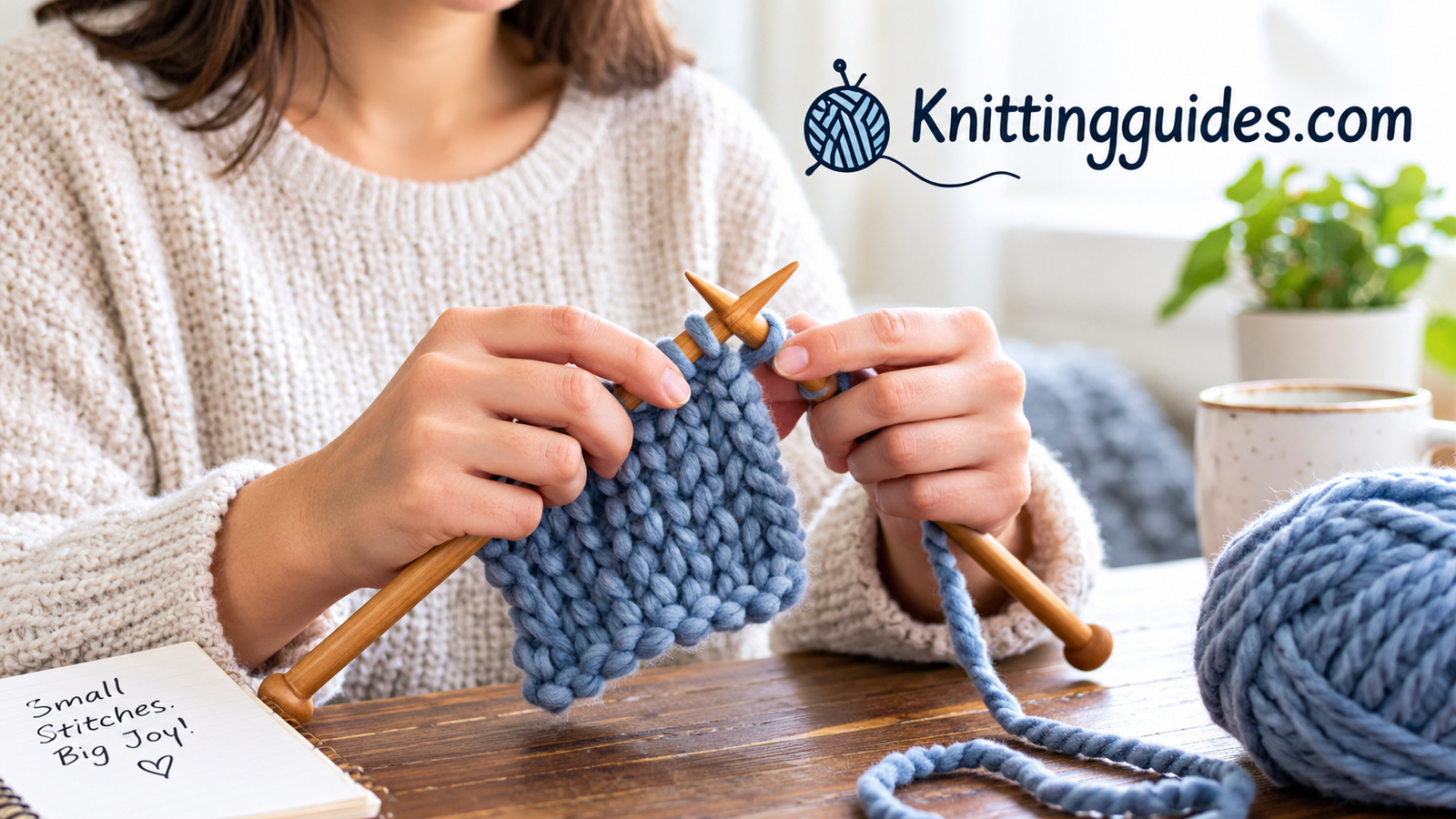
What Size Knitting Needles for Beginners: The Complete, Practical Guide
Pick the wrong needles and your first scarf turns into a battle. Pick the right ones and your hands relax, your stitches even out, and knitting finally starts to feel fun. Here is exactly which size to buy, why it works, and how to adjust as you grow.
Walk into any craft store or open any online shop and you will see a wall of knitting needles in sizes that look almost identical. Some are as thin as a pencil lead. Others look like broom handles. Numbers, millimeters, letters, and colors cover the packaging, and nothing on it tells a nervous first-timer what to actually put in the cart.
That confusion is the reason so many people give up in the first week. They grab needles that are too small for their yarn, fight every stitch, and decide knitting is not for them. In truth, the needles were the problem, not the knitter. Size shapes everything about early practice: how easily the yarn glides, how clearly you can see each loop, how tired your hands get, and how good your first project looks.
This guide walks through needle sizing from the ground up. You will learn how sizes are measured, how they pair with yarn, which sizes suit which beginner projects, how materials change the feel, and how to fix problems when your fabric comes out too tight or too loose. By the end, you will know what to buy with confidence and how to adjust as your skills grow.
Quick answer: Most beginners do best with US size 8 (5 mm) or US size 9 (5.5 mm) needles and a smooth, light-colored worsted weight yarn. That combination is forgiving, easy to see, and works for scarves, dishcloths, and hats.
If you are still putting together your first supplies, our roundups of the best knitting kits for beginners and the best knitting needles for beginners are good companions to this article.
1. The Short Answer: Which Needle Size Should Beginners Choose?
If you want a single recommendation, here it is: choose US size 8 (5 mm) needles, or US size 9 (5.5 mm) if you tend to knit tightly. Pair them with a worsted weight yarn in a smooth, solid color. This pairing sits right in the middle of the range where yarn is easy to handle and stitches are large enough to read.
Why not smaller? Thin needles make small stitches, and small stitches are hard to see, hard to count, and hard to fix. When you drop a stitch on a US size 3 needle with fine yarn, you may not notice for several rows. On a US size 8 needle with worsted yarn, you can see the loop slipping and catch it quickly.
Why not much bigger? Jumbo needles with super chunky yarn look glamorous on social media, but they are heavy, awkward, and tiring to hold. The stitches can also stretch into floppy loops that hide mistakes in a different way and teach you poor tension habits.
The beginner-friendly range at a glance
| Needle size | Best for | Beginner rating |
|---|---|---|
| US 6 to 7 (4 to 4.5 mm) | Lighter yarn, baby items, a tighter fabric | Good once you are comfortable |
| US 8 (5 mm) | Worsted yarn, scarves, dishcloths, hats | Excellent first choice |
| US 9 (5.5 mm) | Worsted yarn for loose knitters, light bulky | Excellent, especially for tight tension |
| US 10 to 10.5 (6 to 6.5 mm) | Bulky yarn, fast scarves, cozy blankets | Very good for quick wins |
| US 11 and larger (8 mm+) | Super bulky and jumbo projects | Fun later, tiring early |
Notice that the middle of the range appears more than once as a top pick. That is not an accident. Mid-sized needles give you room to learn without overwhelming your hands or your eyes.
Ready to grab a pair of beginner-friendly needles?
Shop Beginner Needles on Amazon2. How Knitting Needle Sizes Are Measured
Before you can choose well, it helps to decode the labels. Needle sizes come in a few different systems, and a single package often shows more than one. The only measurement that never changes is the diameter in millimeters. When in doubt, trust the millimeter number.
The US system
American needles use a number scale that starts small and climbs as the needle gets thicker. A US 2 is very thin, a US 8 sits in the middle, and a US 17 is as thick as a marker. The jumps between sizes are not perfectly even, which is why the metric number is more reliable.
The metric system
Metric sizing measures the needle diameter in millimeters. A 5 mm needle is exactly 5 millimeters across. Most patterns written outside the United States use this system, and many American patterns list both so everyone can follow along.
The older UK and Canadian system
Older British patterns use a reversed scale, where the numbers get smaller as the needle gets bigger. A UK size 6 is 5 mm, and a UK size 8 is 4 mm. This catches many beginners off guard when they pick up a vintage pattern, so always double check the millimeter conversion.
Handy conversion table
| US size | Metric (mm) | Older UK size |
|---|---|---|
| 6 | 4.0 | 8 |
| 7 | 4.5 | 7 |
| 8 | 5.0 | 6 |
| 9 | 5.5 | 5 |
| 10 | 6.0 | 4 |
| 10.5 | 6.5 | 3 |
| 11 | 8.0 | 0 |
| 13 | 9.0 | 00 |
| 15 | 10.0 | 000 |
Tip: Many needle packages have the size stamped on the needle itself, but the print can wear off with use. A cheap needle gauge, which is a small card with holes of different sizes, lets you identify any needle in seconds.
Understanding the numbers also protects you from a classic mistake: buying needles that match a pattern’s US number but ignoring that a different brand’s size runs slightly larger or smaller. When a pattern is picky about gauge, the millimeter measurement is your safest guide.
Want an easy way to identify any needle?
Browse Needle Gauges on Amazon3. Matching Needle Size to Yarn Weight
Needles and yarn work as a pair. If you remember only one rule from this guide, make it this: choose needles that suit your yarn. A thick yarn forced onto thin needles will be stiff and hard to work. A thin yarn on thick needles will look holey and loose.
Yarn comes in standard weight categories, numbered from 0 (lace) to 7 (jumbo). Each category has a typical needle range printed on the label. These ranges are a starting point, and your own tension decides where you land inside them.
| Yarn weight | Common names | Typical needle range | Good for beginners? |
|---|---|---|---|
| 0 Lace | Thread, cobweb | US 000 to 1 (1.5 to 2.25 mm) | No, too delicate |
| 1 Super fine | Fingering, sock | US 1 to 3 (2.25 to 3.25 mm) | Not at first |
| 2 Fine | Sport, baby | US 3 to 5 (3.25 to 3.75 mm) | Later on |
| 3 Light | DK, light worsted | US 5 to 7 (3.75 to 4.5 mm) | Reasonable |
| 4 Medium | Worsted, aran | US 7 to 9 (4.5 to 5.5 mm) | Best choice |
| 5 Bulky | Chunky, craft | US 9 to 11 (5.5 to 8 mm) | Great for fast projects |
| 6 Super bulky | Roving | US 11 to 17 (8 to 12.75 mm) | Fun, but heavy |
| 7 Jumbo | Giant yarn | US 17 and up (12.75 mm+) | Not recommended |
What happens when the match is off
When needles are too small for the yarn, the fabric becomes dense, stiff, and almost board-like. Your hands cramp because you are forcing yarn through tight loops. When needles are too large, stitches drift apart, creating a lacy, drapey fabric that may be pretty on purpose but looks accidental when you wanted something solid.
Choosing the weight is half the job. If you are not sure which yarn to start with, the guide to the best yarn for beginner knitting explains what to look for in fiber, color, and texture.
Find a worsted weight yarn that pairs perfectly.
Shop Worsted Yarn on Amazon4. Why Medium Needles (US 8 to 10) Are the Beginner Sweet Spot
Think of needle size like the gears on a bicycle. The lowest gears are slow and fiddly. The highest gears need strength you may not have yet. Somewhere in the middle, you cruise. For knitting, that middle is the US 8 to 10 range.
Stitches you can actually see
Learning to read your knitting is the most valuable early skill. You need to tell a knit stitch from a purl stitch, spot a twisted loop, and notice when a stitch has slipped off. On medium needles with worsted yarn, loops are large enough to inspect without squinting.
Forgiving tension
Many new knitters grip the yarn too tightly. On thin needles, a tight grip makes stitches nearly impossible to slide along. On medium needles, you have some slack. The loops have room to breathe, so a tense hand still produces workable fabric while you learn to relax.
Comfortable hand position
Very thin needles encourage a pinched, cramped hold. Very thick needles force your wrists into awkward angles. Medium needles feel natural in the hand, similar to holding a pencil or a chopstick, so you can practice for longer without soreness.
Fast enough to feel progress
Motivation matters. A scarf on US 8 needles with worsted yarn grows visibly in an evening, while the same scarf on tiny needles takes weeks. Seeing real progress keeps you coming back.
Pros of medium needles
- Easy to see and fix mistakes
- Forgiving for tight tension
- Comfortable for longer sessions
- Match the most common beginner yarns
- Widely available and affordable
Cons of medium needles
- Not suited to fine, delicate projects
- Fabric is thicker than lightweight garments
- You will eventually want other sizes
If you are still working out your very first steps, you may find it useful to read how to start knitting alongside this article. Needle size is only one piece of a successful beginning, and the basics of holding the yarn make a real difference too.
Try a comfortable set in the sweet spot range.
See Mid-Size Needles on Amazon5. Needle Size by First Project
Another way to choose is to start with your project and work backward. Most beginners begin with a handful of simple items, and each one has a size that tends to work well.
A garter stitch scarf
The classic first project. Worsted or bulky yarn on US 8 to 10 needles creates a soft, squishy scarf that grows quickly. Because garter stitch is just knitting every row, it is the best way to practice even tension. If you want a detailed walk-through, see the guide on how to start knitting a scarf.
A dishcloth
Cotton dishcloths are small, quick, and forgiving. Cotton yarn has no stretch, so many beginners find it harder than wool, but a dishcloth is small enough that the practice is painless. US 6 to 8 needles produce a firm, absorbent fabric that scrubs well.
A hat
Hats require a little shaping, but a simple beanie in worsted yarn on US 7 to 8 circular needles is a manageable second project. You will want a circular needle for working in the round, which we cover in the next sections.
A chunky blanket
Bulky yarn on US 10.5 to 15 needles creates a cozy throw surprisingly fast. This is a great confidence booster once you can knit and purl comfortably, though the larger needles are heavy during long sessions.
| Project | Suggested yarn | Suggested needles | Difficulty |
|---|---|---|---|
| Garter scarf | Worsted or bulky | US 8 to 10 (5 to 6 mm) | Very easy |
| Dishcloth | Worsted cotton | US 6 to 8 (4 to 5 mm) | Easy |
| Simple beanie | Worsted | US 7 to 8 (4.5 to 5 mm) | Moderate |
| Chunky blanket | Bulky | US 10.5 to 15 (6.5 to 10 mm) | Easy but heavy |
| Cowl | Bulky or worsted | US 9 to 11 (5.5 to 8 mm) | Easy to moderate |
| Baby blanket | Light or worsted | US 7 to 9 (4.5 to 5.5 mm) | Easy |
Notice how often the US 8 needle appears. If you buy one pair that covers the widest range of beginner projects, size 8 is the clear winner, and size 9 is a close runner-up.
Pick up needles for your first scarf or hat.
Find Project Needles on Amazon6. Bamboo, Wood, Metal or Plastic: How Material Changes the Feel
Size is not the only decision. Needles also come in different materials, and each one changes how the yarn behaves. The same US 8 needle can feel completely different depending on whether it is bamboo or aluminum.
Bamboo and wood
These are warm to the touch and slightly grippy, so stitches tend to stay put instead of sliding off. That makes them a favorite for beginners, who often drop stitches by accident. They are lightweight and quiet, though very thin bamboo needles can snap under pressure.
Metal
Aluminum and nickel-plated needles are slick and fast. Yarn glides smoothly, which suits experienced knitters, but beginners may find stitches slide off too easily. Metal can also feel cold and noisy.
Plastic and acrylic
Plastic needles are affordable and lightweight, with a medium level of slip. They are popular in larger sizes where wood or metal would be heavy. Some are flexible, which can be comfortable but may bend under strain.
Carbon fiber and specialty materials
These are strong, light, and smooth, with a polished tip. They tend to cost more, so most beginners can skip them until they know what they like.
| Material | Grip level | Weight | Beginner friendliness |
|---|---|---|---|
| Bamboo | High grip | Very light | Excellent |
| Wood | Medium grip | Light | Excellent |
| Metal | Very slick | Medium | Fair, stitches slide |
| Plastic | Medium slip | Light | Good |
| Carbon fiber | Smooth | Very light | Good, higher cost |
Beginner pairing tip: Slippery yarn on slippery needles is a recipe for dropped stitches. If your yarn is smooth, choose bamboo or wood. If your yarn is fuzzy or sticky, metal can help it glide.
Compare bamboo and wooden needles for beginners.
Shop Bamboo Needles on Amazon7. Straight, Circular, or Double-Pointed: Choosing Type and Length
Once you know your size, you need to pick a style. This choice affects comfort more than most beginners expect.
Straight needles
These are the traditional pair with a point on one end and a stopper on the other. They are simple and familiar, and many kits include them. They work well for flat projects such as scarves and dishcloths. Lengths run from about 10 to 14 inches, and longer ones can feel unwieldy, with the tips poking your elbows.
Circular needles
Two short needle tips joined by a flexible cable. You can use them for flat knitting by simply turning your work at the end of each row, and for knitting in the round by joining the stitches in a loop. Many experienced knitters prefer them for everything, because the weight of the project rests in your lap instead of your wrists. For a beginner who plans to make hats and cowls soon, a circular needle in US 8 or 9 is a smart buy.
Double-pointed needles
Sets of four or five short needles with points on both ends, used for small circular projects such as socks and mittens. They are fiddly and best left for later, once you are confident with basics.
Which length is best?
For straight needles, a 10-inch pair is a comfortable beginner length for narrow items. A 14-inch pair holds more stitches for wider scarves. For circular needles, a 16-inch cable suits hats, a 24-inch cable suits most general projects, and a 32-inch cable handles blankets.
Why circulars suit beginners
- Weight rests in your lap
- Stitches are less likely to fall off
- Work flat or in the round
- Easier on wrists and shoulders
Possible downsides
- Cables can curl at first
- Joining in the round takes practice
- Less familiar to first-timers
Try a circular needle with a smooth cable.
Browse Circular Needles on Amazon8. How to Read the Yarn Label for the Right Needle Size
The yarn label is a small instruction manual hiding in plain sight. Learning to read it removes much of the guesswork from choosing needles.
The weight symbol
Look for a small icon of a skein with a number from 0 to 7 on it. This is the yarn weight category. A number 4 means worsted, the most beginner-friendly weight.
The needle symbol
Most labels show a picture of knitting needles beside a recommended size, often displayed as a range such as US 7 to 9 (4.5 to 5.5 mm). This is the manufacturer’s suggestion for a typical fabric.
The gauge square
Labels also show a small square with a stitch count and a row count, for example 18 stitches and 24 rows over 4 inches. This tells you how the yarn behaves when knitted at the recommended needle size.
How to choose inside the range
If the label says US 7 to 9, which size do you pick? Here is a simple rule of thumb for beginners:
- Knit tightly? Choose the top of the range or go one size up.
- Knit loosely? Choose the bottom of the range.
- Not sure yet? Start in the middle, then adjust after a few inches.
Fiber content matters too. Wool has natural stretch and forgives variation. Cotton has none, so any unevenness shows. Acrylic is affordable and easy to find. A smooth, light-colored yarn shows stitches clearly, while dark or fuzzy yarn hides them.
Pick a smooth, light-colored yarn that shows every stitch.
Shop Beginner Yarn on Amazon9. Gauge Swatches Made Simple (And Why Beginners Should Care)
Gauge is the number of stitches and rows that fit into a measured space, usually 4 inches. It sounds technical, but it explains why two people knitting the same pattern with the same yarn and needles can produce different sizes.
For simple scarves and blankets, gauge barely matters. Nobody will complain if your scarf is an inch wider than planned. For hats, sweaters, and anything that needs to fit, gauge becomes critical. A tiny difference per stitch adds up over dozens of stitches.
How to knit a swatch
- Cast on about 24 stitches using the needles you plan to use.
- Knit in the pattern stitch for about 5 inches.
- Bind off loosely and wash the swatch the way you will wash the finished item.
- Lay it flat to dry, then measure the middle 4 inches.
If you need a refresher on starting and finishing a swatch, the guides on how to cast on knitting and how to cast off knitting cover both ends of the process.
Reading the result
| What you measure | What it means | What to do |
|---|---|---|
| More stitches than the pattern | Your knitting is tighter | Go up one needle size |
| Fewer stitches than the pattern | Your knitting is looser | Go down one needle size |
| Exact match | Your tension fits the pattern | Start your project |
Notice the logic. Larger needles make larger stitches, so fewer fit in 4 inches. When your swatch has too many stitches, you need bigger needles to spread them out. When it has too few, you need smaller needles to tighten things up.
Beginner reassurance: You do not need to swatch for your first scarf. Save the habit for your first hat or sweater, when fit counts.
Grab a measuring tape and stitch markers for swatching.
Shop Knitting Notions on Amazon10. Common Needle Sizing Mistakes and How to Fix Them
Almost every beginner makes at least one of these mistakes. They are all fixable, and none of them mean you are bad at knitting.
Mistake one: needles too small for the yarn
Signs: stiff fabric, sore hands, stitches that refuse to slide, and difficulty inserting the needle into the loop.
Fix: go up one or two needle sizes, or switch to thinner yarn.
Mistake two: needles too large for the yarn
Signs: holes, floppy fabric, and loose stitches that grow uneven.
Fix: go down one or two needle sizes, or switch to thicker yarn.
Mistake three: choosing slippery needles with slippery yarn
Signs: stitches constantly slide off the tips.
Fix: switch to bamboo or wooden needles, or choose a yarn with more texture.
Mistake four: buying a giant set before knowing your preference
Signs: a drawer full of needles you never use.
Fix: start with one or two pairs in your core size range and add more later.
Mistake five: using dark yarn on dark needles
Signs: squinting, missed stitches, frustration.
Fix: use light, solid-colored yarn while learning so every loop stands out.
Mistake six: ignoring tension changes
Signs: the first rows look different from the later rows.
Fix: relax your grip, take breaks, and remember that tension usually improves with practice.
| Problem | Likely cause | Quick fix |
|---|---|---|
| Stiff, dense fabric | Needles too small | Size up |
| Loose, holey fabric | Needles too large | Size down |
| Stitches slip off | Needles too slick | Switch to bamboo |
| Hand cramps | Grip too tight or needles too thin | Relax grip, size up |
| Uneven stitches | Inconsistent tension | Practice and slow down |
Remember that your tension changes as you gain experience. Needles that felt perfect in week one may feel different by month three, and that is completely normal.
Replace uncomfortable needles with a gentler pair.
Shop Ergonomic Needles on Amazon11. Building a Starter Needle Set Without Wasting Money
Knitting can become an expensive hobby, but it does not have to start that way. A modest, thoughtful purchase gets you through your first several projects.
The minimalist starter plan
- One pair of US 8 (5 mm) needles in bamboo or wood, 10 to 14 inches long.
- One skein of worsted weight yarn in a smooth, light color.
- A pair of scissors, a tapestry needle, and a tape measure.
That is enough to knit a scarf, a dishcloth, or a simple practice swatch.
The comfortable-growth plan
Add a pair of US 9 or 10 needles for bulky yarn, and a 24-inch circular needle in US 8 for hats and cowls. You now cover most beginner projects.
Kits versus separate purchases
Beginner kits bundle needles, yarn, and accessories, sometimes with a pattern. They are convenient and often cheaper than buying everything separately, but quality varies. Check what sizes are included, since a kit with only tiny needles will not suit worsted yarn. Our guide to the best knitting kits for beginners compares the strongest options.
Interchangeable sets
These sets offer several needle tips that screw onto cables of different lengths. They are an excellent investment if you stay with the craft, but a large set is overkill for a total beginner. Wait until you know you will keep knitting.
Pros of starting small
- Lower upfront cost
- Less clutter
- You learn your preferences first
Cons of starting small
- You may need more needles sooner
- Limited project variety at first
Some people ask whether crochet might be easier or cheaper to begin with, since it uses only one hook. If you are curious, read crochet vs knitting, which is easier before committing to either craft.
Browse complete beginner kits with the right needle sizes.
Shop Beginner Kits on Amazon12. When to Size Up or Down as Your Skills Grow
Your first needles are a starting point, not a final destination. As you gain experience, your preferences will evolve.
Signs you are ready to size down
- Your stitches are even and you rarely drop them.
- You want finer fabric for garments, baby items, or accessories.
- You are comfortable with lighter yarn such as DK or sport weight.
Signs you are ready to size up
- You want faster projects such as chunky blankets.
- You prefer a drapey, relaxed fabric.
- You are working with bulky or super bulky yarn.
A natural learning path
- Weeks one to two: US 8 or 9 needles with worsted yarn. Learn to cast on, knit, and bind off.
- Weeks three to six: add purl stitches and try a simple hat on circular needles.
- Months two to three: experiment with a lighter yarn on US 6 or 7 needles, or a bulky yarn on US 10 or 11.
- Beyond: try double-pointed needles, lace weight, and larger garments.
Growth in knitting is gentle. You never have to rush to finer yarn or smaller needles. Plenty of experienced knitters still love US 8 needles and worsted yarn because that combination remains cozy, quick, and satisfying.
Remember: There is no wrong size, only a size that suits your yarn, your hands, and your project today. Adjust whenever something feels off.
Expand your collection as your skills grow.
See Interchangeable Sets on AmazonFrequently Asked Questions
What is the best knitting needle size for a complete beginner?
US size 8 (5 mm) is the most reliable choice, with US size 9 (5.5 mm) close behind. Paired with worsted weight yarn, these sizes are easy to see, comfortable to hold, and forgiving of tension mistakes.
Should beginners use big or small knitting needles?
Neither extreme works well. Very small needles make tiny stitches that are hard to see and fix. Very large needles are heavy and tiring. Medium needles from US 8 to 10 give you the best balance of visibility, comfort, and speed.
What size needles do I use for worsted weight yarn?
Worsted yarn usually calls for US 7 to 9 (4.5 to 5.5 mm). Beginners often start with US 8 and adjust up or down depending on how tightly they knit.
What size needles do I use for chunky yarn?
Bulky or chunky yarn generally works with US 9 to 11 (5.5 to 8 mm). A US 10 or 10.5 needle is a common choice for a quick scarf or hat.
Are bamboo or metal needles better for beginners?
Bamboo and wood are usually better because they have a little grip, which helps stitches stay on the needle. Metal needles are slick and fast, which suits experienced knitters, but beginners may find stitches slide off too easily.
Do I need straight needles or circular needles?
Either works. Straight needles are simple and familiar for scarves. Circular needles are more versatile, letting you knit flat or in the round, and they reduce strain on your wrists because the weight rests in your lap.
What length of needles should a beginner buy?
For straight needles, 10 to 14 inches suits most scarves and dishcloths. For circular needles, a 24-inch cable is a flexible all-purpose length, while 16 inches suits hats and 32 inches suits blankets.
Why is my knitting too tight?
Tight knitting usually comes from gripping the yarn or needles too hard, or from using needles that are too small for your yarn. Relax your hands, take breaks, and try going up one needle size.
Why is my knitting too loose?
Loose, holey fabric often means the needles are too large for the yarn, or that you are letting too much slack form between stitches. Try going down one needle size and keeping a steady, gentle tension.
Does needle size matter if I am only making a scarf?
It matters for comfort and appearance, but not for fit. A scarf can be an inch wider or narrower without trouble. What matters more is choosing needles that suit your yarn so the fabric feels pleasant and your hands stay relaxed.
How do I know what size my needles are?
Check the needle itself or the original package for a stamped size. If it has worn off, use a needle gauge, a small tool with holes labeled by size, to find the match.
Can I use any needle size with any yarn?
Technically yes, but results vary widely. Thin needles with thick yarn create stiff fabric, and thick needles with thin yarn create a loose, open fabric. For predictable results, follow the range printed on your yarn label and adjust slightly to suit your tension.
Conclusion: Start with Size 8, Then Trust Your Hands
Choosing knitting needles does not need to be complicated. For almost every beginner, the answer begins with a pair of US size 8 (5 mm) needles, or US size 9 if you knit tightly, and a smooth worsted weight yarn in a light color. That simple combination gives you stitches you can see, a pace that keeps you motivated, and a fabric that forgives the small mistakes every new knitter makes.
From there, let your yarn label guide you, swatch when fit matters, and adjust one size at a time when something feels off. Tight fabric calls for bigger needles. Loose fabric calls for smaller ones. Slippery stitches call for grippier materials. Each problem has a calm, simple fix.
Most of all, remember that you are learning a craft with your hands, and hands need time. The right needles do not make you a knitter overnight, but they remove the obstacles so your practice can actually feel enjoyable. Pick up your needles, cast on, and enjoy watching the first rows turn into something real.
Ready to start? Get your first pair of needles today.
Shop Beginner Knitting Needles on Amazon