
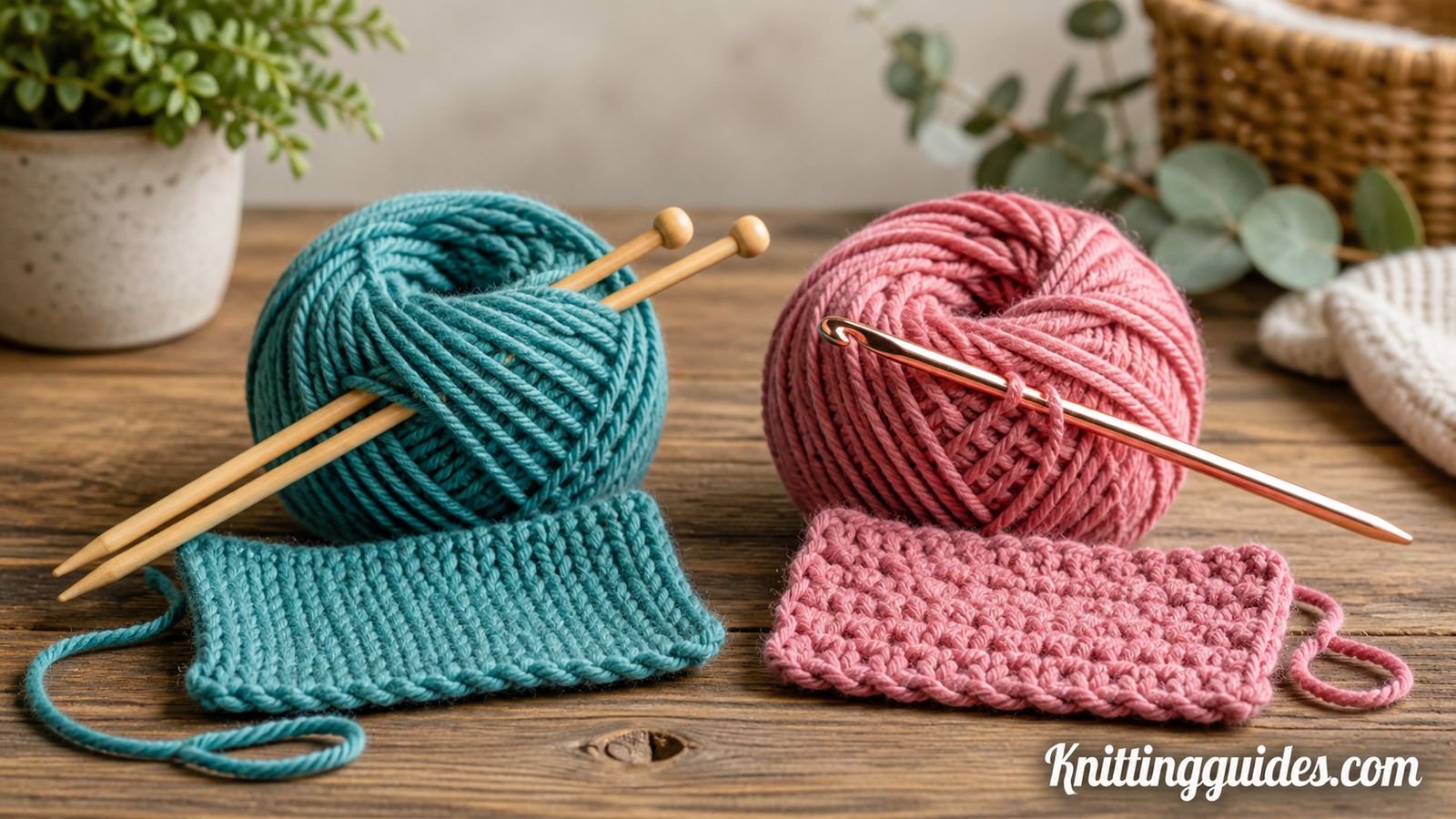
Crochet vs Knitting: Which Is Easier to Learn?
A fair, hands-on comparison of the two most popular yarn crafts, covering tools, stitches, mistakes, patterns, cost, comfort, and the one question that actually decides it for you.
You are standing in a craft store aisle, or scrolling a yarn shop late at night, and you are holding the same question almost every new maker holds: should I learn crochet or knitting? Both turn a strand of yarn into something warm, wearable, and a little bit magical. Both have friendly communities, endless patterns, and a reputation for being relaxing. And both are, at the very beginning, a little bit confusing.
The honest answer to “which is easier” is that crochet is usually easier to start, while knitting is often easier to settle into once the basics click. That sounds like a cop-out, but it is the truth, and the reasons behind it matter more than the headline. The right choice depends on how you like to learn, how you handle mistakes, what you want to make, and even how your hands feel after an hour of holding tools.
In this guide we walk through the real differences, not the marketing version. You will see how the tools work, how long each craft takes to feel natural, how mistakes are fixed, how patterns are written, what each craft costs, and which projects suit a beginner. By the end you should be able to pick a craft with confidence, or decide to learn both and know in what order.
The Short Answer: Which Is Easier, Crochet or Knitting?
If you want a one-line verdict, here it is: most beginners find crochet easier to learn in the first few days, and knitting easier to keep neat over a long project. Neither craft is hard. Both can be learned in an afternoon well enough to make something simple. The difference is where each one asks for your patience.
Crochet asks you to manage one loop at a time with one hook. Nothing else is “live” on your tool, so if you pull the wrong way, very little can go wrong. Knitting asks you to hold a whole row of loops on a needle at once, which feels like juggling for the first hour. The payoff is that knitting has just two core stitches that create a surprising amount of variety, while crochet has a longer menu of stitches that each behave differently.
Easiest to start: Crochet. One hook, one working loop, and forgiving mistakes.
Easiest to keep even and tidy: Knitting. The motion repeats the same way every row, so rhythm builds quickly.
Easiest to fix mistakes: Crochet, because you only ever need to undo back to one loop.
Fewest techniques to memorize: Knitting, which is built on knit and purl.
A quick scorecard
| Category | Knitting | Crochet |
|---|---|---|
| First stitch feels natural | Slower, about an hour of fumbling | Faster, often within minutes |
| Tools needed | Two needles (or a circular pair) | One hook |
| Fixing a mistake | Possible, but can mean unraveling many stitches | Simple, usually one loop at a time |
| Core stitches to learn | Two (knit and purl) | Several (chain, single, double, and more) |
| Even, uniform fabric | Easier to achieve | Takes a little more practice |
| Stretchy, drapey fabric | Natural strength | Needs special stitches |
| Sturdy shapes and 3D items | Possible with more planning | Natural strength |
Think of this scorecard as a starting point. Later sections explain each row in more detail, including the situations where the “winner” flips. Before that, it helps to understand what the two crafts actually are, because the mechanics explain almost everything about how they feel.
Not sure yet? Start with a beginner kit.
Browse starter sets that bundle yarn, tools, and simple instructions.
What Really Separates Knitting From Crochet
At a glance, a knitted scarf and a crocheted scarf can look similar. Up close and in the hand, they are built in completely different ways, and that difference is the root of every comparison in this article.
Knitting: many live loops on two needles
In knitting, you hold a row of loops on one needle and use the second needle to pull new loops through them, transferring each loop from the left needle to the right. At any moment there may be dozens of loops, called live stitches, waiting on your needle. Every one of them has to stay put and stay in order. That is why knitting can feel fussy at first: you are responsible for a whole row, not just one stitch.
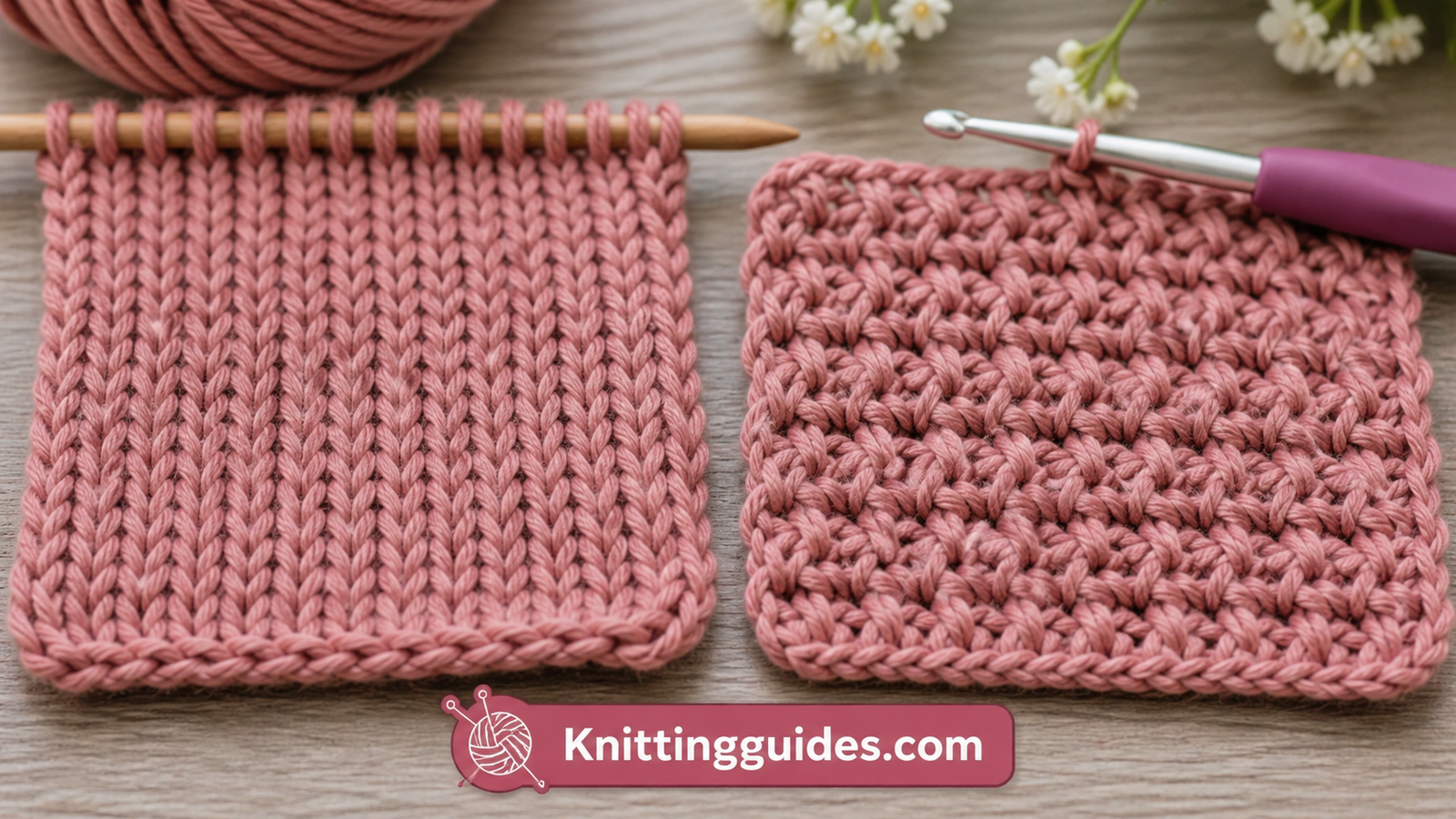
The reward is consistency. Because every stitch is built the same way, a long piece of knitting develops a steady rhythm, and the fabric tends to look even. Knit fabric is made of interlocking rows of V-shaped stitches, which gives it natural stretch.
Crochet: one live loop on one hook
In crochet, you work with a single hook and keep just one active loop on it at a time. You wrap the yarn, pull it through one or more loops, and move on. Each stitch is finished as you go, so the work behind your hook is secure. Nothing is waiting to fall off a needle.
This is the single biggest reason crochet feels friendlier to beginners. You can drop the project in your lap, answer the door, and come back without worrying that a dozen stitches slipped away. Crochet fabric is built from stitches that connect to each other and to the row below, which makes it denser and sturdier.
Core mechanics side by side
| Feature | Knitting | Crochet |
|---|---|---|
| Main tool | Two needles, straight or circular | One hook |
| Loops held at once | An entire row | Usually one |
| Risk of dropping stitches | Real, especially for beginners | Very low |
| Fabric structure | Interlocking rows of loops | Connected knots and posts |
| Typical feel | Soft, stretchy, drapey | Dense, sturdy, textured |
| Can stop mid-row safely | Yes, but needle must be protected | Yes, just pull the hook out carefully |
Good to know: If you want a deeper look at the very first steps of knitting, our guide on how to start knitting walks through holding the needles, yarn tension, and your first rows in plain language.
Compare the tools in person
See beginner needle sets and crochet hook sets side by side.
The Learning Curve: First Hour, First Week, First Month
“Easy” can mean two different things: easy to begin, and easy to get good at. These do not always point at the same craft, so it is worth breaking the learning curve into stages.
The first hour
Crochet wins the first hour for most people. Making a slip knot, chaining a few stitches, and working a first row of single crochet can happen in a single sitting. The motion is simple: insert the hook, yarn over, pull through, yarn over, pull through again. Even if the result is wobbly, you walk away with something that looks like fabric.
Knitting asks for more setup. You need to cast on, which means getting the first row of loops onto your needle, and then you have to learn to hold two needles, manage the working yarn, and keep tension even. Many beginners find the first row of knitting awkward, and the second row more so. It is common to feel clumsy for the first hour or two. That is normal, and it passes.
The first week
By the end of the first week, the picture usually starts to even out. Knitters who stick with it begin to feel the repeating rhythm: insert, wrap, pull, slide. Because the motions are so consistent, muscle memory builds fast. Crocheters, meanwhile, are often learning a second and third stitch, such as the half double and double crochet, and starting to read where each stitch goes in the row below.
This is the stage where many people discover their preference. Some love the neat predictability of knitting. Others love the freedom of crochet, where you can add a stitch or change direction almost anywhere.
The first month
After a month of regular practice, both crafts let you finish a simple project such as a scarf, a dishcloth, or a basic hat. At this point the differences change character. Knitters wrestle with increases, decreases, and shaping that rely on understanding how the stitches stack. Crocheters learn to count stitches carefully, because it is easy to accidentally add or lose one at the ends of rows and end up with a wavy edge.
- Knitting struggle: tension, dropped stitches, and keeping the needles from slipping.
- Crochet struggle: finding the right place to insert the hook, and counting stitches at the edges.
- Shared struggle: relaxing your grip, which makes everything look better and feel better.
Learning style matters more than you think
If you learn best by doing and tolerating messy early attempts, crochet will feel rewarding quickly. If you prefer practicing a small number of movements until they become automatic, knitting suits you. Neither is better. They simply reward different temperaments.
It also helps to know how you tend to learn from instruction. Video lessons show motion well, which suits both crafts, but crochet is slightly easier to follow on screen because the single hook and single loop are easy to see. Knitting video can be harder to follow until you understand which needle is doing what, so a patient, close-up tutorial helps a great deal. A local class or a friend at your elbow shortens the curve for either craft.
Practice yarn that makes learning easier
Smooth, light-colored worsted yarn lets you see every stitch clearly.
Tools and Materials: What You Actually Need to Start
One of the quietest advantages of crochet is how little you need. A single hook and a ball of yarn are enough to begin. Knitting needs a little more, but the shopping list is still short. The trick is avoiding the common beginner mistake of buying tools that make learning harder.
Knitting tools
Knitting needles come in straight pairs, circular needles joined by a flexible cable, and short double-pointed sets for small tubes like socks. Beginners are usually best served by a pair of straight needles or a circular needle, in a mid-range size, in bamboo or wood. Bamboo has a little grip, which keeps stitches from sliding off while you are still learning. Slick metal needles are fast, but they can let loops escape.
Size matters. As a rule of thumb, a medium needle with medium weight yarn is the friendliest combination, which is why our guide to what size knitting needles for beginners recommends starting in that comfortable middle range instead of with very thin or very chunky tools.
Crochet tools
Crochet hooks are available in aluminum, bamboo, plastic, and ergonomic versions with cushioned handles. Aluminum hooks are smooth and cheap, and they are what many beginners start with. Ergonomic handles are worth considering if you already have sore hands. A medium hook, paired with medium weight yarn, again makes learning simpler, because the stitches are big enough to see and to find with your hook.
Yarn: the part most people get wrong
For both crafts, the best learning yarn is smooth, light in color, and medium in weight. Dark yarn hides stitches. Fuzzy or textured yarn hides them even more and makes undoing mistakes frustrating. Cotton can be stiff on the hands, while a soft acrylic or a wool blend is gentler. If you want a more detailed look at what to buy, see our picks for the best yarn for beginner knitting, which applies equally well to your first crochet projects.
| Item | Knitting | Crochet |
|---|---|---|
| Essential tools | Needles, scissors, tapestry needle | Hook, scissors, tapestry needle |
| Helpful extras | Stitch markers, row counter, cable needle | Stitch markers, row counter, measuring tape |
| Best beginner material | Bamboo or wood needles | Aluminum or ergonomic hook |
| Best beginner yarn | Light, smooth, medium weight | Light, smooth, medium weight |
| Typical starter spend | Low to moderate | Low |
Should you buy a kit?
A good starter kit takes out the guesswork by matching tools and yarn to a simple pattern. If you are leaning toward knitting, our roundup of the best knitting kits for beginners explains what to look for and what to avoid. A kit is especially useful if you do not yet know what size or fiber you prefer.
Get everything in one box
Starter kits remove the guesswork about hook, needle, and yarn sizes.
The Basic Stitches Compared
Stitches are where the two crafts feel most different. Knitting is built on a tiny vocabulary used in clever combinations. Crochet is built on a larger vocabulary of stitches that are each fairly simple.
Knitting: two stitches do almost everything
The knit stitch and the purl stitch are mirror images of each other. Work only knit stitches in every row and you get garter stitch, a bumpy, reversible fabric that is perfect for a first scarf. Alternate rows of knit and purl and you get stockinette, the smooth V-patterned fabric you see on most sweaters. Alternate knit and purl within a row and you get ribbing, which is stretchy and good for cuffs and hats.
That is the entire core. Everything else, including cables, lace, and colorwork, is built on top of those two stitches with a few extras. A beginner who learns to knit and purl well has unlocked most of what knitting offers.
Before you can knit, though, you need loops on your needle. Learning to cast on and, later, to cast off, are the two bookends of every knitting project, and they are separate skills from the stitches themselves.
Crochet: a ladder of stitch heights
Crochet begins with a chain, a row of loops that acts as your foundation. From there, the main stitches differ mostly in height. The slip stitch is nearly flat. The single crochet is short and dense. The half double crochet is a bit taller, the double crochet taller still, and the treble crochet taller again. Each one is made by wrapping the yarn a different number of times before pulling through.
The upside is that once you understand the pattern of wrap-and-pull, new stitches feel like variations on a theme. The downside is that you have more names to remember, and the turning chain at the start of each row changes depending on the stitch you are using, which confuses many beginners.
| Stitch | Craft | What it looks like | Best used for |
|---|---|---|---|
| Knit stitch | Knitting | Smooth V shapes | Stockinette and garter fabric |
| Purl stitch | Knitting | Small horizontal bumps | Textures, ribbing, reverse stockinette |
| Chain | Crochet | A row of linked loops | Foundation rows and spacing |
| Single crochet | Crochet | Short, dense, tight | Sturdy fabric, edges, toys |
| Half double crochet | Crochet | Medium height, slightly soft | Hats, blankets |
| Double crochet | Crochet | Tall, airy, quick | Fast blankets and scarves |
Beginner insight: Many people say crochet stitches are easier to “read.” Because each stitch sits on top of the previous row like a little post, you can look at the work and see where to insert the hook. Knit stitches are harder to identify at first because they all look like small Vs until you train your eye.
Add a stitch marker set to your kit
Markers help you count stitches and mark pattern repeats in either craft.
Fixing Mistakes: Frogging, Tinking, and Dropped Stitches
Mistakes are guaranteed in the beginning. How easy a craft is to fix often matters more to a beginner than how easy it is to start, because nothing feels as discouraging as a problem you cannot undo.
Mistakes in crochet
Crochet is wonderfully forgiving. Since only one loop is live at a time, you can pull the hook out of the loop and gently tug the yarn to unravel stitches one at a time, a process crocheters call “frogging” because you “rip it, rip it.” If you notice a mistake three stitches back, you can pull out three stitches and try again. If you notice one several rows down, you can unravel the whole piece back to that point, and the yarn is mostly still in good shape.
The most common crochet mistakes are accidentally adding or skipping a stitch at the end of a row, which makes edges slant or ripple, and inserting the hook into the wrong loop. Both are easy to spot because the edges look wrong, and both are easy to repair by pulling back a few stitches.
Mistakes in knitting
Knitting is a bit less forgiving. If you drop a stitch, the loop can slide down several rows, leaving a run in the fabric. If you do not notice it, you may need to unravel back to the problem. Fixing it is absolutely possible, with a crochet hook or a spare needle, but it takes practice.
Knitters have two main tools for undoing work. “Tinking” is knitting backward, one stitch at a time, which is slow but safe. “Frogging” pulls out whole rows at once, which is quick but can leave you with loose loops that need to be picked up again onto the needle. A lifeline, a thread run through a row of stitches as a safety net, makes frogging far less scary.
Knitting mistakes
- Dropped stitches can run down the fabric
- Picking loops back onto needles takes practice
- Twisted stitches are easy to miss
- Lifelines and stitch markers help a lot
Crochet mistakes
- Only one loop is at risk at a time
- Unraveling back is quick and clean
- Edges can drift if you miscount
- Stitch counts are easy to verify per row
If your biggest fear is “what if I ruin it,” that fear is better soothed by crochet. If you can accept a little more risk for a very consistent result, knitting becomes comfortable quickly once you have fixed your first few dropped stitches and realized the sky does not fall.
Keep a rescue tool nearby
A small hook and a few stitch markers make fixing mistakes far less stressful.
Reading Patterns and Understanding Terminology
Whichever craft you choose, you will eventually follow written patterns. Patterns look like a secret code at first, packed with abbreviations like k2tog, sc, dc, and yo. The good news is that the vocabulary is smaller than it appears, and you pick it up quickly through repetition.
Knitting patterns
Knitting patterns are known for being precise. They tell you how many stitches to cast on, which rows to work in which stitch, and exactly where to increase and decrease. Many also include charts, which are grids of symbols showing the stitch pattern, especially for lace and colorwork. Charts are wonderfully visual, but they take a little time to learn.
Because knitting is so consistent, patterns are usually reliable. If you follow the instructions and gauge, the finished piece will match the picture. The cost of that reliability is that knitting patterns can feel dense and rigid. You are expected to follow along row by row.
Crochet patterns
Crochet patterns are often written in a more conversational style, with repeats like “work 2 dc in next stitch, dc in each of next 3 stitches, repeat across.” They also vary in terminology depending on where the designer lives, because US and UK crochet use the same stitch names for different stitches. A US single crochet is a UK double crochet, for example. This catches many beginners off guard, so always check which terminology a pattern uses before starting.
Crochet patterns can also be written as diagrams with symbols, which many people find easier to read than text because you can see how the stitches relate to one another. Amigurumi patterns, which make small stuffed figures, are usually worked in the round and tracked by counting stitches in each round.
| Aspect | Knitting patterns | Crochet patterns |
|---|---|---|
| Common abbreviations | k, p, k2tog, ssk, yo | ch, sc, hdc, dc, sl st |
| Chart style | Grid symbols, row by row | Diagram symbols, often radial |
| Terminology confusion | Few regional differences | US and UK terms differ |
| Beginner-friendly format | Row-by-row text | Text with repeats, or diagrams |
| Gauge importance | High for wearables | High for wearables, lower for toys |
What about gauge?
Gauge is the number of stitches and rows per inch, and it determines whether a finished garment fits. It matters in both crafts. For simple projects like scarves, blankets, and dishcloths, gauge barely matters, which is exactly why those are the best first projects. Save sweaters for later.
In short, pattern reading is a tie. Knitting is a bit more precise, crochet a bit more flexible, and both are learnable with a little patience and a printed abbreviation list.
Keep patterns organized
Row counters and pattern holders keep your place when you are learning.
Fabric, Speed, and Yarn Use: What Each Craft Makes Best
Ease is not only about technique. It is also about whether the craft naturally produces the kind of thing you want. Trying to force one craft into the other’s strength is a recipe for frustration.
Fabric feel
Knitted fabric is thin, stretchy, and drapey. It hugs the body, which makes it ideal for sweaters, socks, hats, and anything that should bend and move. Crocheted fabric is thicker and more structured, and it has far less stretch, which makes it ideal for blankets, bags, baskets, toys, and decorative items that need to hold their shape.
That is not an absolute rule. Skilled crocheters can produce light, drapey shawls, and skilled knitters can make firm bags. But for a beginner, it is easier to work with the craft’s natural strengths than against them.
Speed
Crochet is generally faster for covering space, especially with taller stitches. A double crochet stitch is roughly three times as tall as a single crochet, so a blanket in double crochet grows quickly. Knitting tends to be slower per inch in the beginning, but experienced knitters build up impressive speed because the movements are small and repetitive.
Yarn use
Crochet typically uses more yarn than knitting for the same size piece, because the stitches are denser and involve more wraps and loops. The difference can be significant on large projects such as blankets, so check the yardage on a pattern before you buy. Knitting often yields more fabric per skein, which can save money when you are making a large item.
| Trait | Knitting | Crochet |
|---|---|---|
| Fabric thickness | Thinner | Thicker |
| Stretch | High | Low |
| Drape | Fluid | Structured |
| Speed for beginners | Slower at first | Faster for covering space |
| Yarn consumption | Lower | Higher |
| Best for | Sweaters, socks, hats, shawls | Blankets, bags, toys, appliques |
Shaping and adding structure
Crochet is easier to shape on the fly. Because each stitch stands alone, you can add a stitch or skip one anywhere, and building three-dimensional shapes like flowers and small animals feels natural. Knitting handles shaping through planned increases and decreases, which are very elegant but require following the pattern closely.
Add all this up, and you can see why “easier” changes depending on the goal. If your dream project is a stretchy sweater, knitting will feel easier because it is built for the job. If you dream of a plush octopus, crochet is the natural choice.
Match the yarn to the craft
Pick a smooth worsted weight for knitting or a sturdy cotton blend for crochet.
Best Beginner Projects for Each Craft
The fastest way to enjoy either craft is to choose a project that matches your skill level. Beginners often fail not because the craft is hard, but because they choose a project that is. Here are good starting points for each.
Great first knitting projects
- Garter stitch scarf. Knit every row. It is forgiving, reversible, and lies flat. Our guide on how to start knitting a scarf covers this in detail.
- Dishcloth. Small, quick, and useful, with room to practice tension without much risk.
- Simple hat in the round. Introduces circular needles and decreases once you have the basics.
- Headband with ribbing. A short project that practices knit and purl together.
Great first crochet projects
- Simple scarf in double crochet. Fast, repetitive, and impressive in a weekend.
- Granny square. The classic starter. Teaches chains, double crochet, and working in the round.
- Washcloth in single crochet. Tight, flat, and very easy to count.
- Small amigurumi. A little stuffed animal teaches stitch counting and shaping in a satisfying way.
Projects to save for later
Fitted sweaters, lace shawls, socks, and colorwork are best left until you are comfortable with the basics. In crochet, complex garments with a lot of shaping and projects that require careful gauge are also best postponed. Patience here prevents burnout.
Knitting suits you if…
- You want wearable, stretchy garments
- You like rhythm and repetition
- You prefer a small, flexible toolkit
- You enjoy precise patterns
Crochet suits you if…
- You want quick wins and sturdy items
- You like toys, bags, and home decor
- You worry about dropped stitches
- You enjoy freeform creativity
One more tip: choose a project you will actually use or give away. Making a scarf for someone you love, or a cloth for your own kitchen, gives practice a purpose and makes finishing it feel worthwhile.
Ready for your first project?
Find beginner scarf kits and granny square sets with everything included.
Cost, Time, and Portability
Practical matters count when you are choosing a hobby. A craft that fits your budget, your schedule, and your life will be the one you actually practice.
Cost
Both crafts are inexpensive to start. A beginner crochet hook costs very little, and a pair of beginner knitting needles is similar. The larger expense in either craft is yarn, and here the difference is slight but real: because crochet uses more yarn per item, it can cost a bit more for projects of the same size. On the other hand, a knitted garment can require specialty needles in multiple sizes and lengths over time, which adds up if you become a regular.
A sensible approach is to buy one set of tools and a few skeins of affordable yarn, make a couple of small projects, and only then decide whether to invest more. Kits help, and so does buying yarn in multi-skein packs for practice projects.
Time
Time depends on what you make. A double crochet scarf can be finished in an evening or two. A knitted scarf of similar size usually takes longer for a beginner. Over a long project, though, an experienced knitter and an experienced crocheter work at similar speeds, so the early difference in speed shrinks as skills develop.
Portability
Both crafts are portable, but they travel differently. Crochet is compact and low-risk: a hook, a ball of yarn, and you are ready, with no needle sticking out to snag your bag. Knitting works well on the go too, but stitches on needles can slip off if the project is jostled, so you may need point protectors or a project bag. If you travel frequently with your craft, our article on bringing knitting needles on a plane covers what to expect at security, and it applies to hooks as well.
| Factor | Knitting | Crochet |
|---|---|---|
| Starting cost | Low to moderate | Low |
| Yarn cost per project | Lower | Higher |
| Speed for first projects | Moderate | Fast |
| Travel friendliness | Good, with protectors | Excellent |
| Space needed | Needles take width | Compact, one hand tool |
Pack a project bag
A zippered pouch keeps yarn, tools, and your work together on the go.
Hands, Wrists, and Posture: Comfort and Ergonomics
A hobby that hurts will not stay a hobby for long, so it is worth thinking about how each craft feels in your body.
How each craft uses your hands
Knitting uses both hands in a balanced way, with each hand holding a needle, which spreads the work across both sides. Crochet concentrates the effort in the hook hand, which does most of the movement, while the other hand manages yarn tension and holds the work. Some people find that crochet strains the dominant wrist or thumb, especially if they grip the hook tightly. Others find that knitting strains the shoulders and forearms if they hunch.
Common comfort fixes
- Relax your grip. A death grip on the tool is the number one cause of tired hands in both crafts.
- Try ergonomic hooks or lightweight bamboo needles to reduce strain.
- Take short breaks to stretch your fingers and wrists every half hour.
- Sit with your elbows supported and your shoulders low.
- Work in good light so you are not leaning forward to see stitches.
Left-handed makers
Left-handed beginners often worry about being at a disadvantage. In truth, both crafts can be learned left-handed with a little adjustment. Crochet is slightly more affected, because the dominant hand holds the hook and most tutorials are shown right-handed, so you may need to mirror the instructions or find left-handed videos. Knitting is more symmetrical, and many left-handed knitters simply learn the standard method or use the continental style, which carries the yarn in the left hand.
If you have existing hand pain: Check with a healthcare professional before taking up any repetitive hobby, and begin with short sessions. Both crafts can be done gently and in small amounts.
Overall, comfort tends to come down to technique and setup rather than the craft itself. Whichever you choose, a loose grip and good posture matter more than anything else.
Choose comfort-first tools
Ergonomic hooks and smooth bamboo needles are gentler on your hands.
How to Choose: A Simple Decision Guide
You now have a lot of comparisons. Here is how to turn them into a decision without overthinking it.
Start by asking what you want to make
This single question settles the debate more often than any other. If your answer is a sweater, socks, or a soft shawl, start with knitting. If your answer is a blanket, a bag, a plush toy, or a decorative piece, start with crochet. If your answer is “a scarf,” either will do, and you can choose by temperament.
Then ask how you handle frustration
If the idea of a dropped stitch makes you anxious, crochet will feel safer. If you like systems and routines and are willing to learn a few rescue techniques, knitting will feel rewarding. If you simply cannot decide, pick the one whose tools you would rather hold. Enjoyment is the best predictor of whether you will keep going.
- Pick crochet first if you want fast results, hate the idea of live stitches, and like building shapes.
- Pick knitting first if you want garments, like rhythm, and prefer a smaller set of techniques.
- Pick either if you want a scarf, a cloth, or a gift, and mostly want to have fun.
- Learn both over time if you are curious by nature. The skills reinforce each other.
Can you learn both?
Absolutely, and many makers do. Learning one craft makes the other easier, because you already understand yarn tension, gauge, and how stitches build fabric. A common path is to start with crochet for the quick wins, then add knitting for garments, or the reverse. Neither order is wrong. What matters is not to start both on the same day, because switching between them while you are still building muscle memory can slow you down. Give your first craft a few weeks before adding the second.
If your final answer is knitting, a good next step is to get a matched set of needles and yarn, and our guide to the best knitting kits for beginners is a good place to begin. If your answer is crochet, a hook set and a few skeins of smooth worsted yarn are all you need.
Try both without the guesswork
Pick up a small kit for each craft and let your hands decide.
Frequently Asked Questions About Crochet vs Knitting
Is crochet easier than knitting for beginners?
For most beginners, yes. Crochet uses a single hook and one active loop, so there is less to manage and mistakes are easier to undo. Knitting has a slightly steeper first hour but becomes very rhythmic. The best choice still depends on what you want to make.
Which is faster to learn, crochet or knitting?
Crochet is usually faster to learn at a basic level, because you can make a simple fabric after a short lesson. Knitting takes a bit longer to feel comfortable, mainly because of casting on and handling two needles, but many people find the repeating motion becomes automatic quickly.
Is it harder to fix mistakes in knitting?
Generally, yes. A dropped stitch in knitting can run down several rows, while crochet only keeps one loop live at a time. With practice and tools like lifelines and a small hook, knitting mistakes become much easier to repair.
Which craft is cheaper to start?
Crochet is slightly cheaper to start because you only need one hook. Knitting needles cost a little more, especially if you need multiple sizes. Over time, crochet can use more yarn per project, so the savings are modest.
Is crochet or knitting better for making a scarf?
Both work well. Knitting makes a softer, more drapey scarf, while crochet makes a sturdier, thicker one and works up faster in tall stitches. If you want guidance for the knitted version, see our guide on how to start knitting a scarf.
Can I learn crochet and knitting at the same time?
You can, but most people learn faster by focusing on one craft for a few weeks before adding the other. The two use different motions and tools, so switching too early can make both feel clumsy.
Which uses more yarn, crochet or knitting?
Crochet typically uses more yarn for the same size piece because the stitches are denser and more complex. Always check the yardage in a pattern, and buy a little extra to avoid running short.
What size tools should a beginner buy?
A medium-sized tool paired with medium weight yarn is the easiest combination to learn on. For knitting, our guide on what size knitting needles for beginners explains the details. For crochet, a medium hook with worsted yarn is a reliable starting point.
Is knitting or crochet better for making clothes?
Knitting is generally better for fitted, stretchy garments like sweaters, socks, and hats. Crochet can make clothing too, but its fabric is thicker and less elastic, so it often suits shawls, cardigans, and accessories better.
Do I need special yarn for each craft?
No. The same yarn can be used for both. For learning, choose a smooth, light-colored, medium weight yarn so that you can see your stitches. You can browse our recommendations for the best yarn for beginner knitting.
Is crochet or knitting more relaxing?
Both are calming, but in different ways. Knitting offers a steady, meditative rhythm, while crochet offers quick progress and creative freedom. Many makers find that whichever craft they enjoy more is the more relaxing one.
Can left-handed people learn both crafts?
Yes. Crochet may require mirrored tutorials or left-handed videos, while knitting is more symmetrical and many left-handed knitters simply learn the standard method. With a little adjustment, both are very accessible.
How do I decide which one to start with?
Think about what you want to make first. Garments and soft, stretchy items point to knitting. Blankets, bags, toys, and quick projects point to crochet. If you are still unsure, try a small kit for each and see which one your hands enjoy.
Conclusion: Which Is Easier, and Which Should You Choose?
So, which is easier, crochet or knitting? Crochet is easier to start, easier to fix, and easier to carry. Knitting is easier to keep even, relies on fewer stitches, and makes the stretchy fabric that clothing loves. Neither is difficult in any way that patience and practice cannot solve, and the gap between them narrows quickly as your hands learn.
The most useful takeaway is that you are not making a permanent decision. Picking one craft this month does not close the door on the other. Start with the one that matches the first thing you want to make, choose smooth medium yarn and medium tools, begin with a simple scarf or cloth, and give yourself permission to be clumsy for the first few sessions. Before long, the clumsiness fades and the satisfaction of making something with your own hands takes its place.
Whichever craft you pick, you are joining a very welcoming world. Grab your yarn, find a comfortable chair, and make the first stitch.
Ready to make your first stitch?
Pick up your tools and yarn today and start your first project this weekend.
You May Also Like
Disclosure: As an Amazon Associate, we earn from qualifying purchases. If you click a link and buy, we may earn a small commission at no extra cost to you.