
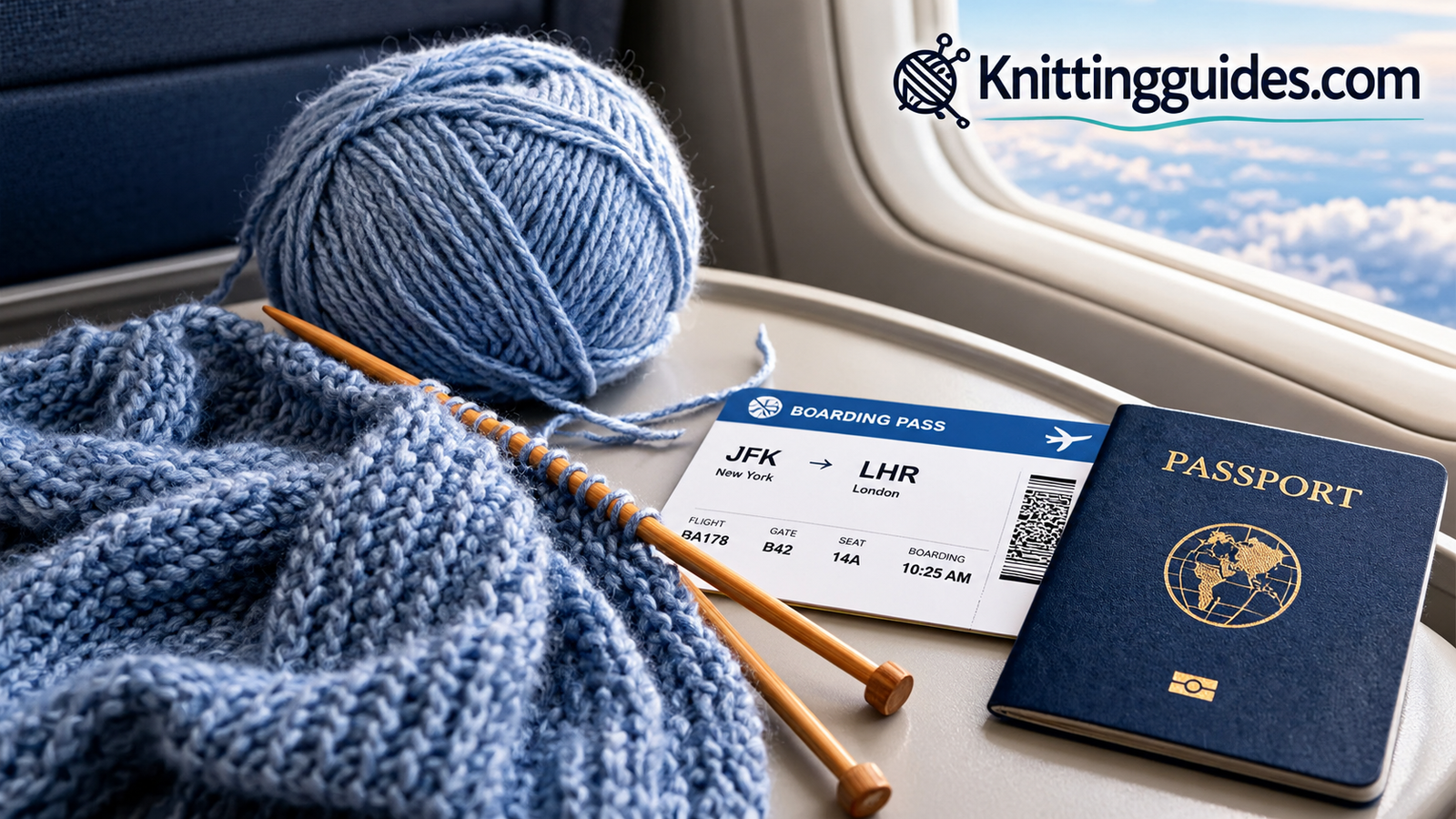
Can You Bring Knitting Needles on a Plane?
Yes, in most cases you can. Here is exactly how security treats needles, hooks, scissors and notions, and how to pack a project so nothing slows you down at the checkpoint.
You have a long flight ahead, a half-finished sweater sleeve in your bag, and a nagging worry: will the person at the security checkpoint take your needles away? It is one of the most common questions knitters ask before a trip, and the good news is that the answer is almost always reassuring. Knitting is one of the best ways to survive hours of cabin time, and airport security has long since stopped treating a ball of yarn as a threat.
That said, “almost always” is not “always.” Rules differ between countries, individual officers have discretion, and a few items in a typical knitting bag really can cause trouble. This guide walks through what is allowed, what is not, how to pack, what to say if someone raises an eyebrow, and which needles and projects make flying a pleasure rather than a gamble. Some links below are affiliate links, which means a small commission may come to us at no extra cost to you.
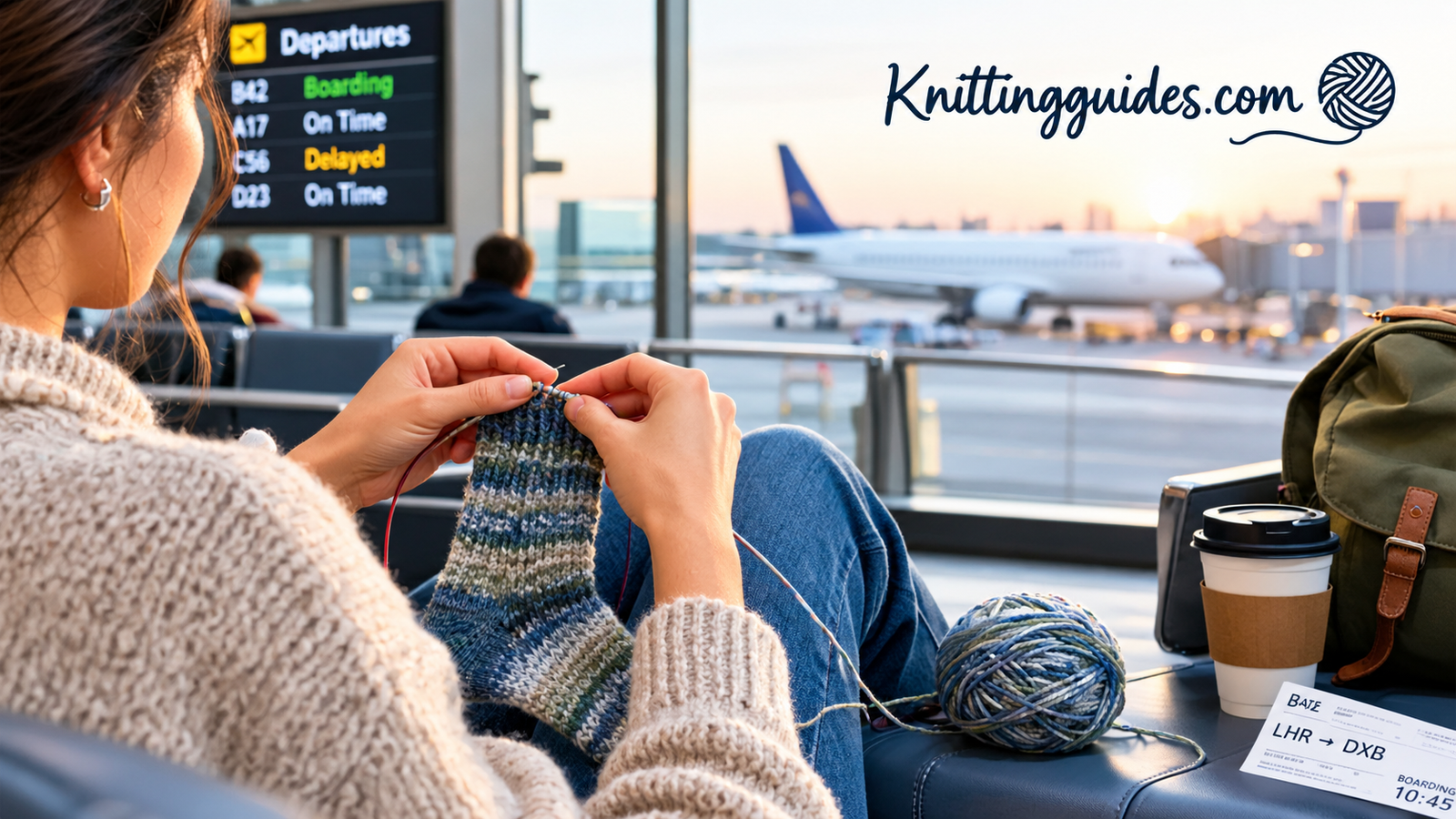
The Quick Answer: Are Knitting Needles Allowed on Planes?
In the United States, yes. The Transportation Security Administration lists knitting and crochet needles as items you may bring in both carry-on and checked luggage. Many other countries take a similar approach, although the final call always rests with the security officer on duty and sometimes with the airline itself.
That single sentence covers the big picture, but a few details matter. Needles are permitted because they are tools with a clear everyday purpose and, in the form most knitters carry them, they are not especially dangerous. A pair of bamboo straight needles with a scarf hanging off them looks like exactly what it is. A bare bundle of sharp metal double-pointed needles with no yarn in sight is more likely to prompt a second look, even though it is technically allowed too.
The practical takeaway: you can fly with your needles, and you should plan to do it in a way that makes a security officer’s decision easy. Keep your work on the needles, keep the project in a clear or open-top bag that is easy to pull out, and favor materials and styles that look unthreatening. Do that, and the vast majority of knitters sail through without a single question.
Why this question gets so much anxiety
Part of the worry is history. Years ago, rules about sharp objects on aircraft were stricter and less clearly communicated, and plenty of knitters remember a friend who surrendered a favorite pair of needles at the gate. Part of it is the nature of airport security itself: the lists of permitted and prohibited items feel long, the stakes feel high, and nobody wants to be the person holding up the queue while an officer inspects a tangle of mohair.
Part of it, too, is that advice online is wildly inconsistent. One forum post says needles are fine, the next says someone got stopped in a different country, and a third insists that only plastic ones are safe. The truth sits in the middle. The official rule is permissive; real-world experience depends on the airport, the officer, and how you present your project.
What this guide covers
- The official US rules and what “final decision rests with the officer” actually means
- Whether needles belong in your carry-on or your checked bag
- How different needle materials and styles compare for travel
- Which other knitting tools are fine and which are not
- What to expect on international flights
- Packing, project choice, etiquette in your seat, and a plan if someone says no
Browse travel-friendly knitting needles
Compact, smooth and security-friendly options for your next flight.
How TSA Treats Knitting Needles
The Transportation Security Administration publishes a searchable “what can I bring” tool, and knitting needles appear on it with a straightforward green light for carry-on and checked bags. Crochet hooks get the same treatment. This has been the position of the agency for many years, and it is one of the reasons airports are now full of people quietly working on socks while they wait to board.
There is, however, a line printed on that tool that every knitter should understand: the final decision rests with the TSA officer at the checkpoint. This is not a loophole that officers use on a whim. It reflects the reality that security is a judgment-based process. If an officer believes something in your bag could be used as a weapon, or if an item is packed in a manner that looks concerning on the scanner, they can ask you to remove it, put it in checked baggage, or hand it over.
What the screening process looks like
Your carry-on goes through an X-ray machine. A dense ball of wool, a metal tin of notions, and a bundle of needles can all show up as unusual shapes. Officers are trained to look at images of exactly this kind of cluttered bag, and they see craft supplies daily. If the image is unclear, your bag may be pulled for a hand check. That usually means someone opens the bag, looks through it, perhaps swabs a few items, and sends you on your way. It takes a minute or two.
Being organized helps enormously. A project bag with the needles, yarn and work-in-progress in one place makes it easy for an officer to see what they are looking at. A bag with loose sharp tools scattered through a jumble of chargers, cosmetics and snacks is harder to read.
Scissors: the rule that trips people up
Knitters rarely need much more than a pair of small scissors to snip yarn tails. In the United States, scissors with blades shorter than four inches, measured from the pivot point, are allowed in carry-on bags. Anything longer must go in checked luggage. Most small embroidery scissors, folding travel scissors and fingertip snips fall comfortably under the limit, but it is worth glancing at what you actually own before you pack.
If you do not want to risk any discussion at all, a small yarn cutter on a keychain or a pair of blunt-tipped safety scissors is a quiet solution. Alternatively, tear or break your yarn at the end of a flight session and save the cutting for when you land.
Good habit: Before every trip, search the TSA tool for each item in your project bag and screenshot the result. If an officer questions something, showing the official listing on your phone is far more persuasive than saying “I’m pretty sure it’s fine.”
Airlines can have their own rules
Security checkpoint rules and airline policies are separate. Airlines generally defer to the airport’s security screening, but a carrier can impose its own restrictions, especially on smaller regional or international routes. If you are flying a lesser-known airline or connecting through several countries, it is worth a quick check of the airline’s baggage page. Most knitters never run into a conflict, but you do not want to discover one at the gate.
If you are brand new to the craft and still deciding which needles to buy before your first trip, our guide to the best knitting needles for beginners explains the differences in material and size, which also helps you think about what suits travel.
Pack small scissors that clear security easily
Compact craft scissors and thread snips for your project bag.
Carry-On or Checked Bag: Where Should Your Needles Go?
Technically you can put needles in either bag. Practically, the answer depends on what you want to do during the flight and how much you value your needles. For nearly every knitter, the carry-on is the right call, because the entire point of bringing a project is to work on it in the air.
Reasons to keep needles in your carry-on
- You can actually knit. Needles in the hold are needles you cannot use at 35,000 feet.
- Protection from loss. Checked bags can be delayed, misrouted or rummaged through. A project you have invested weeks in is better in your hands.
- Protection from damage. Bamboo and wood needles can snap in a stuffed suitcase. Fragile wire cables and delicate lace work can be crushed.
- Easy explanation. If an officer has a question, you are right there to answer it, rather than finding a notice tucked into your suitcase on arrival.
When the checked bag makes sense
There are a few situations where it is smarter to check some of your gear. If you are traveling with a large collection of long straight needles, a full interchangeable set with many tips and cables, or tools that might raise concern such as long blades, pins, or a rotary cutter, checking those items avoids the question entirely. The same goes for bulky equipment like a ball winder, a swift, or a small blocking board, which are awkward to carry through a cabin and are better wrapped in clothing in a suitcase.
A good compromise is to split your supplies. Keep one active project and a minimal toolkit in your carry-on, and pack everything else, including backup needles and the extra yarn for the next project, in your checked bag. That way, if a carry-on item is questioned, you have lost very little, and if your suitcase goes astray, you still have something to knit.
A simple split that works for most people
| Item | Best place | Why |
|---|---|---|
| Current project on circular needles | Carry-on | Ready to knit, easy for officers to recognize |
| Short straight needles with work on them | Carry-on | Looks like a craft project, not a loose tool |
| Spare needle sizes and swatch gear | Checked bag | Not needed in flight, reduces what is screened |
| Long blades, large shears, rotary cutter | Checked bag | May exceed carry-on blade limits |
| Blocking pins and wires | Checked bag | Many sharp points, not needed on board |
| Ball winder and swift | Checked bag | Bulky, only useful at your destination |
| Backup project and extra yarn | Either | Compresses well, no restrictions |
Keep your project organized and easy to inspect
Zippered project bags with clear panels make security checks painless.
Which Types of Knitting Needles Are Safest to Fly With?
All standard knitting needles are allowed under US rules, but they are not all equally easy to travel with. Some styles are more likely to attract attention, some are more comfortable in a cramped seat, and some are far more forgiving if a stitch slips off. Understanding the differences helps you choose a set that gets through security and also works well at your seat.
Circular needles
Circular needles, two short tips joined by a flexible cable, are the top choice for flying. The cable keeps your work contained, so there is no long, pointed stick poking out into the aisle or your neighbor’s ribs. Your project hangs in a compact bundle in your lap, and if you drop one tip, the cable keeps it attached to your work. Circulars can be used for flat knitting and for working in the round, which makes them the most versatile option for travel.
Most people who knit in the air regularly settle on a pair of circulars with a short cable, around sixteen inches, for small projects like hats, cuffs and socks, and a longer cable for bigger pieces. Not sure what size to start with? Our guide on what size knitting needles for beginners walks through sensible starting points that translate well to travel projects.
Straight needles
Long straight needles are allowed, but they are the least convenient for planes. Ten to fourteen inches of pointed stick is awkward in an economy seat, tricky to get past a snoozing passenger, and more likely to be eyed warily. If you love straights, short ones around seven to nine inches are far more practical, though they only suit narrow projects such as scarves or small pieces.
Double-pointed needles
Double-pointed needles, often called DPNs, are used for socks, mittens and the crowns of hats. They are small, light and allowed, but there are five of them, they are sharp at both ends, and they can fall out of the work if you are not careful. Officers generally know what they are, especially when a half-finished sock is hanging from them. Bamboo, wood or smooth coated metal in a short length are all fine, but a loose bundle with no knitting on them is more likely to prompt a question.
Interchangeable sets
A full interchangeable set, with a dozen tips, several cables and a small tool for tightening, is wonderful at home but a lot to haul through a checkpoint. For travel, pull just what you need for the project and leave the rest in the checked bag.
Material matters, a little
Bamboo, wood, plastic, metal and carbon fiber needles are all treated the same by the official rules. In practice, wood and bamboo look gentler, are quiet in a cabin, and grip yarn so stitches stay on. Smooth metal is fast but slippery, which is less ideal when the plane hits turbulence. Plastic and resin are lightweight and affordable. Because security’s reasoning is judgment-based, softer-looking materials rarely hurt, but they are a perk, not a requirement.
| Needle style | Allowed? | Travel comfort | Best for |
|---|---|---|---|
| Circular, short cable | Yes | Excellent | Hats, socks, cuffs, small flat pieces |
| Circular, long cable | Yes | Very good | Scarves, shawls, sweaters |
| Short straight | Yes | Good | Narrow flat pieces |
| Long straight | Yes | Poor | Better left at home |
| Double-pointed | Yes | Fair | Socks, mittens, small tubes |
| Interchangeable set | Yes | Fair | Bring only the tips and cable you need |
Why circulars win for flying
- Compact and contained in your lap
- Stitches stay secure on the cable
- No long points near other passengers
- Work flat or in the round
Drawbacks to expect
- Cable memory can make some brands coil
- Short cables limit very wide projects
- Quality ones cost more than basic straights
Find circular needles for your next trip
Flexible cables and smooth joins in bamboo, wood and metal.
Other Knitting Tools: What Is Fine and What Is Risky
Needles get all the attention, yet the rest of a typical project bag is where surprises happen. A knitter’s kit is a collection of small items, some of which are completely harmless and a few of which can complicate your checkpoint experience. Here is how the usual suspects tend to fare. Always verify against the current TSA tool or your own country’s equivalent, since lists can be updated.
| Item | Carry-on | Notes |
|---|---|---|
| Yarn and finished knitting | Fine | No limits on yarn; bulky balls may be hand-checked |
| Crochet hooks | Fine | Treated like knitting needles |
| Cable needles | Fine | Tiny and obviously a craft tool |
| Stitch markers, row counters | Fine | Metal rings may show up on the scanner; keep them in a small pouch |
| Blunt tapestry needles | Fine | Store in a case or a bit of felt |
| Small scissors | Usually fine | Blades must be under the carry-on length limit |
| Thread or yarn cutters | Check first | Enclosed blades are often accepted but may draw a second look |
| Measuring tape | Fine | Soft tape is no problem |
| Blocking pins and T-pins | Better checked | Many sharp points together look odd on a scan |
| Rotary cutter or craft knife | Checked only | Exposed blades are generally not allowed in carry-on |
| Wool wash and blocking spray | Liquid limits apply | Travel-size containers in your liquids bag |
The items worth a second thought
Blocking pins are the classic example. Individually, they are small. In a handful, they are a bag of metal points, and a scanner image of that is less reassuring than you might expect. Since you almost never need to block a project in the air, it is easy to leave them in your checked bag or buy them after you arrive.
Thread cutters, the little pendants and keychain gadgets with a hidden blade, sit in a gray zone. Many are accepted in carry-on baggage because the blade is enclosed, but an officer may decide otherwise. If you want zero risk, leave them behind and use fingernail clippers or simply break your yarn.
Any liquid, whether wool wash, blocking spray or hand lotion for dry airplane skin, must fit inside the standard liquids rule: small containers, all in one clear bag. Knitters often forget that a bottle of fiber wash counts.
A tidy toolkit that rarely causes questions
- One small zippered pouch for stitch markers, a cable needle, a row counter and a measuring tape
- A blunt tapestry needle in a protective case
- A pair of short-blade craft scissors or a foldable snip
- A spare set of needles in one size up or down in case you drop or bend one
- A tiny crochet hook for picking up dropped stitches
That last item deserves special mention: a small crochet hook is the single best rescue tool for a dropped stitch on a bumpy flight, and it is entirely allowed. If crochet interests you as well, our comparison crochet vs knitting: which is easier breaks down how the two crafts differ, including how well each travels.
Build a compact travel notions kit
Stitch markers, cable needles, row counters and a tidy pouch to hold them.
Flying Internationally With Knitting Needles
US rules are the clearest and most widely quoted, but many of us fly elsewhere. Most countries with modern aviation security take a risk-based approach similar to the United States, which means knitting needles are usually permitted in hand luggage, with some discretion left to the officer. A few places are stricter, and some airlines impose their own guidelines.
The honest advice is this: do not assume. If your trip includes an international leg or a connection through an unfamiliar airport, spend five minutes checking the official guidance for each country you will pass through. Security authorities in most countries publish lists of permitted and prohibited items, and airlines typically link to them from their baggage pages.
Where to look
- The official aviation security authority for each departure and connecting airport
- The airline’s own carry-on and prohibited-items pages
- Your booking confirmation, which sometimes lists restrictions for the specific route
Connections matter more than you think
The rule that governs you is the rule at the airport where you are being screened. If you fly from a country with a relaxed policy and connect through a stricter one, you may be rescreened and face different standards. Where your itinerary has several stops, assume the strictest policy might apply and pack accordingly, perhaps with circular needles in bamboo or wood and a small, plainly visible project.
Language and communication
If you are traveling somewhere you do not speak the language, a short note on your phone explaining that these are knitting needles for a hobby project, with a photo of a typical knitting setup, can help break the ice. A friendly smile and a visible half-knitted item do more than any speech.
Make “plan B” part of your packing
Even a thoughtful knitter can run into a stricter-than-expected officer overseas. Plan for it: carry an inexpensive pair of needles and a small, low-value project, not your finest heirloom sweater, so that giving up the needles costs you very little. Consider mailing yourself the really precious items or checking them in a padded bag. Our guide on how to start knitting is a useful companion if you plan to pick the craft up on the road, since it covers the basic kit you really need and nothing more.
Key idea: When rules are unclear, choose the item that is easiest to replace. Cheap bamboo circulars and a basic yarn are far better to risk than a hand-carved heirloom set and hand-dyed silk.
Pick up low-cost backup needles
Affordable bamboo sets that are easy to replace if rules differ abroad.
How to Pack Your Knitting Project for Security
Packing is where you take control of how the checkpoint goes. A well-packed knitting bag tells the story of itself in a glance. A messy one invites a closer look. The goal is not to hide anything, but to make everything obvious.
Keep the work on the needles
A project in progress is the most convincing proof that your needles are a craft tool. Rows of stitches, a visible pattern, a ball of yarn attached by a strand: this is clearly someone knitting a sweater, not someone carrying a stick. Avoid packing needles bare when you can. If you must carry bare needles, tuck them in a case with a few notions so they read as part of a kit.
Use a bag with visibility
A clear or mesh project bag, or at least one with a wide zippered opening, helps. Officers can see inside quickly, and you can pull the whole thing out of your backpack in one move and place it in a tray. Put your project bag at the top of your carry-on so you are not digging through your belongings while a line forms behind you.
Protect your needle tips
Tip protectors, small rubber or silicone caps, keep stitches from sliding off and cover the points. They are cheap, reusable and make your needles look safer and tidier. A simple rubber band wrapped around the ends of your needles does the same job in a pinch.
Contain the yarn
A loose ball of yarn rolls around under the seat and unravels into chaos. A yarn bowl is not travel-friendly, but a simple drawstring bag or even a zip-top bag with a small hole for the yarn to feed through keeps things neat. If you are working from a center-pull ball, tuck the end into the middle and pull from there. A cake of yarn is even better because it holds its shape.
A packing checklist
- Choose one active project and keep it on circular needles or short straights.
- Attach tip protectors or a rubber band to the needle ends.
- Place the project in a bag you can open and inspect quickly.
- Sort small notions into a single zippered pouch.
- Check scissors and cutters against the carry-on blade limits.
- Put liquids such as wool wash in your regular liquids bag.
- Place the project bag on top where you can reach it.
- Leave pins, large blades and spare gear in your checked bag.
Pattern and notes
Bring your pattern on a phone, tablet or a printed sheet rather than a heavy book. A pattern page in a plastic sleeve keeps it safe and lets you tape a row counter note to it. A written reference also helps explain your project if an officer asks what you are making.
If you are starting a very simple project to keep your hands busy, you may want a plan that is forgiving in the air. Our walkthrough on how to start knitting a scarf is the kind of low-pressure project that suits a long flight, since it is straightforward and does not need much attention.
Protect your needle tips on the move
Silicone tip protectors keep stitches secure and points covered.
Choosing the Best Travel Knitting Needles
If you fly often, a dedicated travel set is worth the small investment. The ideal travel needle is short, smooth, light and forgiving. It holds stitches securely when the cabin bumps, it does not clatter, and it does not look alarming. Here is what to weigh when shopping.
Length and cable
A sixteen-inch circular suits most small projects, while a thirty-two-inch cable stretches to larger pieces and can be used for magic-loop knitting. Shorter tips are easier in a tight seat. Look for a cable that is flexible and does not retain a coil, since a stubborn cable will spring around in your lap and nobody enjoys that.
Material and grip
Wood and bamboo have a slight grip that prevents stitches from sliding off during turbulence. They are also quiet. Smooth metal is quick but slippery and clicks audibly. Plastic is light and cheap, with a bit more flex. Carbon fiber is strong and smooth, but a little pricey. For a first travel set, bamboo or a coated wood is usually the best balance of grip, weight and cost.
Tip shape
A sharper tip makes lace, cables and tight stitches easier. A blunter tip is friendlier to security, to your seatmate and to your fingers. For travel, a medium point is a good compromise: sharp enough to work smoothly, soft enough that nobody flinches.
Size range
Match your needles to your yarn and project. If you are new to the craft and unsure how to choose, our guide to the best yarn for beginner knitting helps you match fiber and weight to a sensible needle size, and a mid-weight yarn on a medium needle makes a very forgiving travel project.
| Material | Grip | Noise | Weight | Good for |
|---|---|---|---|---|
| Bamboo | High | Very quiet | Very light | Beginners, turbulence-proof knitting |
| Wood | Medium to high | Quiet | Light | Comfortable all-day knitting |
| Plastic or resin | Medium | Quiet | Very light | Budget travel sets |
| Metal | Low | Audible clicks | Medium | Fast knitting on slick or sticky yarn |
| Carbon fiber | Medium | Quiet | Very light | Strong tips with light weight |
A dedicated travel set gives you
- Peace of mind if a pair is confiscated
- A kit that is always packed and ready
- Short, comfortable needles for tight seats
- A project that stays on the needles between trips
Things to consider
- One more set of needles to buy
- Fewer sizes on hand while traveling
- Cheap sets may have rough joins that snag yarn
Shop interchangeable needle sets
Choose only the tips and cables you need for the journey.
The Best Knitting Projects for a Flight
Choosing the right project can matter as much as choosing the right needles. A flight is a strange knitting environment: cramped, dim, interrupted and often turbulent. The best airplane projects are small, portable, forgiving of interruptions and not so complicated that you need a quiet room to concentrate.
Socks
Socks are the classic travel project for good reason. They are small, the yarn is light, and the repetitive leg and foot sections are ideal for autopilot knitting. One sock in progress fits in a pouch smaller than a sandwich. If you use double-pointed needles or a short circular, stitches are well contained.
Hats
A hat on a sixteen-inch circular is another excellent choice. Plain stockinette or simple ribbing can be knitted without constant pattern checking, and you will be ready to begin the crown decreases when you land. Hats are fast, which gives you the satisfaction of finishing something on a long trip.
Scarves and cowls
A simple garter-stitch scarf, a rib cowl or a basic infinity scarf is wonderfully low-stress. Mistakes are easy to hide, there is no shaping to track, and you can pick them up and put them down at will. If you are new to knitting, this is the ideal first travel project.
Dishcloths and small squares
Cotton dishcloths and small squares are quick to finish, easy to carry, and good for practicing stitch patterns without committing to a larger piece. They are also perfect gifts to knit on the way to a visit.
What to avoid on a plane
- Complex lace or colorwork charts that demand total focus in dim lighting
- Huge blankets that spill across your lap and the armrest
- Projects with many cables or tiny beads that can scatter if dropped
- Anything made of a slippery yarn on slick needles during a bumpy flight
Cast on before you leave
Casting on and setting up the first few rows is the fiddliest part of a new project, and it is much more pleasant at your kitchen table than in seat 34B. If you are starting from scratch, practice your method beforehand using our guide on how to cast on knitting, and get a few rows done before you board.
Similarly, if you plan to finish something on the trip, knowing how to close your work neatly makes it easy. Review how to cast off knitting so you can finish a piece in a hotel room or at the gate and block it later at home.
Grab easy-care yarn for your travel project
Smooth, mid-weight yarns that are forgiving on a bumpy flight.
Getting Through Security Smoothly
You know what is allowed and how you are packed. Now it is about the moment itself. A calm, prepared approach turns a potential hold-up into a thirty-second formality.
Before you reach the front of the line
- Have your project bag accessible, not buried beneath your laptop and jacket.
- Know what is inside it and be able to describe it in one sentence.
- Pull your liquids bag out and ready if your wool wash is in there.
- Keep your phone handy with a screenshot of the official listing for needles.
At the belt
In some airports, officers ask you to remove electronics and liquids but leave other items in your bag. In others, you may be asked to place your project bag in its own bin. Follow the instructions given at that checkpoint and do not stress if it differs from your last trip. If you are asked about the needles, answer plainly: “It’s my knitting project, I’m working on a sock.” That is almost always enough.
If your bag is pulled for inspection
Stay calm and cooperative. Officers deal with this constantly and, in most cases, the check is quick. Explain what the items are, let them handle the bag, and ask permission before reaching in to demonstrate a stitch. If they ask you to leave the needles aside, do so politely and ask what your options are.
Consider expedited screening
If you travel regularly, enrolling in a trusted-traveler program can reduce how often your bag is opened, because screening lanes in those programs tend to be less intensive. It is not a magic pass, since officers still have discretion, but it can make the experience smoother.
A few phrases that help
- “This is my knitting. It’s a sock in progress on circular needles.”
- “The scissors are under the length limit; I checked the official list.”
- “Would you like me to take the project out of the bag?”
- “If the needles can’t come through, what are my options?”
Each of those keeps the tone cooperative and the conversation short. The officer’s job is to assess risk, and nothing communicates “low risk” better than a friendly, organized traveler.
Keep everything in one tidy bag
Pouches and organizers that make your kit easy to inspect.
Knitting in Your Seat: Etiquette and Practical Tips
Once you are through security and on board, the real fun begins. Knitting in flight is relaxing, occupies your hands and mind, and tends to charm the people around you. A little consideration keeps it that way.
Mind your elbows
Seat space is limited, and the rhythmic motion of knitting can bring your elbows into your neighbor’s territory. Keep your hands close to your body, work in your lap rather than at tray-table height, and use short or circular needles to keep the motion compact. If you are in a window seat, it is easier. In a middle seat, be extra considerate.
Follow crew instructions
Flight attendants are generally relaxed about knitting, but they have the final say. If asked to put your project away during takeoff, landing or turbulence, do so without fuss. It is good practice to stow your needles during those phases anyway, since stitches and sharp points do not mix with sudden movement.
Light and visibility
Cabin lighting is often dim, especially on overnight flights. A small clip-on reading light helps, but be thoughtful about shining it into your neighbors’ faces. Lighter-colored yarns are much easier to see than black or navy, which is worth bearing in mind when choosing a project.
Handling dropped items
A dropped needle tip rolling under the seats is the main in-flight hazard. Circular needles reduce the risk, since the cable anchors the tip. If a tip does fall, do not unbuckle and scramble in the aisle while the seatbelt sign is on. Ask the crew for help, or wait until it is safe.
Rescuing a dropped stitch
If a stitch slips, stay calm. Place your work in your lap, use your small crochet hook to catch the loop, and work it back up the ladder. If the lighting is too poor to do this confidently, secure the work with a stitch holder or a spare needle, and fix it when you can see properly.
Keep it quiet
Knitting is a wonderfully quiet craft, but clicking metal needles can irritate neighbors on a silent flight. Bamboo and wood are gentler. Keep yarn tidy so it does not drag across the aisle.
Use the time well
Long flights are ideal for the steady, meditative rows of a simple project. Many knitters find that flying is when they make the most progress of the whole month. Pair your knitting with an audiobook or a favorite playlist, and the hours pass remarkably easily.
Light up your project without bothering anyone
Clip-on and neck reading lights for dim cabins.
Common Mistakes and What to Do If Your Needles Are Refused
Even careful travelers slip up. Here are the mistakes that cause most knitting-related security delays, and what to do if the worst happens.
Mistakes to avoid
- Packing bare needles with no project. A loose bundle looks like a tool, not a hobby.
- Forgetting scissors are in the bag. A pair that is slightly too long can hold up your whole line.
- Carrying a large collection. Every extra item is something an officer might question.
- Bringing an irreplaceable set. Heirloom or custom needles are not worth the risk of losing them.
- Assuming every country is the same. International rules differ, and so can individual airlines.
- Burying the project bag. Make it easy to take out and show.
- Arguing with the officer. Calm and polite always works better than debate.
If an officer says the needles cannot come through
First, stay friendly. Ask whether a supervisor can review the decision, since the decision rests with the officer but a second opinion is often available. You can politely show the official listing on your phone. If they still decline, you have several options.
- Check them into your luggage if you have not yet dropped your bag, perhaps at the airline counter, which may involve a fee.
- Mail them to yourself using a postal service at the airport, where available.
- Hand them to a companion who is not traveling with you.
- Place them in a vehicle or lockable storage outside the secure area, if you can leave and re-enter.
- Surrender them and replace them at your destination.
Surrendering inexpensive needles is not tragic. Most knitters carry a spare set, and local craft shops or online stores are easy to find. If you have a cheap set and a cheap project, your trip goes on without disruption.
A calm mindset
It helps to remember that a confiscation, while annoying, is rare. The overwhelming majority of knitters travel without issue. Prepare thoughtfully, pack sensibly, and accept that a small chance of inconvenience is a fair price for hours of relaxing, productive time in the air.
If the thought of losing a project makes you nervous, consider carrying a beginner kit rather than your best supplies. Our roundup of the best knitting kits for beginners includes complete sets with needles, yarn and instructions that are inexpensive enough to treat as truly disposable travel companions.
Grab an affordable all-in-one knitting kit
A low-risk travel option with needles, yarn and a pattern included.
Frequently Asked Questions
Can you bring knitting needles on a plane in your carry-on?
Yes. In the United States, knitting needles are permitted in carry-on and checked bags. Many other countries allow them too, though officers have final discretion, so keep your work on the needles and your project easy to inspect.
Are circular needles allowed on airplanes?
Yes, circular needles are treated the same as other knitting needles. They are also the most practical option for flying, because the cable keeps your work compact and secure in your lap.
Can I bring metal knitting needles through airport security?
Metal needles are allowed under the same rules as wood, bamboo or plastic. Some travelers choose softer-looking materials to avoid attention, but the material itself is not what determines whether they are permitted.
Are double-pointed needles allowed on planes?
Yes. Double-pointed needles are allowed, but a loose bundle of them can look unusual on a scanner. Keep them on a work in progress, such as a sock, so their purpose is obvious.
Can I bring scissors for my knitting on a flight?
In the United States, scissors with blades shorter than four inches from the pivot point are allowed in carry-on bags. Longer ones must be checked. If you want zero risk, use a small yarn snip or break your yarn by hand.
Is it okay to bring crochet hooks on a plane?
Yes. Crochet hooks are generally allowed in both carry-on and checked baggage, treated much like knitting needles. A tiny hook is also handy for fixing dropped stitches mid-flight.
Can I knit during takeoff and landing?
Flight crews may ask you to stow your project during takeoff, landing and turbulence. It is sensible to put it away during those phases anyway, and to follow any instructions from the crew.
Will airport security take my yarn?
No, yarn is not restricted. Bulky balls may be pulled for a hand check because they appear as dense shapes on the scanner, but you can bring as much yarn as will fit in your bag.
Are knitting needles allowed on international flights?
Often yes, but rules vary by country and airline. Check the security authority and airline guidance for every airport on your itinerary, including connections, and carry a low-cost backup set in case an officer disagrees.
Can I bring blocking pins or a rotary cutter on a plane?
Pins are safest in checked luggage, since a handful of sharp points looks unusual on a scan. Rotary cutters and craft knives with exposed blades are generally not permitted in carry-on bags and belong in checked luggage.
What should I do if security won’t let my needles through?
Stay polite, ask for a supervisor if you wish, and show the official listing on your phone. If the answer is still no, you can check them, mail them to yourself, hand them to someone outside the checkpoint, or surrender them and buy replacements.
What are the best knitting projects to take on a flight?
Socks, hats, scarves, cowls and dishcloths are all excellent. They are small, easy to put down, and forgiving of interruptions. Avoid complicated charts and large blankets that spill into your neighbor’s space.
Conclusion: Pack Smart and Knit Happily
So, can you bring knitting needles on a plane? In most cases, yes. In the United States, they are permitted in both carry-on and checked bags, and many other countries follow a similar approach. The caveat is that officers have the final say, rules vary abroad, and a handful of other knitting tools, particularly large blades and pins, are better left in your checked bag.
The recipe for a smooth journey is simple. Choose circular needles or short straights. Keep your project on the needles. Pack everything in an easy-to-inspect bag. Check your scissors. Know the rules for each airport on your route. And bring a low-cost backup set so that the rare confiscation is an annoyance, not a disaster.
With a little preparation, the hours you spend in transit become some of the most productive, peaceful knitting time you get all year. Pick a project that suits the journey, pack with care, and enjoy the flight.
Ready to pack your travel knitting kit?
Browse needles, notions and project bags that make flying with your craft easy.