
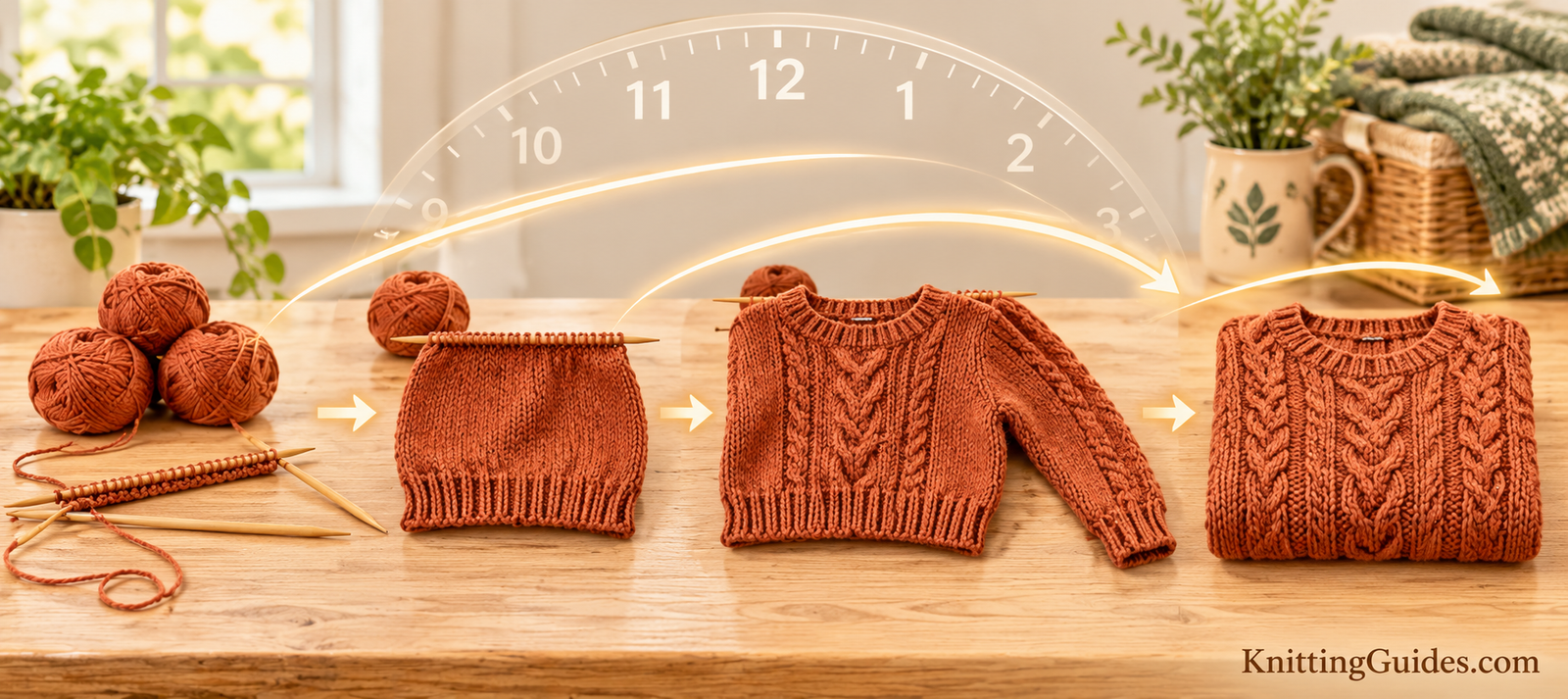
How Long Does It Take to Knit a Sweater? Realistic Timelines for Every Skill Level
Most hand-knit sweaters take roughly 20 to 80 hours of actual knitting. Spread across a normal life with a job, a commute, and a sofa, that usually means a few weeks to a few months — and the exact number depends on yarn weight, pattern complexity, size, and how fast and how often you knit.
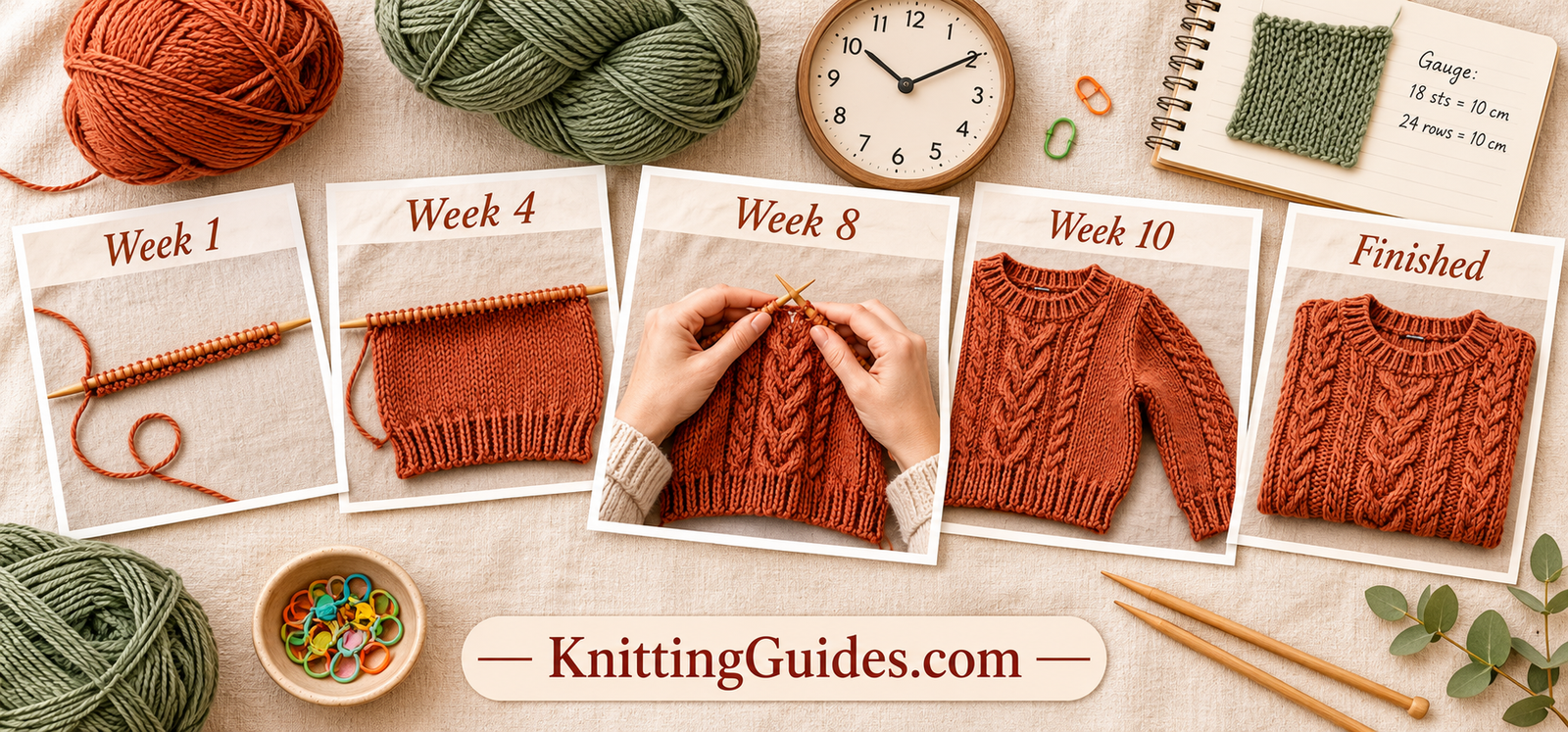
Ask ten knitters how long a sweater takes and you will get ten different numbers, all of them delivered with total confidence. That is not because anyone is lying. It is because “how long does it take to knit a sweather” is really two questions: how many hours of knitting does the fabric contain, and how many weeks of your life will it occupy? Those answers rarely match.
The short version: most hand-knit adult sweaters land somewhere between 20 and 80 hours of actual knitting time. A chunky, simple pullover in a large needle might be a 20-hour project for a confident knitter and a 35-hour project for a newer one. A fine-gauge Fair Isle cardigan in fingering weight can quietly become 120 hours or more. For most people knitting in the normal margins of an ordinary week — an evening here, a commute there — that translates to a few weeks to a few months.
Why the range is so wide comes down to five things: yarn weight and needle size, the size and length of the garment, how complicated the stitch pattern is, how the sweater is constructed, and how fast and how often you personally knit. Change any one of those and the timeline moves, sometimes dramatically.
What follows is a full breakdown. You will find realistic hour ranges by skill level, yarn weight, pattern style, and size; a look at how the hours split between body, sleeves, ribbing, and finishing; a simple formula for estimating your own sweater from a gauge swatch; and honest guidance on whether the time is worth it. If you have never knit anything before, start with our guide to how to start knitting — then come back and see what your first garment might demand.
1. How Long Does It Take to Knit a Sweater? The Quick Answer
If you only read one part of this guide, read this section. It gives you the honest ranges and the two numbers you should keep separate.
The typical time range
For an adult sweater in a mid-weight yarn — worsted or aran — knitted by someone with a project or two behind them, the fabric itself usually contains somewhere between 35 and 70 hours of knitting. Push that down toward 20–30 hours if you are working in bulky yarn with a simple stitch pattern and a relaxed fit. Push it up toward 80–120 hours if you are working in fine yarn, adding cables or colourwork, or knitting a large size with long sleeves and a generous body.
These are estimates rather than guarantees, and they assume steady knitting rather than intense marathon sessions. Treat them as planning numbers: useful for deciding whether a sweater is a sensible gift project before a birthday, and useful for keeping your morale up in the long middle stretch when the body seems to stop growing.
Hours of knitting vs. calendar time
This is where most knitters get surprised. A 50-hour sweater does not take “50 hours” in any way that shows up on a clock you can see. At five hours of knitting a week — a realistic amount for a busy person who knits most evenings — 50 hours becomes roughly ten weeks, or a bit over two months. At ten hours a week it is five weeks. At two hours a week it is half a year.
So the calendar timeline is a simple division: total hours divided by your weekly knitting hours. Life gets a vote, though. Holidays, work deadlines, a sleeve that goes wrong, a week where you simply do not feel like picking it up — all of these stretch the calendar without adding a single hour of knitting. Plan for the stretch.
Beginner, intermediate, and advanced timelines
A beginner knitting a first sweater typically needs 60 to 120 hours or more, because a meaningful share of the time goes on learning rather than producing: reading the pattern, fixing mistakes, understanding shaping, and unpicking rows that went astray. An intermediate knitter who has completed a garment or two usually lands in the 35 to 70 hour band. An experienced, fast knitter working a simple pattern in a heavier yarn can finish in 20 to 45 hours.
The skill gap is not really about hand speed. It is about decisions per minute. A confident knitter stops less, reads ahead, recognises a mistake three rows back instead of thirty, and does not need to re-learn techniques mid-project. Those savings add up far more than raw stitch speed does.
Why your sweater may take longer or shorter
Longer: fine-gauge yarn, a fitted silhouette with lots of shaping, colourwork that needs two strands managed at once, a cable panel that pulls the fabric tight and slows the hands, a large or long size, seaming and finishing, a yarn that splits, a pattern you have to re-read constantly, or simply knitting while distracted.
Shorter: bulky yarn on big needles, a boxy drop-shoulder shape with minimal shaping, plain stockinette, knitting in the round so there is no seaming, a cropped length, and a pattern you have knit before in a similar weight. If you want the fastest possible sweater, pick every item on that second list.
Quick timeline table by skill level and yarn weight
Use this as a first-pass estimate. Ranges are approximate knitting hours for a plain adult pullover.
| Skill level | Bulky / super bulky | Worsted / aran | DK / sport | Fingering |
|---|---|---|---|---|
| Beginner | 25–40 hrs | 45–70 hrs | 60–95 hrs | 90–140 hrs |
| Intermediate | 18–30 hrs | 32–50 hrs | 45–70 hrs | 70–105 hrs |
| Advanced / fast | 12–22 hrs | 22–35 hrs | 32–52 hrs | 55–85 hrs |
Start With a Yarn Weight That Matches Your Patience
Heavier yarns finish faster; lighter yarns drape beautifully. Browse both before you commit.
Check Knitting Yarn on Amazon2. What Affects How Long a Sweater Takes
Five levers control your timeline. Understand them and you can design a project that fits the deadline instead of fighting it.
Yarn weight and needle size
Yarn weight is the single biggest lever you control. A sweater knit in super bulky yarn on large needles might contain 900 to 1,200 stitches per square of fabric you actually work, while the same shape in fingering weight can hold three or four times that many stitches for the same area. Fewer stitches means fewer movements of the hands, which means less time, and the difference is not subtle — a chunky sweater can genuinely be finished in a third of the time a fingering-weight one takes.
Needle size travels with yarn weight, and it also affects comfort. Very large needles can tire the hands and produce uneven tension until you adjust; very small needles are precise but slow. If you are unsure which needle belongs with which yarn, our guide to what size knitting needles for beginners covers the pairings worth starting with.
Sweater size and length
Bigger garments need more fabric, and more fabric means more stitches. A cropped, boxy sweater for a small frame is not merely slightly quicker than a long, oversized cardigan for a large frame — it can be nearly half the work. Sleeve length matters too, and sleeves are more fiddly than they look because you are often working on a small number of stitches in the round with several needles in play.
Length is the quiet multiplier. Every extra inch added to the body and to each sleeve adds a full round (or row) of a large number of stitches. Two extra inches on the body and two on each sleeve can add several hours of knitting without changing anything about how the sweater looks in a photograph.
Pattern complexity (stockinette, cables, colourwork, lace)
Plain stockinette is the speed champion: the same stitch, row after row, easy to read and easy to work while talking or watching something. Ribbing is close behind. Cables slow you down because every crossing requires a pause, a cable needle, and a reshuffle of stitches, and the fabric pulls in, so you knit more rows for the same length. Colourwork slows you down differently — you are managing two strands, checking a chart, and untangling yarns, and tension problems can force you to redo sections.
Lace is slower again, because you are counting constantly and a single misplaced decrease can cascade. If the pattern also includes shaping, pockets, button bands, or a complex collar, budget extra hours for the mental overhead of following it. Reading a pattern well is a skill in itself; if charts make your eyes blur, spend an evening with how to read a knitting pattern before you cast on.
Construction method (top-down, bottom-up, seamed, raglan, yoke)
Top-down and bottom-up seamless construction, particularly raglan and circular yoke, means no seaming at the end and lets you try the garment on as you go. The trade-off is long rounds — by the time you reach the body of a large sweater you may be knitting several hundred stitches per round, and each round takes noticeably longer than a flat row of a sleeve.
Seamed construction works in smaller, more portable pieces, which suits knitters who travel or knit in short bursts. But you then owe the project a finishing phase: blocking pieces, matching them, seaming shoulders and sides, and setting in sleeves. That finishing can be a couple of hours or a full evening, depending on how fussy you are. Working in the round is its own learning curve — see how to knit in the round for beginners if circular knitting is new to you.
Your knitting speed and style
Raw speed varies enormously between knitters, and it is only one factor. A relaxed knitter who enjoys every row and rarely makes mistakes often finishes ahead of a fast knitter who has to rip out sections. Your style matters too: some knitters hold yarn in the left hand and pick, others throw with the right, and the tension, rhythm, and fatigue profile of each affects how long you can comfortably knit in one sitting.
Also count your environment. Knitting in good light with a comfortable chair and a project you can pick up without re-reading the pattern is dramatically faster in practice than knitting in poor light on a project you have to study before every row. Small frictions, repeated over a hundred hours, decide the calendar.
Match Your Needles to Your Yarn
The right needle size keeps tension even and the project moving.
Check Knitting Needles on Amazon3. Timeline by Skill Level
Experience changes the timeline more than hand speed does. Here is what each stage realistically looks like.
How long it takes a beginner
Expect 60 to 120 hours for a first adult sweater, and do not be discouraged by the upper end. A first garment involves learning to cast on a large number of stitches and keep them even, to increase and decrease at the right points, to read a written pattern or chart, and to fix errors without panicking. Beginners also tend to knit tighter as they concentrate, which can make the fabric slower to work and occasionally requires a restart.
The best strategy is to choose a pattern written specifically for beginners, in a mid-weight yarn, with minimal shaping. Many first-sweater knitters finish in eight to twelve weeks of steady evening knitting — slower than they hoped, but enormously satisfying. If you want a low-stakes warm-up before a sweater, a scarf teaches the basics fast; see how to start knitting a scarf.
How long it takes an intermediate knitter
An intermediate knitter with one or two garments completed usually needs 35 to 70 hours for a worsted-weight adult pullover, and can push below 30 hours for a bulky, simple design. At this stage the pattern reading is largely automatic, gauge is checked without resentment, and mistakes are caught early. The knitter also knows their own pace and can estimate a deadline with reasonable accuracy.
Intermediate knitters often take on more ambitious projects precisely because the basics no longer consume attention — which means the timeline can stay flat or even grow, since cables, colourwork, and fitted shaping are slower than plain fabric. Ambition is a wonderful thing to spend hours on, as long as you know you are spending them.
How long it takes an experienced knitter
Experienced knitters routinely complete simple sweaters in 20 to 45 hours, and some will tell you they can finish a chunky pullover over a long weekend. What they have is rhythm, automaticity, and a deep library of patterns to draw on: they can improvise shaping, substitute yarns confidently, and correct errors on the fly. They also tend to knit more hours per week, which shrinks the calendar dramatically.
The interesting part is that advanced projects are not faster. An expert knitting an intricate colourwork cardigan in fingering weight may spend 100 hours on it happily. Expertise buys control over the timeline, not necessarily a shorter one.
Continental vs. English vs. other knitting styles
Continental knitting, where the yarn is held in the left hand and picked, is often described as faster because the hands travel less. English knitting, where the yarn is thrown with the right hand, is the more common starting style in many places and is perfectly efficient once the movement becomes automatic. Portuguese knitting, lever or Irish cottage knitting, and other styles each have devoted followings among knitters who value efficiency or reduced strain.
In practice, the style that keeps your hands comfortable for two hours beats the style that is theoretically fastest for fifteen minutes. If you are curious, try another style on a small project rather than mid-sweater. For more on how quickly the fundamentals click into place, our piece on how long it takes to learn knitting is useful context.
Skill level comparison table
| Skill level | Knitting hours | Calendar time at 5 hrs/week | Where the time goes | Biggest time saver |
|---|---|---|---|---|
| Beginner | 60–120 hrs | 3–6 months | Learning, fixing, re-reading pattern | Simple pattern, heavier yarn |
| Intermediate | 35–70 hrs | 2–3.5 months | Pattern features and finishing | Confident gauge swatch |
| Advanced | 20–45 hrs | 1–2 months | Pure knitting and details | Consistent daily routine |
Shorten the Learning Curve
A good starter kit removes the guesswork before your first sweater.
Check Knitting Kits on Amazon4. Timeline by Yarn Weight
If you are choosing a project around a deadline, choose the yarn first. It sets the ceiling.
Bulky and super bulky yarn sweaters
Bulky and super bulky yarns are the sprinters of the knitting world. On large needles, the fabric grows visibly after every session, which is a genuine morale advantage on a long project. A simple adult pullover in super bulky yarn is often a 15 to 35 hour project depending on size and skill, and a cropped, boxy shape can come in lower still.
The trade-offs are weight, drape, and warmth. Bulky sweaters are heavy, can look chunkier than expected, and are warm enough that you may only wear them a few months of the year. Tension also shows more, so uneven knitting is more visible. If you love the look of chunky knits, our roundup of what to knit with chunky yarn has plenty of quick-win ideas.
Worsted weight sweaters
Worsted and aran weights are the sensible middle: fast enough to finish in a season, fine enough to give a garment that looks like clothing rather than a blanket. Most adult pullovers in worsted weight land between 30 and 65 hours, with the spread explained by size, pattern complexity, and your pace. This is the weight most first-sweater patterns use, for good reason.
Worsted also behaves predictably. It is easy to see your stitches, easy to fix mistakes in, and easy to block. If you want the best balance of speed and finish, this is it — and if you are choosing a first project, our guide to the best yarn for beginner knitting explains which fibres forgive the most.
DK and sport weight sweaters
DK and sport weight sit between worsted and fingering: lighter, more refined, noticeably slower. A typical adult sweater in DK weight runs 45 to 85 hours, and sport weight pushes slightly higher. The payoff is a garment with better drape and a more polished, shop-quality look, particularly in smooth wool or wool blends.
These weights are also where many knitters fall in love with process over speed. The rhythm is meditative, the fabric is pleasant in the hands, and the finished sweater is wearable across more of the year. Just go in knowing the project will take a while.
Fingering weight sweaters
Fingering weight is the marathon. A plain adult pullover in fingering weight commonly takes 70 to 110 hours; add colourwork or lace and 130 hours or more is entirely normal. The stitches are small, the rows are long, and progress is measured in centimetres rather than inches. Many knitters work on these over an entire winter.
What you get is the kind of sweater people assume was machine-made: fine, light, elegant, and highly wearable. If you commit to one, plan a deliberate milestone system — sleeve, sleeve, body, band — so the project never feels endless.
Yarn weight comparison table
| Yarn weight | Typical needle range | Knitting hours | Finished feel | Best for |
|---|---|---|---|---|
| Super bulky | 9–12 mm | 15–35 hrs | Chunky, warm, heavy | Fast gifts, first sweaters |
| Bulky / aran | 6–8 mm | 22–45 hrs | Cosy, substantial | Winter pullovers |
| Worsted | 4.5–5.5 mm | 30–65 hrs | Balanced, everyday | Most knitters, most sweaters |
| DK / sport | 3.5–4.5 mm | 45–85 hrs | Light, polished drape | Year-round layering |
| Fingering | 2.25–3.5 mm | 70–130 hrs | Fine, elegant, light | Heirloom and colourwork |
Pick Your Weight, Then Your Skeins
Compare fibres and yardage before you buy for a whole sweater.
Browse Sweater Yarn on Amazon5. Timeline by Sweater Style and Pattern
Two sweaters in the same yarn can differ by dozens of hours purely because of what the stitches are doing.
Simple stockinette pullovers
The plain stockinette pullover is the baseline against which everything else is measured. Most knitters find they can work it almost on autopilot after the first few rows, which means it is perfect for knitting while listening to something or talking to family. In worsted weight, a simple adult pullover is typically a 30 to 55 hour project.
It is also the best pattern for learning what your own knitting speed actually is, because there are no surprises to distort the measurement. If you have never followed a garment pattern, start here; it teaches shaping and finishing in the least punishing way possible.
Cardigans and button bands
Cardigans look simple and quietly add work. You knit the body in pieces or with steeks, then pick up and knit a button band along the whole front opening and neckline, work buttonholes evenly spaced, and often add a reinforcing band that must match in tension on both sides. Expect a cardigan to take 10 to 20 percent longer than an equivalent pullover.
Button bands are also where finishing skill shows. A band that pulls or ripples can spoil an otherwise beautiful garment, so budget time to sew on buttons properly and to block the finished piece. In exchange, cardigans are wonderfully versatile and forgiving on fit.
Cable knit sweaters
Cables are slow and rewarding. Every crossing interrupts the rhythm, the fabric pulls in so you need more stitches and more rows for the same measurements, and reading the pattern requires attention throughout. A cable sweater commonly takes 40 to 80 hours in worsted weight, and heavily cabled Aran-style designs can run well beyond that.
The result is worth it: cabled fabric has structure, texture, and a handmade quality nothing else matches. Keep a cable needle handy and practise the crossing on a swatch first, because uneven cabling shows up immediately on a finished front panel.
Colourwork and Fair Isle sweaters
Colourwork slows you through logistics rather than complexity. You manage two strands, keep tension even across the floats, read a chart that repeats around the body, and untangle yarns constantly if you are not using a yarn guide or bobbins. Expect 45 to 90 hours in a mid-weight yarn for a patterned adult sweater, more for all-over patterning.
Colourwork is also the most likely style to require re-knitting, because tension issues become obvious once the fabric is blocked. Take your time with the first repeat of any chart — an hour spent there saves an evening later.
Style and pattern comparison table
| Style | Knitting hours | Extra vs. plain | Main time cost | Difficulty |
|---|---|---|---|---|
| Stockinette pullover | 30–55 hrs | Baseline | Plain rows only | Easy |
| Cardigan with bands | 38–65 hrs | +10–20% | Bands, buttonholes, buttons | Easy–moderate |
| Cable knit | 40–80 hrs | +25–50% | Crossings and denser fabric | Modererate |
| Colourwork / Fair Isle | 45–90 hrs | +30–60% | Charts, floats, tension | Moderate–hard |
| Lace or textured yoke | 45–85 hrs | +25–55% | Counting and fixing | Hard |
Organise Your Pattern Reading
Row counters, markers, and a chart holder keep complex projects moving.
Check Knitting Notions on Amazon6. Timeline by Size and Fit
Size is a straight multiplier on stitch count — and fit decisions can quietly add hours you never planned for.
Child and baby sweaters
Baby and child sweaters are the fastest garments in knitting, and they are the reason so many knitters discover they can actually finish things. A simple baby sweater in a light worsted or DK yarn is often a 6 to 15 hour project; a child’s pullover is commonly 12 to 25 hours. They also use less yarn, which makes them ideal for stash-busting and for practising new techniques at low risk.
The downside is the deadline pressure of a growing child and the small circumference of sleeves, which can be fiddly on double-pointed needles. If you are knitting for a new arrival, what to knit for a baby covers quick, useful ideas, and knitting projects for kids is full of small-scale inspiration.
Small and medium adult sweaters
Small and medium adult sizes are the reference point for most published patterns and for the hour ranges quoted throughout this guide. A plain worsted-weight pullover in a small or medium typically runs 30 to 55 hours; an intermediate knitter often lands near the lower half of that band. Sleeve and body lengths in standard sizing are usually manageable without adjustment.
This is the sweet spot for planning a gift or a personal project around a season, because the estimate you make before casting on tends to hold reasonably true once you have one sweater of experience.
Large and plus-size sweaters
Larger sizes need more fabric in every direction — wider body, wider yoke, longer rows and rounds, larger necklines and bands. The increase is not dramatic per size step, but across several steps it adds up: a large or plus-size sweater often takes 20 to 40 percent more knitting than a small in the same pattern and yarn.
Two practical notes. First, check yardage carefully before buying, because running short means waiting for a matching dye lot. Second, many knitters find that a well-fitted larger sweater in a lighter weight feels better to wear than a heavy one, even though it takes longer to knit.
How length and sleeve changes add time
Length changes are the easiest place to lose or gain hours. Adding two inches to the body and two to each sleeve can add three to six hours of knitting on a medium worsted-weight sweater, depending on your gauge. Cropping the body or shortening sleeves is the fastest way to bring a project inside a deadline without changing the look completely.
Fit style matters as well. Oversized and drop-shoulder designs need more fabric; fitted, cropped designs need less. If you are choosing between two patterns you like equally and time is the deciding factor, the shorter, boxier one wins.
Size comparison table
| Size | Knitting hours | Relative effort | Notes |
|---|---|---|---|
| Baby | 6–15 hrs | Roughly 25% of an adult S | Great for stash yarn and practice |
| Child | 12–25 hrs | Roughly 45% of an adult S | Small sleeves can be fiddly |
| Adult S–M | 30–55 hrs | Baseline | Standard pattern sizing |
| Adult L–XL | 38–68 hrs | +15–25% | Check yardage before buying |
| Adult 2XL–4XL | 48–85 hrs | +25–45% | Lighter weights feel better worn |
Measure Twice, Buy Once
A flexible tape measure and gauge ruler keep sizing decisions accurate.
Check Measuring Tools on Amazon7. How Long Each Part of a Sweater Takes
Knowing where the hours go helps you plan around them — and helps you avoid the classic trap of assuming you are nearly finished when you are not.
Body
The body is the biggest single chunk of knitting, usually 40 to 55 percent of the total hours. It is also the part where progress feels slowest, because by the time you reach the lower body on a seamless sweater you are working large rounds that take real time to complete. Many knitters describe this stretch as the “sleeve of the body” — a long, plain middle with little visible change.
Counter this with milestones: mark every inch or every pattern repeat, and let yourself notice the fabric growing. If you are knitting flat in pieces, the body may feel faster because each row is shorter.
Sleeves
Sleeves account for roughly 20 to 30 percent of the hours, and they are the part knitters most often underestimate. There are two of them, they change width as they go, and once you reach the forearm the stitch count is small, which means more needle management per stitch. Sleeve island — knitting one sleeve and then facing a second identical one — is a well-known motivation dip.
A common trick is to knit both sleeves at the same time on one long circular needle, so they match exactly and you finish them together. It feels slower per session but saves re-reading and second-sleeve syndrome.
Yoke, neckline, and collar
The yoke and neckline take perhaps 10 to 20 percent of the hours, but they carry most of the visual impact. Raglan and circular yokes involve frequent decreases worked at set intervals, and a shawl collar or folded collar adds picked-up stitches, short rows, and a second layer of fabric. Neatness here is what makes a hand-knit sweater look professional.
Do not rush this part. Necklines are the first thing people notice and the hardest area to redo invisibly once seamed or bound off.
Ribbing, hems, and edging
Ribbing is quick per stitch but easy to work too tightly, which pulls the hem in and adds frustration when you try to stretch it over your hands. Budget 5 to 10 percent of the hours for hems, cuffs, and any picked-up edging, and remember that ribbing often uses a smaller needle, which slows you slightly.
Stretchy bind-off methods matter more than they sound here. A hem that will not stretch is a garment you cannot put on. If bind-offs are still unfamiliar, review how to cast off knitting before you reach the finish line.
Seaming, blocking, and finishing
Finishing is the unglamorous final 5 to 15 percent: weaving in ends, seaming shoulders and sides if the sweater is worked flat, blocking the finished garment to measurements, sewing on buttons, and checking the fit. On a colourwork or heavily textured sweater, blocking is not optional — it is what evens the fabric and opens the pattern.
Set aside one full session for finishing rather than squeezing it in at midnight. And build the habit of weaving in ends as you go; a sweater with forty dangling ends is a project that stalls at the exact moment you should be celebrating.
| Sweater part | Share of total time | What makes it faster or slower |
|---|---|---|
| Body | 40–55% | Length, stitch pattern, flat vs. in the round |
| Sleeves (both) | 20–30% | Working them together saves re-reading time |
| Yoke and neckline | 10–20% | Collars and short rows add work |
| Ribbing and edging | 5–10% | Smaller needles and picked-up stitches slow you |
| Finishing | 5–15% | Seaming, blocking, ends, buttons |
Finish Like a Professional
Blocking mats, tapestry needles, and a good tape measure do the final 10%.
Check Finishing Supplies on Amazon8. How to Estimate Your Own Knitting Time
Stop guessing. Twenty minutes of measuring now gives you a timeline you can actually trust.
Knitting a gauge swatch and timing it
Cast on more stitches than the stated gauge requires — roughly thirty — and work enough rows to make a square that is at least fifteen centimetres tall. Time yourself working a plain section of that swatch with a stopwatch, pausing it when you stop knitting. You now have two numbers: your gauge, and how long a known number of stitches took.
Wash and block the swatch before measuring gauge, because yarns change after washing and a sweater that grows is a sweater you knit twice. This is also the moment to check that you like the fabric — needle size is not a law, it is a starting point.
Calculating your stitches per hour
Take the number of stitches in the timed section of your swatch and divide by the minutes you spent, then multiply by sixty. That is your stitches per hour at a comfortable pace, not a sprint. Write it down; you will use it for every future project and you will be surprised how much faster your estimates become.
Keep one number for plain knitting and, if you like, a second for patterned work. Cables and colourwork typically fall well below your plain-stitch rate, and trying to pretend otherwise is the most common source of optimistic deadlines.
Estimating total stitches from the pattern
Most patterns give stitch counts per row or round at each section, and many give the number of rows or rounds to work. Multiply and add them up for the body, sleeves, and yoke. If the pattern does not spell it out, estimate from gauge: work out the fabric area in square centimetres, multiply by your stitches per square centimetre, and add a margin for shaping.
You do not need to be exact. Within about 15 percent is plenty accurate for planning a season of knitting, and the exercise itself teaches you which parts of a garment are genuinely large.
Adding time for mistakes, frogging, and finishing
Add a buffer. Beginners should add 25 to 40 percent on top of the raw calculation for learning, fixing, and re-reading; experienced knitters can often get away with 10 to 20 percent. Then add a separate allowance for finishing — weaving ends, seaming, blocking — since that time is real but never shows up in a stitch count.
Fixing errors is part of knitting, not a personal failing. Our guide to how to fix mistakes in knitting covers tinking, lifelines, and dropping down a column, all of which save hours compared with ripping out a whole section in frustration.
Simple formula and example estimate
Here is the whole method in one place. Use it before you buy yarn and you will never again cast on a project that cannot possibly be finished in time.
Stitches per hour  =  timed stitches ÷ timed minutes × 60
Total stitches     =  body + sleeves + yoke + bands
Knitting hours     =  total stitches ÷ stitches per hour
Buffered hours     =  knitting hours × (1 + buffer %)
Calendar weeks     =  buffered hours ÷ hours you knit per week

Example:
  Swatch: 340 stitches in 11 minutes
  Stitches per hour = 340 ÷ 11 × 60  ≈ 1,855
  Estimated total   = 42,000 stitches (worsted adult pullover)
  Knitting hours    = 42,000 ÷ 1,855  ≈ 23 hrs
  Buffered (+30%)   ≈ 30 hrs
  At 5 hrs/week     ≈ 6 weeks
Your numbers will differ, and that is the point. The formula converts a vague worry into a plan you can adjust: fewer hours per week means a later finish, more complicated stitch patterns mean a bigger buffer, and a heavier yarn means a smaller total.
Build Your Own Estimate Kit
A swatch tool, row counter, and notebook make every future estimate easier.
Check Knitting Tools on Amazon9. How Many Hours Per Week You Knit Matters
The same sweater can be a one-month project or a six-month project depending purely on how often it lands in your hands.
Knitting a little each day
Short daily sessions are remarkably effective. Twenty to thirty minutes a day adds up to two and a half to three and a half hours a week, which means a 40-hour sweater takes roughly three to four months — but it also keeps the pattern fresh in your memory, so you spend almost no time re-reading. Daily contact with a project is the single best defence against abandonment.
Attach the habit to something you already do: the first coffee of the morning, the train journey, the hour before bed. Consistency beats intensity for any project that lasts months.
Weekend knitting
If you prefer longer sittings, weekend knitting can deliver big chunks of progress — two or three hours on a Saturday and Sunday is six hours a week, enough to finish many sweaters in two months. The risk is the gap between sessions: a complicated pattern can take fifteen minutes to re-orient in each time, which quietly eats the session.
Leave notes in the pattern at the end of every sitting: where you are, what comes next, any modifications. Thirty seconds of note-taking makes the next session start at full speed.
Fast knitting vs. relaxed knitting
There is nothing wrong with relaxed knitting, and for many people the whole point is the process rather than the product. But it is worth knowing which one you are doing this week. If you are knitting to a deadline — a gift, a season, a class — you need more hours or a simpler project. If you are knitting for pleasure, the calendar is irrelevant and the hours are the reward.
Most knitters move between the two modes. Choosing a project that matches the mode you are actually in is a small decision that prevents a lot of disappointment.
Sweater timelines by weekly knitting hours
Take any total-hours estimate and divide. A 45-hour sweater is a two-month project at six hours a week, a one-month project at eleven hours a week, and a four-month project at three hours a week. There is no universal right answer — only the answer that fits your life this season.
If the division lands somewhere you do not like, you have three levers: choose a simpler pattern, choose a heavier yarn, or choose a smaller size. Any one of them moves the number.
Hours-per-week comparison table
| Hours per week | 30-hour sweater | 50-hour sweater | 80-hour sweater |
|---|---|---|---|
| 2 hrs (a couple of evenings) | ~4 months | ~6 months | ~10 months |
| 5 hrs (most evenings) | ~6 weeks | ~2.5 months | ~4 months |
| 10 hrs (daily + weekends) | ~3 weeks | ~5 weeks | ~2 months |
| 15 hrs (project-focused) | ~2 weeks | ~3.5 weeks | ~5.5 weeks |
Make Long Sessions Comfortable
Good light and a rest for your wrists keep the hours enjoyable.
Check Craft Lighting on Amazon10. Ways to Knit a Sweater Faster
Nothing here is a cheat. These are the choices that remove friction between you and a finished garment.
Choosing bulky yarn and larger needles
The most reliable speed boost in knitting is simply more fabric per stitch. Moving from fingering to bulky weight can cut the knitting time of the same silhouette by half or more, and larger needles are easier on the hands during long sessions. If you have a hard deadline, this is the lever to pull first.
Choose a yarn that shows off simplicity rather than fighting it — a smooth, plied wool in a solid or gently heathered colour reads beautifully at a chunky gauge and hides tension variations better than a highly textured single.
Picking a simple pattern
Plain stockinette with minimal shaping is the fastest garment you can knit. Every additional feature — cables, colourwork, pockets, complex collars, mixed stitch patterns — costs hours and attention. That is not a reason to avoid them; it is a reason to know what you are paying.
A useful compromise is one feature and everything else plain: a textured yoke on a stockinette body, or a cable panel down a plain front. You get the visual interest without the full time tax.
Using the right needles and tools
Needles that suit your hands make a measurable difference over a hundred hours. Smooth joins matter on circular needles, because a snag at the join slows every single round. Interchangeable sets let you change sizes without buying new needles, and a good project bag keeps yarn, markers, and the pattern together so you never lose fifteen minutes searching.
Circular versus straight is a real decision too, and it affects both speed and shoulder strain; our comparison of circular vs. straight knitting needles explains the trade-offs. If you knit a lot, interchangeable knitting needle sets are worth reading about.
Setting up a knitting routine
Routine turns intention into hours. Keep the project where you actually sit, with the needles already on it and the pattern open at the right page. Decide in advance which session is for plain knitting and which is for reading a tricky section, so you are never trying to learn a new technique while exhausted.
Batch the small jobs too: wind all the yarn before you cast on, weave in ends at the end of each colour or skein, and check measurements at the same point every session. Small systems compound over months.
Avoiding common time-wasters (and mistakes that need ripping out)
The biggest time-wasters are avoidable: not checking gauge, not reading the whole pattern first, knitting while too tired to count, ignoring a mistake because undoing it feels worse than living with it, and buying yarn that splits or squeaks. Each one costs far more than the pause it takes to prevent it.
Keep a lifeline in complicated sections — a length of contrasting yarn threaded through a good row so you can rip back safely. And if you find yourself fighting the project, put it down for a day rather than pushing through; tired knitting is where most re-knitting begins.
Upgrade the Tools That Slow You Down
Smooth needles, tidy storage, and good notions remove the small frictions.
Check Needle Sets on Amazon11. Tips for Beginners Knitting a First Sweater
Your first sweater is a learning project that happens to be wearable. Choose it accordingly and you will finish it.
Choosing a beginner-friendly sweater pattern
Look for patterns described as beginner-friendly, with plain stitch patterns, minimal shaping, few or no seams, and clear instructions in both written and charted form where relevant. Top-down raglan pullovers are a popular first-sweater choice because you can try the garment on as you go and adjust length before finishing.
Read the pattern all the way through before casting on. If more than a couple of techniques are unfamiliar, either pick a simpler design or practise those techniques on a swatch first. A project that introduces one or two new skills is enjoyable; one that introduces seven is a course, not a sweater.
Picking forgiving yarn
Choose a smooth, plied, mid-weight wool or wool blend in a light, solid colour. Dark yarn hides your stitches and makes fixing mistakes harder; highly textured or novelty yarns hide mistakes but make it impossible to see whether you are making them. Smooth plied yarn gives clear stitch definition, which is what you want while learning.
Also choose something you actually want to wear and touch. A first sweater in a yarn you love is a sweater you will finish; a first sweater bought purely because it was cheap is a project you will quietly abandon.
Learning the skills you need first
Before a sweater, make sure you are comfortable with casting on, knitting and purling, increasing, decreasing, working in the round if the pattern requires it, and casting off with enough stretch. Practise each on a small square rather than discovering them mid-garment. Our full walkthrough in how to start knitting covers the fundamentals in order.
Casting on neatly matters more than people expect — a tight, uneven cast-on edge is hard to fix later and shows on the finished neckline and hem. How to cast on knitting covers several methods worth practising.
Staying motivated on a long project
A sweater is long enough that motivation will dip. Plan for it: set small milestones, keep a simple project for tired evenings, join a group or knit-along for accountability, and take photographs of your progress so you can see how far you have come when the fabric feels unchanged.
It also helps to know why you are knitting it. A sweater made for yourself, for someone specific, or to learn a technique gives you a reason to return to the sofa on the evenings when it would be easier not to.
Common first-sweater mistakes to avoid
- Skipping the gauge swatch and ending up with a garment that does not fit.
- Choosing a pattern far above your current skill level because you love the photographs.
- Buying only enough yarn, then discovering the dye lot no longer matches.
- Knitting sleeves that are too long or a body that is too short because you skipped checking measurements.
- Binding off tightly at the neckline so the sweater will not fit over your head.
- Leaving all the ends to weave in at the end and stalling on the finish line.
Every one of these is preventable with an hour of preparation. And if the budget matters as much as the timeline, our guide to is knitting expensive sets realistic expectations before you shop.
Everything You Need for a First Sweater
Starter kits, beginner needles, and forgiving yarn take the guesswork out.
Check Beginner Supplies on Amazon12. Is Knitting a Sweater Worth the Time?
Twenty to eighty hours is a real investment. Here is an honest look at what you get back.
Cost of yarn vs. a store-bought sweater
On pure materials, a hand-knit sweater usually costs more than a mass-produced one and less than a premium equivalent. Yarn for an adult sweater ranges widely by fibre and brand, and quality wool or specialty blends sit at the upper end. Add needles, notions, a pattern, and blocking supplies if you are starting from nothing, and the first sweater costs more than the second.
If saving money is the goal, the honest comparison is with a garment of similar fibre and construction, not with the cheapest item on a rail. Our breakdown of is knitting cheaper than buying goes through the maths properly.
The value of a handmade, custom-fit sweater
What you cannot buy is the fit. Hand-knitting lets you choose the exact length, the exact sleeve, the exact ease across the shoulders, and the exact colour — adjustments that ready-made clothing rarely offers outside of tailoring. Knitters who make their own garments often find they wear them far more precisely because the garment was built around their body rather than a size chart.
There is also the value of the skill itself. Once you can knit a sweater, you can knit one every year, adjust patterns confidently, and make gifts that last. The first sweater is the expensive one; the skill is the asset.
Knitting as a relaxing hobby
The hours are not dead time. Knitting is repetitive, tactile, and absorbing, which makes it a genuine form of downtime rather than an errand — you are relaxing while the sweater grows. Many knitters describe it as the part of the day where their hands are busy and their mind settles.
There is real research interest in the wellbeing effects of crafts like knitting; if that side of it interests you, read the benefits of knitting, our piece on knitting and anxiety, and whether knitting is good for the brain.
Gift sweaters and deadlines
Knitted gifts are deeply personal and deeply risky. Before promising a sweater, work out the total hours honestly, divide by your realistic weekly hours, and add a buffer — then ask whether that lands comfortably before the occasion. It usually does not, and it is far kinder to say so in advance than to knit through December in a panic.
If you do want to gift, choose a smaller project, a heavier yarn, or a simpler pattern for deadline knitting. And if you are thinking about selling what you make, pricing is its own subject: how much to charge for knitted items covers how to value the hours properly.
Final tips before you cast on
- Choose the yarn weight first; it sets the timeline more than anything else.
- Swatch, wash the swatch, and time yourself — twenty minutes of work saves weeks of guesswork.
- Read the whole pattern before buying yarn, so you know the yardage and the techniques involved.
- Plan your weekly hours honestly and pick a deadline that leaves slack.
- Finish one small project before a big one if you are new; the confidence is worth it.
Worth the Hours? Start With the Right Yarn
Choose a fibre you will love wearing for years.
Check Sweater Yarn on AmazonFrequently Asked Questions
Quick, direct answers to the questions knitters ask most before starting a sweater.
How long does it take to knit a sweater?
Most hand-knit adult sweaters take roughly 20 to 80 hours of actual knitting. On a normal schedule of a few hours a week, that works out to anywhere from a few weeks to a few months. Bulky, simple designs sit at the fast end; fine-gauge, patterned, or large sweaters sit at the slow end.
How long does it take a beginner to knit a sweater?
A first sweater commonly takes 60 to 120 hours or more, because part of the time goes into learning techniques, reading the pattern, and fixing mistakes. Practically, that means two to six months of steady evening knitting depending on how many hours a week you can give it.
How many hours does it take to knit a sweater?
For an intermediate knitter working a plain adult pullover in worsted weight, around 30 to 60 hours is typical. Add more for cables, colourwork, fine yarn, or larger sizes; subtract for bulky yarn, cropped lengths, and simple stitch patterns.
How long does it take to knit a sweater by hand per day?
Per day, most knitters manage somewhere between 20 minutes and two hours. At about 30 to 60 minutes a day you will complete many adult sweaters in roughly two to four months. Knitting several hours daily can bring that down to a month or so.
Is knitting a sweater faster with chunky yarn?
Yes, noticeably. Chunky and super bulky yarns cover more fabric per stitch and are worked on larger needles, so the same silhouette can be finished in roughly half the time of a worsted-weight version and far less than a fingering-weight one. The trade-offs are weight, warmth, and more visible tension.
How long does it take to knit a cardigan?
A cardigan usually takes about 10 to 20 percent longer than an equivalent pullover because of the button bands, buttonholes, and extra finishing. Expect roughly 38 to 65 hours for a plain worsted-weight adult cardigan, more for cables or colourwork.
How long does it take to knit a cable sweater?
Cable sweaters commonly take 40 to 80 hours in worsted weight. Cables interrupt your rhythm, pull the fabric in so you work more stitches and rows, and demand constant attention to the pattern. Heavily cabled designs can run considerably longer.
How long does it take to knit a baby sweater?
A simple baby sweater often takes 6 to 15 hours, and a child’s pullover roughly 12 to 25 hours. They are excellent quick projects, ideal for using leftover yarn, and a great way to practise shaping before committing to an adult garment.
Can I knit a sweater in a week?
Yes, but only with the right conditions: bulky or super bulky yarn, a simple pattern, a smaller or cropped size, and a lot of free time — likely 30 to 40 hours of knitting in seven days. For most people, a week is realistic for a chunky simple pullover rather than a fine, patterned one.
Why does knitting a sweater take so long?
Because a garment contains a very large number of individual stitches, and each one is made by hand. An adult sweater can easily hold tens of thousands of stitches before shaping, ribbing, and finishing are counted. The time is not wasted — it is the reason the finished fabric feels like nothing else.
How much yarn do I need for a sweater?
It depends on size, yarn weight, and length, so follow the yardage stated in your pattern and always buy a little extra for swatching and safety. As a rough sense of scale, a fine-gauge adult sweater uses far more metres of yarn than a chunky one, even though it contains a similar shape.
Is it cheaper to knit a sweater or buy one?
Materials usually cost more than a budget ready-made sweater and less than a premium one of similar fibre. If you count your time, hand-knitting is not a way to save money — it is a hobby that produces something wearable. For a full breakdown, see our guide to whether knitting is cheaper than buying.
Curious About the Craft Itself?
Browse books and starter supplies while you plan your first project.
Check Knitting Books on AmazonConclusion
So, how long does it take to knit a sweater? The honest answer is 20 to 80 hours of knitting for most adult garments, which becomes a few weeks to a few months once real life is added to the calculation. Your personal number is decided by five things: the yarn weight you choose, the size and length you knit, how complex the stitch pattern is, how the sweater is constructed, and how fast and how consistently you work.
Skill shifts the number most dramatically in your favour. A first sweater often takes 60 to 120 hours; a confident knitter with a simple pattern in bulky yarn can bring that below 30. But the arithmetic is simple either way: total hours divided by your weekly hours gives you the finish date, and a buffer keeps it realistic.
Your first action: knit a gauge swatch, time yourself working a known number of stitches, and calculate your stitches per hour. Then count — or estimate — the stitches in the pattern you are considering. In twenty minutes you will know whether that sweater is a one-month project or a winter-long one, and you can choose the yarn and pattern to match.
Whatever the timeline turns out to be, the hours are enjoyable ones. Pick a fibre you love, a pattern that suits your patience, and a pace that fits your week — and the sweater will get finished.
Yarn for Your Next Sweater
Compare weights, fibres, and yardage before you buy.
Check Yarn on AmazonNeedles That Suit Your Hands
Circular, straight, and interchangeable sets in every size.
Check Needles on AmazonNotions That Save Time
Markers, counters, tapestry needles, and blocking tools.
Check Notions on AmazonYou May Also Like
More guides to help you plan projects, choose tools, and get the most out of your knitting hours.
Best Spinning Wheels for Beginners
Where handspun yarn starts, and what to look for in a first wheel.
SpeedBest Knitting Machines
When you want fabric faster than hands alone can produce it.
ComfortBest Knitting Light
Good lighting makes long evening sessions easier on your eyes.
TravelCan You Bring Knitting Needles on a Plane?
What to know before you pack a project for a long flight.
ComparisonAddi Click vs. ChiaoGoo Interchangeable Needles
Two popular systems compared for feel, joins, and everyday use.
ProjectsSmall Knitting Projects With Leftover Yarn
Quick wins for the half-skeins left after a sweater.
GivingKnitting for Charity Ideas
Thoughtful things to make and where they are genuinely needed.
BusinessHow to Sell Knitted Items on Etsy
Turning finished projects into listings people actually find.
BusinessKnitting Business Ideas
Ways to earn from the craft beyond finished garments.
CommunityHow to Start a Knitting Group
Company makes long projects finish faster and far more enjoyably.