
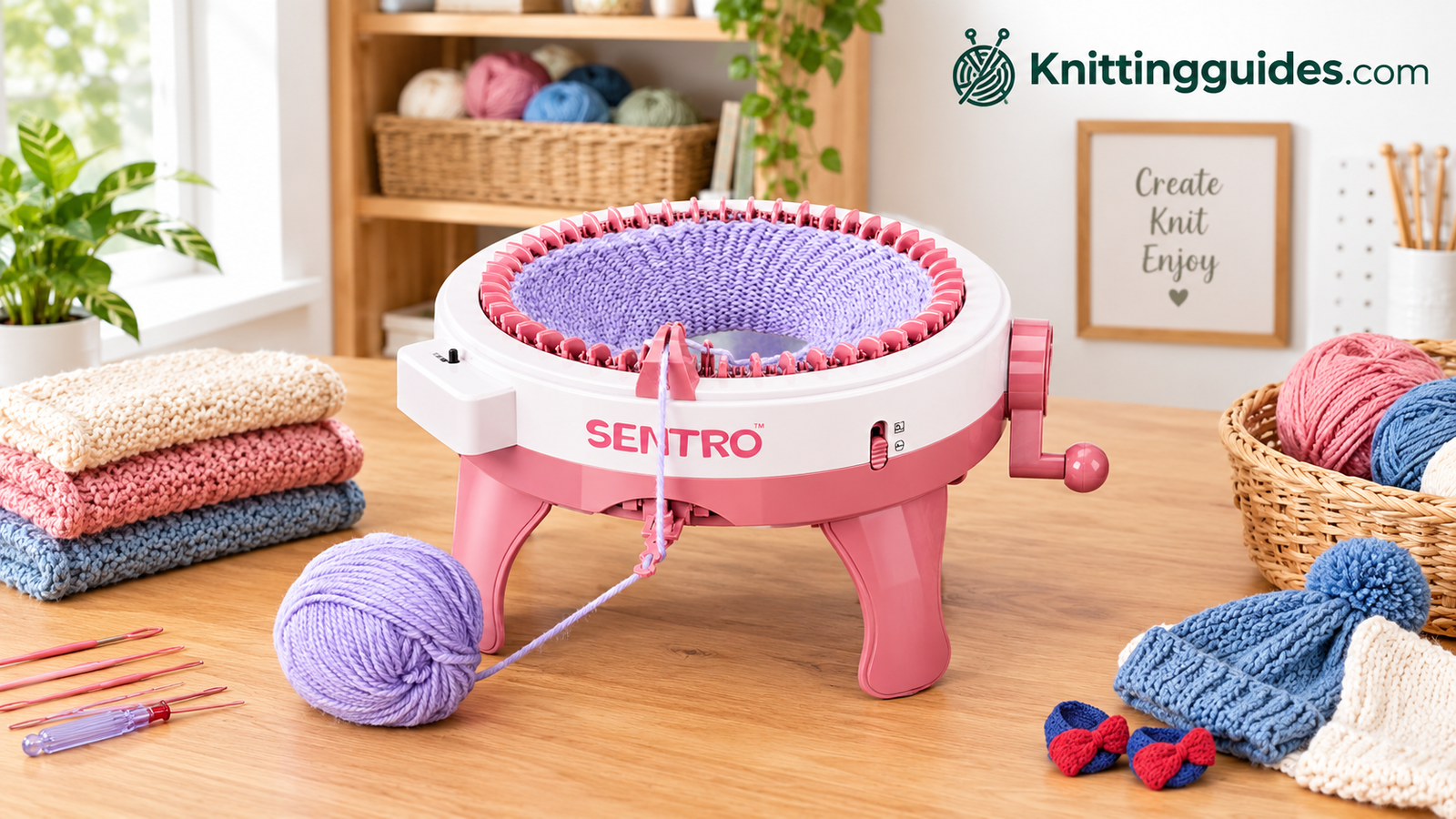
Best Knitting Machines: 7 Machines That Actually Speed Up Your Stitching
Circular powerhouses, mid-gauge flatbeds, and beginner looms compared side by side — so you can pick the machine that matches your projects, your patience, and your yarn stash.

There is a specific kind of frustration every knitter knows: you have a brilliant idea for a hat, a cowl, a blanket square, or a stack of holiday gifts, and the only thing standing between you and finished fabric is time. Hand knitting is meditative and beautiful, but it is also slow. That is exactly the gap a knitting machine fills.
A knitting machine does not replace the craft — it redistributes it. The machine handles the repetitive part (row after row of identical stitches), and you keep the creative part: choosing yarn, deciding on structure, shaping, seaming, adding colourwork, and finishing. Once you feel a machine turn a full skein into a smooth, even tube of fabric in the time it takes to drink a coffee, the category stops being a novelty and starts being a tool.
The catch is that “knitting machine” covers a surprisingly wide range of devices. On one end you have compact circular crank machines that are nearly as approachable as a kitchen gadget. On the other you have mid-gauge flatbed machines with tension dials, carriage levers, and a genuine learning curve. Somewhere in between sit loom kits, which are technically looms rather than machines but serve the same purpose for many crafters: fast, consistent fabric without four needles and a lot of counting.
In this guide we compare seven popular options — the addi Express Kingsize, the SENTRO 48-Needle Knitting Machine, the Walfront LK150 Mid-Gauge Flatbed, the READAEER Knitting Loom Kit, the BUAOB Knitting Machine, the BZVV Knitting Machine, and the Umootek Knitting Machine. We look at what each one is genuinely good at, where it struggles, and which one deserves your money based on the projects you actually want to make.
If you have never picked up yarn before, it is worth spending a weekend with needles first — our guide on how to start knitting walks through the absolute basics. Understanding what a knit stitch is supposed to look like makes you dramatically better at reading your machine when something goes wrong. And yes, there is real cognitive upside to all of this: researchers and crafters alike have found that rhythmic, repetitive handwork supports focus and calm — something we cover in is knitting good for the brain.
Below you will find a full side-by-side comparison, individual deep dives on every machine, a practical buying guide, and a troubleshooting section that covers the problems every new machine knitter eventually meets.
Quick Comparison: Our Top Picks
Every machine in this guide is listed below with the details that matter most when you are choosing between them. We have kept the spec language honest — where a figure cannot be verified from the product itself, we describe the capability instead of guessing at a number.
Swipe to see more →
| # | Image | Product | Key Specs & Capabilities | Verdict | Where to Buy |
|---|---|---|---|---|---|
| 1 |  |
addi Express Kingsize Knitting Machine Best Overall Top Pick | Wide circular format · Hand-crank operation · Makes tubes and flat panels · Knits smoothly with a broad range of yarns | The most polished, reliable circular machine here — the one you buy once and keep. | Check Price on Amazon |
| 2 |  |
SENTRO 48-Needle Knitting Machine Best for Fast, Wide Projects | 48-needle wide cylinder · Hand crank · Row counter · Tension adjuster · Tubes and flat knitting modes | The workhorse for hats, cowls, and blankets where speed and width matter most. | Check Price on Amazon |
| 3 |  |
Walfront LK150 Mid-Gauge Flatbed Knitting Machine Best for Garment Makers | Flatbed needle bed · Sliding carriage · Adjustable tension dial · Mid-gauge needle spacing · Handles flat panels and shaped work | The one to choose when you want sweaters and shaped pieces, not just tubes. | Check Price on Amazon |
| 4 |  |
READAEER Knitting Loom Kit Best Budget Starter | Multiple loom sizes in one kit · Includes hook tool · No assembly or setup · Great for tubes, hats, and chunky projects | Lowest-friction way into machine-style knitting — perfect for kids and true beginners. | Check Price on Amazon |
| 5 |  |
BUAOB Knitting Machine Best Compact Pick | Compact round cylinder · Hand crank · Suction or clamp base options · Simple tube and panel knitting | A tidy, space-saving machine for small accessories and travel crafting. | Check Price on Amazon |
| 6 | |
BZVV Knitting Machine Best for Yarn Stash Projects | Round needle cylinder · Hand-crank drive · Adjustable yarn tension · Suitable for scrap-yarn blankets and accessories | Friendly, forgiving, and ideal for turning leftover yarn into usable fabric. | Check Price on Amazon |
| 7 |  |
Umootek Knitting Machine Best for Gifting & Crafting Nights | Hand-crank circular design · Portable footprint · Beginner-friendly controls · Works with standard medium-weight yarns | An easy, approachable machine to share with family or take to craft meet-ups. | Check Price on Amazon |
1. Why a Knitting Machine Belongs in Your Craft Room
Most crafters arrive at knitting machines through one of three doors. The first is pure volume: you want to make a dozen gifts before a holiday and your hands simply cannot produce that much fabric in time. The second is physical comfort — hand knitting is wonderful until it isn’t, and repetitive strain, arthritis, or plain fatigue can take the joy out of long projects. The third is curiosity. You have been hand knitting for a while and you want to understand how commercial knitwear is made, so you want a machine on the table to experiment with.
All three are legitimate reasons, and all three lead to slightly different purchases. But before we get into which machine does what, it helps to understand what a machine actually changes about your workflow.
Speed is the obvious win — but consistency is the real one
Everyone expects a machine to be faster. What surprises people is how much more even the fabric becomes. Hand knitting tension varies with your mood, your fatigue, the time of day, and how much coffee you have had. A machine regulates that for you. The result is fabric with a uniform gauge that blocks beautifully and looks far more professional than most first attempts at hand knitting.
That consistency also makes machine knitting ideal for projects where pieces must match. If you are making blanket squares, sock cuffs, hat bands, or garment panels that will be seamed together, an even gauge is the difference between “handmade with love” and “handmade with skill”.
It keeps the creative decisions where they belong
A common misconception is that a machine does the knitting for you and therefore removes the craft. In practice, you still choose the yarn, you still decide on structure, and you still finish everything by hand. Seaming, ribbing, edging, weaving in ends, adding colour, shaping a neckline — those are human decisions. The machine simply removes the monotonous repetition that stands between your idea and your finished object.
Think of it the way a bread machine changed home baking: the appliance handles the predictable, time-consuming stage, and you still choose the ingredients and the flavour. Once the dough (or in this case, the fabric) exists, the artistic work continues.
It is genuinely easier on your hands
Hand knitting demands thousands of small, identical movements of the fingers and wrists. Machine knitting shifts most of that load into a smooth crank motion that involves the arm and shoulder rather than fine finger articulation. For anyone dealing with stiffness or limited dexterity, this can be the difference between finishing a project and abandoning it. The loom-style options in this guide go even further, since working a loom uses a simple hook-and-wrap motion that many crafters find comfortable for long stretches.
It makes big, ambitious projects realistic
A blanket, a full-length scarf, a throw, a set of matching holiday accessories — in hand knitting these are multi-week commitments. On a wide circular machine, a tube of fabric that would take a weekend of hand knitting can often be produced in an afternoon. That changes your ambition level entirely. You start planning projects around what you want to make rather than what you can physically sustain.
Bottom line
A knitting machine is not a shortcut around the craft. It is a force multiplier for the parts of the craft that are repetitive, while leaving every creative decision in your hands. If you are still weighing machine knitting against crochet, our comparison of crochet vs knitting covers how the two feel different in practice.
2. Circular, Flatbed, or Loom: Picking the Right Type
Before you compare individual models, decide which category of device fits the projects in your head. This single decision matters more than any feature list, because each type produces fundamentally different fabric.
Circular crank machines
These are the recognisable ones: a cylinder of needles mounted in a plastic housing with a hand crank on the side. Turn the handle and the needle bed rotates, drawing yarn through each hook in sequence and producing a seamless tube of knitting. Most can also produce flat panels by reversing the crank direction partway through, which creates a back-and-forth mode.
Circular machines are fast, intuitive, and forgiving. They excel at hats, cowls, scarves, tube socks, scrunchies, drawstring bags, and blanket squares that you later seam together. Their limitation is shape: they make tubes and rectangular panels, not naturally shaped garments. You can absolutely build a sweater out of machine-knit panels, but you will do the shaping by binding off and seaming rather than on the machine itself.
In this guide, the addi Express Kingsize, SENTRO 48-Needle, BUAOB, BZVV, and Umootek all sit in this category.
Flatbed machines
A flatbed machine looks more like a piece of workshop equipment: a long horizontal bed of needles with a carriage you slide across by hand. Instead of rotating, the carriage travels back and forth, laying down one row per pass. Because you control the carriage manually and the machine exposes individual needles, you can shape fabric directly — increasing, decreasing, holding stitches, and creating actual garment curves.
This is the category to choose if you dream of sweaters, cardigans, shaped shawls, or anything with deliberate structure. The trade-off is setup and learning: flatbeds ask more of you before they reward you. If you want to understand how needle sizing relates to yarn weight in a more granular way, our guide to what size knitting needles for beginners is a useful primer on gauge thinking.
The Walfront LK150 Mid-Gauge Flatbed is the flatbed representative here.
Loom kits
Looms are not machines in the mechanical sense — nothing cranks or slides. Instead, you wrap yarn around fixed pegs and lift loops over one another with a hook tool. But looms deserve a place in this conversation because they solve the same problem: fast, even fabric without the finesse of four needles.
Looms are also the gentlest possible entry point. There is almost nothing to break, nothing to tension, and nothing to assemble. If you are buying for a younger crafter, or you simply want to test whether you enjoy making fabric on a fixed frame before investing, a loom kit is the sensible first step. The READAEER Knitting Loom Kit covers this ground with a set of graduated looms.
At a glance: which type fits which project
Swipe to see more →
| Machine Type | Best Projects | Learning Curve | Best For |
|---|---|---|---|
| Circular crank machine | Hats, cowls, tubes, scarves, blanket squares, bags | Low — minutes to first stitches | Speed, gifts, casual crafters |
| Flatbed machine | Sweaters, cardigans, shaped panels, textured stitch patterns | Medium — needs setup and practice | Garment makers and ambitious projects |
| Loom kit | Hats, scarves, cowls, chunky blankets | Very low — almost no setup | Beginners, kids, small budgets |
It is also worth noting that machine knitting and hand knitting are not competing hobbies. Many machine owners keep a set of needles on the go for the parts of a project that need hand detail. If you are building out a general toolkit, our roundups of the best knitting kits for beginners and circular vs straight knitting needles help you pick the hand tools that pair best with machine output.
3. addi Express Kingsize Knitting Machine
The addi Express Kingsize is the machine most people mean when they say “buy the good one first”. It is the largest circular machine in the addi Express family, built for crafters who want to work quickly without sacrificing fabric quality.
addi Express Kingsize Knitting Machine
What separates this machine from the budget circular options is the feel of the operation. The crank turns with a confident, weighted motion rather than a rattling one, and the needle hooks release yarn cleanly instead of snagging on fibres. That mechanical calm translates directly into fabric: fewer dropped stitches, fewer jammed rows, and far less time spent unpicking.
Key Features
- Wide circular format: the largest cylinder in the addi lineup, sized comfortably for adult hats, cowls, and generous tubes.
- Tube and flat panel modes: knit in the round for seamless tubes or reverse direction to produce flat fabric you can seam.
- Smooth mechanical action: a well-damped crank that keeps a steady rhythm even when you are working fast.
- Consistent tension output: even, professional-looking fabric across an entire skein without manual adjustment.
- Accessory tools included: the standard needles and threading aids that come with the machine get you started without a separate shopping trip.
What We Like
- The most reliable, jam-free experience of any circular machine here
- Wide enough for full-size adult hats and generous cowls
- Fabric quality looks closer to commercial knitwear
- Durable construction that survives being packed away and pulled out again
Keep in Mind
- Priced higher than the budget circular machines
- Still a tube-and-panel machine — shaping happens by hand
- Large footprint means it needs real storage space
If you plan to work in the round regularly, pairing this machine with a solid grounding in circular construction will help you finish machine-knitted tubes into real garments. Our guide to how to knit in the round for beginners explains the logic that machine tubes follow.
Check Price on Amazon4. SENTRO 48-Needle Knitting Machine
The SENTRO has become the default recommendation in online knitting circles, and the reason is simple: it puts a wide cylinder, a row counter, and a tension adjuster into a package that is easy to learn and fast to operate.
SENTRO 48-Needle Knitting Machine
The 48-needle count in the name is the headline: this is a wide-format cylinder that comfortably handles adult headwear, wide cowls, and the long tubes that become scarves and blanket panels. The built-in row counter is a small feature that makes a huge difference when you are producing matched pairs of anything.
Key Features
- Wide needle cylinder: the 48-needle format produces generous tubes and panels suitable for adult-size projects.
- Integrated row counter: keeps an accurate count so two sleeves, two socks, or two blanket squares actually match.
- Adjustable yarn tension: lets you dial the fabric in for chunkier or finer yarns within the machine’s comfortable range.
- Tube and flat modes: switch between seamless circular knitting and flat back-and-forth panels.
- Stable base: designed to sit firmly on a table while you crank at speed.
What We Like
- Exceptional speed for blanket squares, hats, and cowls
- Row counter removes the most common beginner mistake
- Tension dial gives you real control over fabric density
- Enormous community of tutorials and troubleshooting tips
Keep in Mind
- Plastic construction asks for careful handling at the needles
- Very fuzzy or heavily textured yarns can snag
- Expect a short practice phase before your tension looks even
Yarn choice is the single biggest factor in how a wide circular machine behaves. Fine, slippery, or heavily textured yarns fight the hooks; smooth medium-weight yarns glide. If your stash is mostly hand-knitting yarn, our guide to the best yarn for beginner knitting covers which fibre types behave predictably.
Check Price on Amazon5. Walfront LK150 Mid-Gauge Flatbed Knitting Machine
Everything changes when you move from a cylinder to a needle bed. The Walfront LK150-style mid-gauge flatbed is a different tool with a different ambition level, and for the right crafter it is the most rewarding machine in this entire guide.
Walfront LK150 Mid-Gauge Flatbed Knitting Machine
A flatbed turns knitting into a linear, mechanical process: you cast on across a bed of needles, slide the carriage across for each row, and build fabric one deliberate pass at a time. Because individual needles are exposed and controllable, you can shape the fabric directly — which is the entire basis of garment construction.
Key Features
- Flat needle bed: the linear layout that makes shaping, increasing, and decreasing possible.
- Manual carriage control: you set the speed and the rhythm, row by row.
- Adjustable tension dial: a genuine gauge control that changes how dense or airy the fabric comes out.
- Mid-gauge spacing: the versatile middle ground that works with a broad band of yarn weights.
- Panel-friendly output: produces the flat, shaped pieces that sweaters, cardigans, and structured accessories are built from.
What We Like
- The only option here that supports real garment shaping
- Tension control gives professional-looking gauge consistency
- Handles a wider variety of stitch structures than circular machines
- Satisfying, workshop-like feel for serious hobbyists
Keep in Mind
- Significantly steeper learning curve than a crank machine
- Requires assembly, a stable table, and stored accessories
- Slower than a circular machine for simple tube projects
Flatbed machines reward pattern literacy. If you are moving from hand knitting into machine work, being able to read instructions fluently will shorten your learning curve considerably — see our walkthrough on how to read a knitting pattern before your first big project.
Check Price on Amazon6. READAEER Knitting Loom Kit
Sometimes the smartest purchase is the one that lowers the barrier to entry. The READAEER loom kit does exactly that: a set of graduated looms and a hook tool, ready to use straight out of the box with nothing to assemble, tension, or calibrate.
READAEER Knitting Loom Kit
Because the kit includes multiple loom sizes, you can match the frame to the project rather than forcing everything onto one diameter. Small looms make snug tubes for hats and cuffs; larger ones open up for wider cowls and headwear. It is a genuinely useful set rather than a single-use gadget.
Key Features
- Multiple loom sizes: graduated diameters that cover everything from narrow tubes to full headwear.
- Hook tool included: the one piece of equipment you need to lift loops over pegs.
- No setup required: no assembly, no calibration, no tension learning curve.
- Lightweight and portable: easy to toss in a bag for travel, commutes, or crafting nights.
- Forgiving of yarn choice: looms handle bulkier, textured yarns that would fight a machine’s needle hooks.
What We Like
- The most approachable option in this entire guide
- Multiple sizes make the kit genuinely versatile
- Excellent for chunky yarns and textured fibres
- Affordable way to test the concept before buying a machine
Keep in Mind
- Hand-powered — slower than a crank machine
- Loops are formed by hand, so output is still time-intensive
- Limited to the diameters the kit provides
Loom work translates neatly back to needle work later, and if you decide to expand into hand tools after starting here, our guide to the best knitting needles for beginners picks up where the loom leaves off.
Check Price on Amazon7. BUAOB Knitting Machine
Not everyone wants a machine that dominates the craft table. The BUAOB is a compact circular machine built for crafters who value a small footprint and simple operation as much as output.
BUAOB Knitting Machine
Smaller circular machines have a real advantage that gets overlooked: they are easy to leave out. When a machine lives permanently on a side table instead of buried in a cupboard, you actually use it. The BUAOB’s compact format also makes it a natural companion for travel crafting and small apartments.
Key Features
- Compact cylinder format: a small-footprint machine that stores and travels easily.
- Hand-crank operation: simple mechanical drive with no power supply required.
- Stable mounting options: designed to sit or clamp securely while you work.
- Tube and flat knitting: the standard circular machine versatility for accessories and panels.
- Straightforward controls: minimal dials and levers, so there is very little to learn.
What We Like
- Takes up minimal space on a table or shelf
- Very quick to set up and put away
- Comfortable for small accessories and quick projects
- A good “second machine” for travel or crafting groups
Keep in Mind
- Smaller output limits you to narrower tubes and panels
- Fewer adjustment options than a full-size machine
- Not ideal for blanket-scale projects
Compact machines reward good yarn discipline. Using a consistent yarn weight across a project produces noticeably cleaner results — our roundups on beginner-friendly yarns cover which weights behave best in tight needle beds.
Check Price on Amazon8. BZVV Knitting Machine
Every knitter has a stash: partial skeins, abandoned colour experiments, yarn bought for a project that never happened. The BZVV is the kind of machine that turns that pile into finished fabric.
BZVV Knitting Machine
Circular machines are naturally friendly to scrap-yarn work. Because you are producing continuous tubes and panels, you can join new yarn whenever one runs out, building striped, colour-blocked, or scrappy fabrics that look intentional rather than improvised. The adjustable tension guide helps you keep those joins looking tidy.
Key Features
- Round needle cylinder: produces seamless tubes for accessories and quick garments.
- Hand-crank drive: smooth, quiet, and completely power-free.
- Adjustable yarn tension: helps balance the fabric when you switch between yarns mid-project.
- Scrappy-project friendly: well suited to stash-busting blankets, stripe work, and colour experiments.
- Beginner-tolerant design: forgiving enough to learn on without constant unpicking.
What We Like
- Great for using up leftover yarn instead of storing it
- Tension adjuster helps when changing yarn mid-project
- Cheaper entry point than premium circular machines
- Fast enough to finish a project in a single evening
Keep in Mind
- Consistency depends on the yarn you feed it
- Build quality is lighter than premium machines
- Best results come after a short practice period
Scrap projects also pair beautifully with a broader maker toolkit. If you enjoy the process side of fibre crafts, our guide to the best interchangeable knitting needle sets covers the hand tools that complement machine output for finishing work.
Check Price on Amazon9. Umootek Knitting Machine
Knitting machines have a wonderful social side that rarely gets discussed. They are genuinely fun to use around other people — the cranking is rhythmic and satisfying, results appear quickly, and there is no steep skill barrier keeping a beginner from participating. The Umootek fits that role particularly well.
Umootek Knitting Machine
What makes this machine a good shared tool is how little explanation it needs. Show someone how the crank turns and how the yarn feeds through the guide, and they are producing fabric within a couple of minutes. That accessibility makes it a favourite for family crafting sessions, school holiday projects, and gift-making marathons.
Key Features
- Hand-crank circular design: intuitive mechanical operation that anyone can learn quickly.
- Portable footprint: light enough to move between rooms, desks, and crafting events.
- Beginner-friendly controls: minimal settings and clear, simple operation.
- Standard yarn compatibility: designed to work smoothly with common medium-weight yarns.
- Quick-output projects: ideal for accessories that can be finished and gifted the same day.
What We Like
- Extremely easy for a complete beginner to pick up
- Great shared activity for families and craft groups
- Fast results keep younger makers engaged
- Light and easy to store between sessions
Keep in Mind
- Less control over fine gauge than a flatbed machine
- Not intended for large-scale blanket projects
- Handles best with smoother yarns
Machine knitting is also a lovely way to introduce someone to the wider world of fibre crafts. If they catch the bug, our guide to how to start knitting is the natural next step from machine to needles.
Check Price on Amazon10. What to Look For Before You Buy
Marketing copy for knitting machines tends to emphasise the same things: speed, needle counts, and fun. Those matter, but they are not what determines whether a machine ends up in regular use or in the back of a cupboard. Here is how we evaluate machines, and what you should think about before spending.
How we compared the machines
We looked at each machine through the lens of real crafting behaviour rather than spec sheets: how quickly a beginner can produce usable fabric, how the fabric actually looks and drapes, how much fiddling the machine demands between rows, how forgiving it is of imperfect technique, and whether it supports the projects people genuinely want to make. Where a spec could not be verified, we described the capability instead of quoting a number.
1. Learning curve versus your patience
Circular crank machines and looms produce usable fabric almost immediately. Flatbed machines ask for several hours of setup and practice before you are happy with your output. Neither is a wrong choice — but buying a flatbed when you wanted instant results is a recipe for frustration, and buying a crank machine when you want shaped garments is a recipe for outgrowing it in a month.
2. Fabric width and project scale
The width of the cylinder or needle bed sets the physical limit of what you can make in one piece. A narrow machine is perfect for tubes and accessories but struggles with anything meant to cover a lap. If blankets, wide cowls, or adult headwear are on your list, prioritise width. If you are making scrunchies, cuffs, and gift bags, a compact machine does the job beautifully.
3. Tension control
This is the feature that separates machines you can grow with from machines you will replace. Being able to adjust tension means you can work with a broader range of yarn weights and correct for fabric that is too tight or too loose. On flatbeds, tension dials are central to the whole experience. On circular machines, a tension adjuster makes a noticeable difference in how the fabric drapes.
4. Yarn compatibility
Every machine has a comfort zone. Smooth, medium-weight yarns are almost universally the easiest for machine needles to grab. Very fine yarns can slip; extremely fuzzy or heavily textured yarns can snag on hooks and shed fibres into the mechanism. Before you buy, look at what is already in your stash. If your yarn drawer is mostly chunky roving and novelty fibres, a loom may serve you better than a machine.
5. Build quality and long-term use
Most home knitting machines use plastic housings and needle beds. That is normal and fine — the difference is in how well the parts fit and move. A machine with a smooth, consistent crank and well-formed hooks will produce clean fabric for years. A machine with rough tolerances will drop stitches and frustrate you. Reviews that mention jamming, snagging, or broken hooks after light use are the red flag to watch for.
6. Storage and workspace
A wide circular machine takes real shelf space. A flatbed needs a table it can sit on semi-permanently. A loom kit fits in a drawer. Be honest about your space before you buy, because a machine you have to fully assemble before every use is a machine you will use less.
7. The finishing toolkit
Machine knitting produces fabric, not finished objects. You will still need basic hand tools for seaming, weaving in ends, and edging. Budget for a tapestry needle, a good pair of scissors, stitch markers, and a crochet hook for picking up dropped stitches. If you are building out that toolkit, our guides to the best knitting needles, needle sizing for beginners, circular vs straight needles, and interchangeable needle sets cover everything you need alongside your machine.
Quick decision checklist
Swipe to see more →
| If your main goal is… | Choose this type | Look for |
|---|---|---|
| Fast gifts and accessories | Circular crank machine | Wide cylinder, row counter, smooth crank |
| Sweaters and shaped garments | Flatbed machine | Tension dial, mid-gauge bed, carriage control |
| A low-risk first step | Loom kit | Multiple sizes, hook tool included |
| Blankets and big projects | Wide circular machine | Maximum cylinder width, stable base |
| Travelling and small spaces | Compact circular machine | Small footprint, simple controls |
11. Setup, Yarn Choices, and Your First Machine-Knit Projects
Owning a machine and using a machine comfortably are two different states. The good news: the gap between them is usually one or two practice sessions. Here is how to get there as quickly and calmly as possible.
Set the machine up like you mean it
Whether it is a circular machine or a flatbed, stability matters more than anything else. Clamp or suction the base firmly, sit at a comfortable height, and place the yarn on the floor or in a bowl below the machine so it feeds upward through the tension guide without resistance. Half of all beginner “machine problems” are actually yarn supply problems: the skein rolls away, the yarn catches, the tension spikes, and a stitch drops.
Cast on and produce a practice swatch
Before starting a real project, knit a plain practice piece. Your only goals are to feel how the crank should sound, see how the fabric hangs, and learn what a normal row looks like so you can spot an abnormal one. If you have never cast on by hand, our guide to how to cast on knitting explains the principle behind what the machine is doing at the start of a piece.
Learn to cast off cleanly
Finishing is where machine knitters lose the most fabric. A loose or uneven cast-off will unravel if it is not secured properly. Take the time to work a proper bind-off at the end of every piece — our walkthrough on how to cast off knitting covers the technique that keeps machine-knit edges tidy.
Choose yarn that co-operates
Start with a smooth, medium-weight yarn in a light colour. Light colours make it far easier to see the stitches and spot problems before they cascade down a row. Once you are confident, you can experiment with texture and darker shades. Our guide to the best yarn for beginner knitting is a solid reference for predictable fibres.
Your first three projects
- A simple tube cowl: the fastest win in machine knitting. Knit a length of tube, join the ends, and you have a wearable accessory in one sitting.
- A grafted scarf: flat-panel knitting that teaches you to manage long rows evenly. If you want a hand-knit companion project, see how to start knitting a scarf.
- A set of blanket squares: the best possible exercise in consistency, since matching pieces are the entire point.
Read patterns before you improvise
Machine knitting borrows most of its language from hand knitting. Understanding abbreviations, repeats, and shaping notation lets you adapt hand-knitting patterns to machine output — and vice versa. Our guide on how to read a knitting pattern decodes the notation you will encounter.
12. Care, Maintenance, and Troubleshooting
Knitting machines are mechanically simple, which means most problems have a simple cause. A few minutes of maintenance habit will save you hours of unpicking.
Keep the needles clean and dry
Dust, fibre fluff, and residual yarn oils build up around the hooks over time. Wipe the needle bed down periodically with a soft, dry cloth, and remove any fibres caught in the mechanism. Never use water or household cleaners on a plastic needle bed; a dry cloth is all you need.
Store it properly
Store machines flat, in a dry place, with nothing resting against the needle bed. Bent hooks are the most common long-term damage, and they are almost always caused by storage rather than use. If you keep your machine in a cupboard, place it where it will not be crushed by heavier items.
The three most common problems
- Dropped stitches: usually caused by yarn that is too fine, tension that is too loose, or a skein that snagged mid-row. Slow down, correct the stitch with a crochet hook, and adjust your tension.
- Jammed or stiff cranking: almost always means caught fibre or yarn wound around the mechanism. Stop immediately, clear the obstruction, and rethread rather than forcing the crank.
- Uneven fabric: typically a tension or yarn-supply issue rather than a machine fault. Make sure the yarn feeds freely and your tension setting suits the weight you are using.
If you end up doing hand finishing and hit a problem you cannot resolve, our guide to how to fix mistakes in knitting covers the recovery techniques that work for both hand and machine-knit fabric.
Make your workspace work for you
Machine knitting asks you to watch the needle bed closely for long stretches. Good task lighting reduces eye strain dramatically and helps you catch problems before they cascade. Our guide to the best knitting light covers the lighting setups that make detailed work comfortable.
When to service versus replace
If a machine is dropping stitches despite correct tension and clean needles, or if the crank has become gritty and resistant, it may be a mechanical wear issue. For mid-priced machines, replacement often makes more sense than repair. For premium machines, contact the manufacturer first — quality brands support their products with replacement parts and advice.
Maintenance in one sentence
Keep it clean, keep it dry, keep it stored flat, and never force the crank — that is ninety percent of machine care.
Frequently Asked Questions
Is a knitting machine worth buying if I already knit by hand?
For most people, yes — but as a complement rather than a replacement. Hand knitting gives you control over texture, shaping, and detail. A machine gives you volume and speed. Many crafters use a machine for the large, repetitive parts of a project and finish by hand for the parts that need judgement. If your project list regularly involves gifts, blankets, or matched sets, a machine will genuinely change what you can produce.
Can a complete beginner use a knitting machine with no experience?
Absolutely. Circular crank machines and looms are designed for exactly this. The learning curve is measured in minutes for basic operation and in a couple of sessions for clean, even fabric. If you have never knitted at all, spending a little time with the fundamentals in our beginner knitting guide will help you understand what the machine is producing and why.
What is the difference between a circular machine and a flatbed machine?
A circular machine has a rotating cylinder of needles that produces seamless tubes and, in many cases, flat panels when reversed. A flatbed has a horizontal bed of needles with a carriage you slide across, producing flat fabric that you can shape directly. Circular machines are faster and easier for accessories; flatbeds are more capable and better for garments.
Which yarns work best in a knitting machine?
Smooth, medium-weight yarns are the most reliable across all machine types. Very fine yarns can slip between hooks, while highly textured or extremely fuzzy fibres can snag. If you are stocking up, our guide to the best yarn for beginner knitting covers fibre types and weights that behave predictably.
Can I make garments with a circular knitting machine?
You can, though you will build them from tubes and flat panels rather than shaping on the machine itself. A seamed sweater made from machine-knit panels is entirely achievable and looks excellent. For direct shaping, a flatbed machine is the better tool. Understanding how circular construction works helps either way — see how to knit in the round for beginners.
How long does it take to knit a hat on a machine?
Once you are comfortable with the machine, a simple hat tube can often be produced in well under an hour of actual knitting time. The finishing — gathering the crown, adding a brim, weaving in ends — usually takes longer than the machine work itself. That ratio is typical of machine knitting generally.
Do I still need knitting needles if I buy a machine?
Yes, for finishing. You will want a tapestry needle for seaming, and a crochet hook for picking up dropped stitches. If you plan to add hand-knit details, a basic needle set is essential — our guide to the best knitting needles for beginners is a good starting point.
What is the difference between a knitting machine and a knitting loom?
A knitting machine uses a mechanical needle bed and a crank or carriage to form stitches. A loom uses fixed pegs and a hook tool, with you forming each loop by hand. Loops on a loom are slower but far more forgiving; machines are faster but need correct tension and yarn choice. For total beginners, a loom kit like the READAEER set is a low-risk first step.
How do I fix a dropped stitch on a knitting machine?
Stop cranking immediately when you spot one — dropped stitches cascade fast on a machine. Use a crochet hook to pull the loose strand back through the ladder of stitches above it, then re-seat the loop on its needle and continue slowly. Our guide to fixing knitting mistakes covers the technique in detail.
Can I take a knitting machine or knitting needles on a plane?
Hand knitting needles are generally permitted in carry-on luggage in most regions, though policies vary by airline and country, so it is always worth confirming before you fly. Machines are bulkier and are usually better checked or shipped. For the current rules on needles specifically, see our guide on bringing knitting needles on a plane.
How much space does a knitting machine need?
Less than you might think. A compact circular machine sits comfortably on a small side table. A wide circular machine needs a stable table or desk with clearance for the crank. A flatbed needs a table it can rest on with room on either side for the carriage to travel. A loom kit fits in a drawer.
Should I buy a machine or a knitting kit first?
If you have never knitted at all, a small starter kit is the cheaper way to find out whether you enjoy the craft before investing in machinery. If you already know you want to produce in volume, go straight to a machine. Our comparison of the best knitting kits for beginners covers the low-cost starting options.
Final Verdict: Which Knitting Machine Should You Buy?
After working through all seven options, the choice becomes surprisingly clear once you know what you want to make.
If you want the machine that will feel best, last longest, and produce the most professional fabric, the addi Express Kingsize is the one to buy. It is the most polished circular machine here, and it is the pick we would make for anyone who already knows machine knitting will become a regular part of their craft life.
If speed and width are the priority — blanket squares, holiday gift batches, wide cowls — the SENTRO 48-Needle delivers more output per hour than anything else in this guide, and the row counter alone earns its place.
If you want to make garments rather than accessories, the Walfront LK150 Mid-Gauge Flatbed is in a class of its own here. It asks more of you up front and gives back far more creative control.
And if you are simply curious whether machine-style knitting suits you, the READAEER Knitting Loom Kit is the gentlest, most affordable way to find out. The BUAOB, BZVV, and Umootek each fill their niche well — compact, stash-busting, and shareable respectively.
Whichever you choose, the same advice applies: set it up stably, start with smooth medium-weight yarn, produce a practice piece before your real project, and finish your edges carefully. Do those four things and the machine will reward you with finished fabric far faster than you expect.