
Circular vs Straight Knitting Needles: Which One Should You Actually Knit With?
Two needles, one craft, and a debate that has split knitting circles for decades. Here is a clear, experience-based look at how straight and circular needles really differ — in comfort, speed, portability, project range, and cost — so you can stop guessing and start knitting.
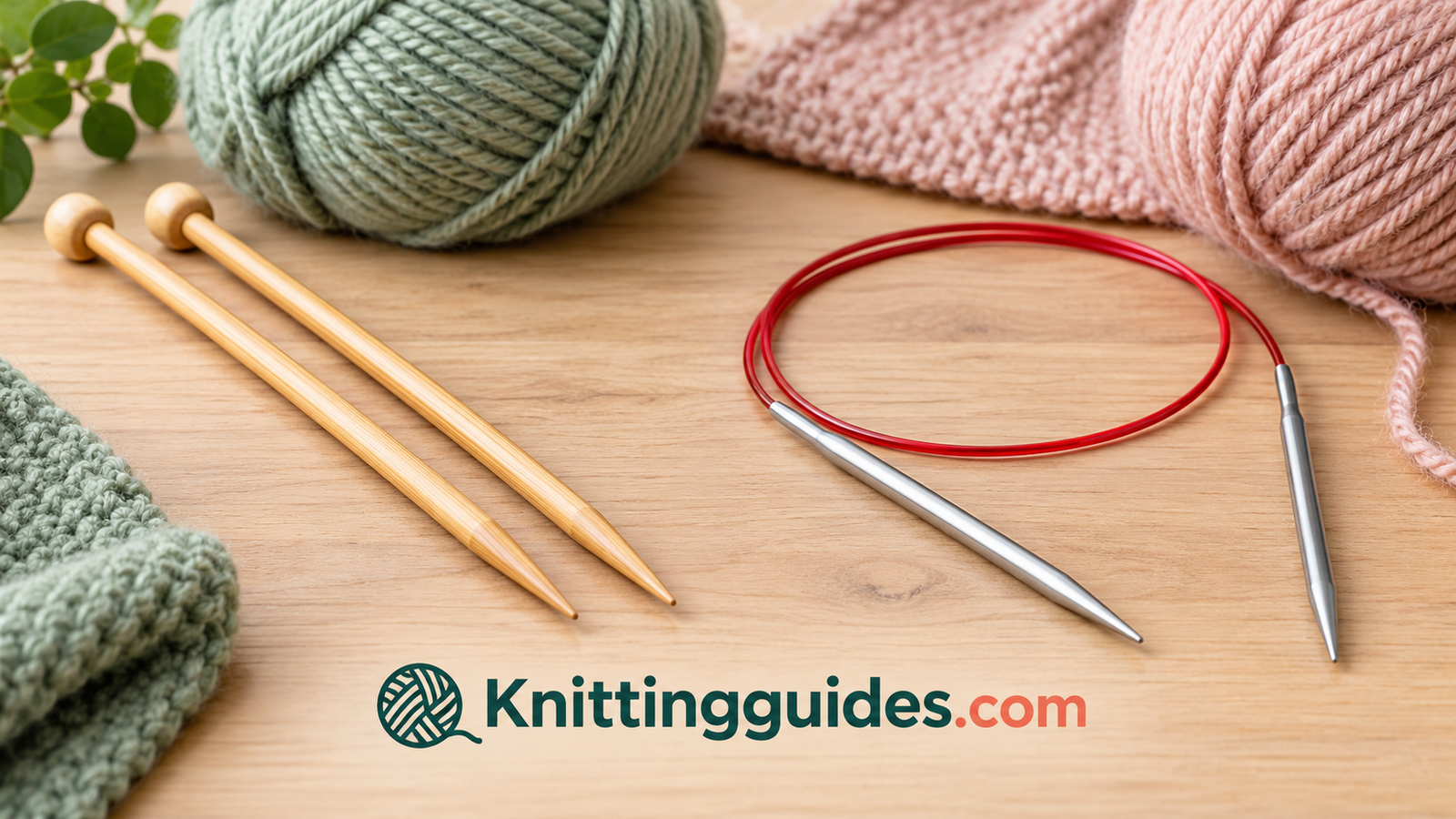
Why the Circular vs Straight Needle Question Matters More Than You Think
Ask ten knitters which needle is better and you will get ten answers, three heated opinions, and at least one story about a dropped sweater. That is because the question is not really about metal versus wood or length versus cable. It is about how you like to hold your work, what you dream of making, and how much friction you are willing to tolerate between your hands and your stitches.
Here is the honest starting point: neither style is objectively superior. Straight needles and circular needles are different tools with different strengths, and the “right” choice depends almost entirely on the fabric you want to produce and the body you are producing it with. A knitter who makes dishcloths and scarves will swear by straight needles. A knitter who makes seamless sweaters will look at a straight needle like it is a museum artifact. Both are correct.
What does get confusing is the sheer amount of folklore attached to the topic. You will hear that circular needles are only for knitting in the round. Not true. You will hear that straight needles are easier for beginners. Sometimes true, sometimes not. You will hear that circulars are gentler on the wrists, that they knit faster, that they change your gauge, that wooden needles are for beginners and steel is for experts. Some of that holds up. Some of it falls apart the moment you actually sit down and knit the same swatch on both.
So this guide does something slightly different. Instead of crowning a winner, it walks through both tools in detail — what they are made of, how the weight sits in your hands, what projects each one handles beautifully, what problems each one creates, and what each one costs over a knitting lifetime. By the end, you will know exactly which needle to reach for, and you will probably understand why most experienced knitters quietly own both.
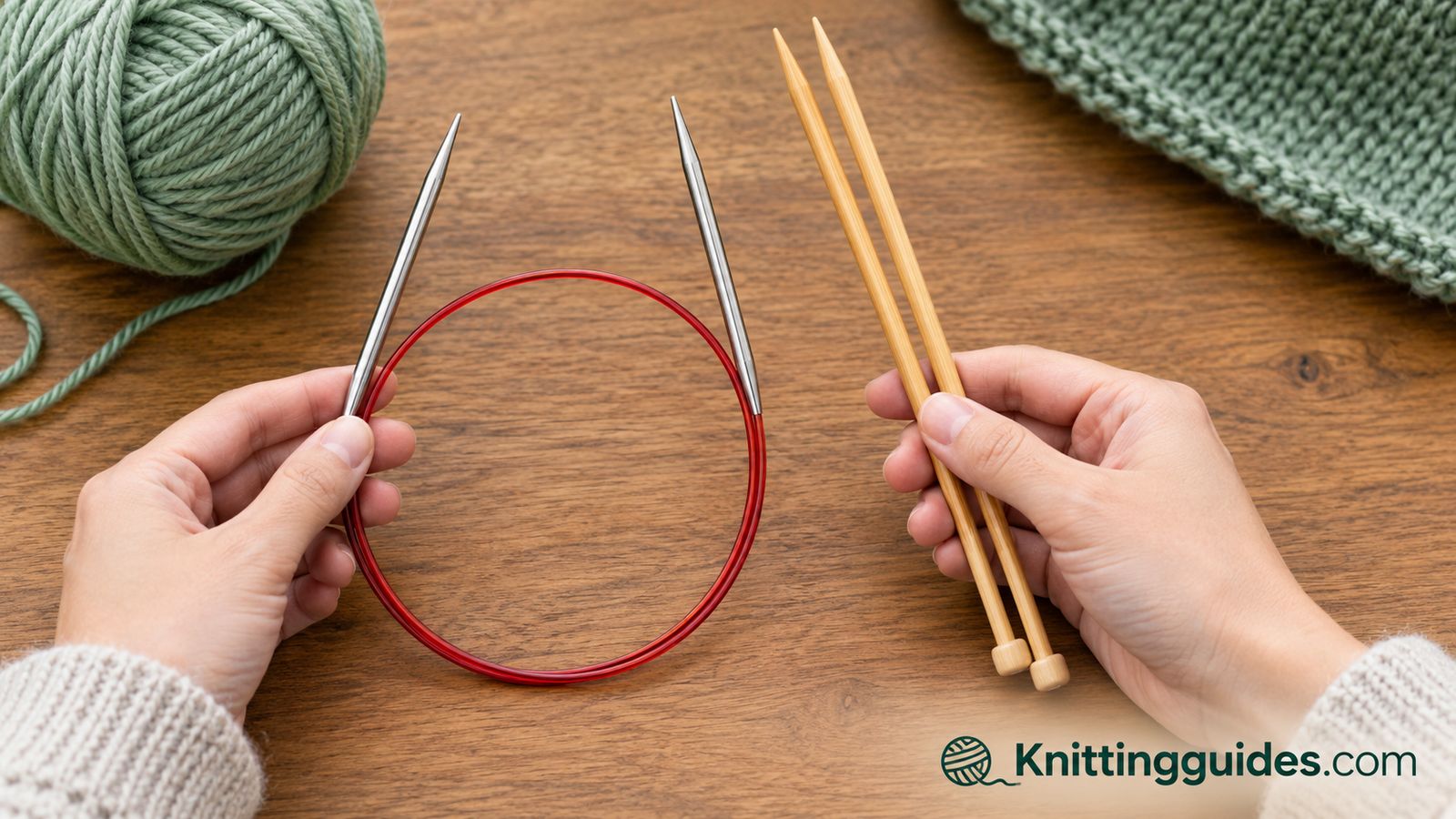
If you want maximum versatility for the smallest investment, buy a pair of circular needles first — they knit flat and in the round, they carry the weight of the fabric on the cable, and they travel well. If you are learning the absolute basics on a small flat project and want the simplest possible setup, a pair of straight needles removes cable management from the equation. Everything else in this guide refines that sentence.
Ready to see the options? Browse circular and straight knitting needles side by side before you commit.
Check Needle Prices on AmazonQuick Comparison: Circular vs Straight Knitting Needles
Before the deep dive, here is the whole argument compressed into one table. Read the rows top to bottom and you will already have most of what you need to make a decision.
Swipe to see more →
| # | Factor | Straight Needles | Circular Needles | Which Wins | Shop |
|---|---|---|---|---|---|
| 1 | Top PickVersatilityBest all-round value | Flat knitting only | Flat knitting and knitting in the round | Circular — one tool covers both modes | Check Price on Amazon |
| 2 | Weight in the handsComfort over long sessions | Whole fabric hangs from the needle ends | Weight rests on the cable and your lap | Circular for big projects | Check Price on Amazon |
| 3 | Learning curveFirst-ever project | Nothing extra to manage; stitches face you | Cable adds a small learning step | Straight, by a small margin | Check Price on Amazon |
| 4 | Project rangeHats, socks, sleeves | Limited to flat pieces you seam later | Tubes, sleeves, hats, socks, seamless garments | Circular | Check Price on Amazon |
| 5 | PortabilityKnitting on the move | Long, rigid, easy to bump | Coils small; project stays on the cable | Circular | Check Price on Amazon |
| 6 | Stitch securityKeeping stitches on | Open ends unless capped | Closed loop keeps work attached | Circular | Check Price on Amazon |
| 7 | Storage footprintSmall apartment stash | Needs length and space | Coils into a pouch or pocket | Circular | Check Price on Amazon |
| 8 | Traditional feelClassic knitting rhythm | The classic silhouette knitters picture | Modern, flexible, workhorse | Straight for pure feel | Check Price on Amazon |
Every column above reflects how these tools behave in real hands rather than how they are marketed. Now let us take each one apart properly.
Comparing the two yourself? Start with one affordable pair of each style and knit the same swatch twice.
Check Price on AmazonStraight Knitting Needles 101: What They Are and Where They Shine
Straight needles are the image most non-knitters carry in their heads: two long, elegant shafts, pointed at one end and capped at the other, with a flat square stopper or a decorative knob keeping the stitches from sliding off the back. They are the older tool, the simpler tool, and the one that most beginners pick up first because a straight line of stitches is the easiest thing in the world to see.
Functionally, a straight needle is a rigid shaft of a fixed length. Common lengths run from short needles suited to small pieces up to long ones intended for wide panels, and the length you choose is dictated by how many stitches must live on the needle at once. Crowd too many stitches onto a short pair and the fabric bunches at the tip; leave too few on a very long pair and you will feel every extra inch of metal in your wrists.
Single-pointed versus double-pointed: a distinction worth clearing up
People new to the craft often group all straight needles together, but there are really two families here. Single-pointed needles — one point, one stopper — are used for flat fabric worked back and forth in rows. Double-pointed needles have points at both ends and no stopper, and they are used for small tubes: sock cuffs, mitten thumbs, hat crowns, sleeve caps. Double-pointed needles technically knit in the round, but they are a separate skill and a separate tool from the circular needle, which is why knitters talk about “straights” and “DPNs” as different things even though both are rigid.
For this comparison, “straight needles” means the single-pointed pair you use for flat panels. Double-pointed needles come up again when we talk about small circumferences.
A straight needle is a single rigid beam: the fabric, and its full weight, hangs from that beam.
Where straight needles genuinely excel
- Small flat projects. Scarves, dishcloths, pot holders, headbands, simple panels. The fabric never gets heavy enough to become a problem.
- Learning stitch mechanics. Because the stitches face you in a straight line and the work cannot spin, it is very easy to see what each stitch is doing — great for understanding knit versus purl and for spotting mistakes early.
- Wide panels worked flat. Blanket squares, shawl bodies, and back panels are comfortable when the project is still manageable in size.
- Very tactile materials. Wooden and bamboo straight needles grip slippery yarn beautifully, which matters when you are learning tension.
- Gauge-sensitive swatching. Some knitters find their flat gauge is easier to reproduce on straight needles because the tension at the edges is more predictable.
Where straight needles start to fight back
The trouble begins when the project gets heavy. Every ounce of knitted fabric hangs from the ends of two rigid shafts that are levering against your palms, wrists, and forearms. A half-finished blanket on straight needles is not just heavy — it is heavy at the end of a lever, which multiplies the strain. Second, a straight needle can only produce flat fabric. Anything tubular must be seamed, and seaming is a separate skill that many knitters enjoy far less than knitting itself.
There is also the practical annoyance of length. Long straight needles poke out of tote bags, tap against chairs on the bus, and roll off tables. None of these are deal-breakers, but they are the small daily frictions that make some knitters switch to circulars and never look back.
Pros
- Intuitive for absolute beginners
- No cable to manage or straighten
- Excellent for small flat projects
- Wide range of materials and price points
- Easy to see and count stitches
Cons
- Cannot knit tubes without seaming
- Fabric weight loads the wrists
- Bulky to store and transport
- Stitches can slide off open ends
- Awkward for very wide projects
Thinking about a classic pair? Straight needles in wood or metal are widely available in every common size.
Check Straight Needle Prices on AmazonCircular Knitting Needles Explained: Tips, Cables, Joins, and Why They Took Over
A circular needle looks like two short needle tips connected by a flexible cable. That is the entire idea, and it is one of the smartest small inventions in textile history. The cable takes over the job of holding the stitches, and suddenly the fabric weight sits in your lap instead of levering against your hands. The stitches also cannot fall off the ends, because the ends are joined into a loop.
The obvious use is knitting in the round — hats, socks, sleeves, seamless sweaters, cowls. But here is the part that surprises new knitters: a circular needle is also a perfectly good flat needle. Turn the work at the end of every row exactly as you would with straights, and you are knitting flat fabric on a circular. This is why so many experienced knitters own circulars almost exclusively.
Fixed circulars versus interchangeable circulars
Fixed circulars have permanently attached tips and a cable of one set length — a single tool for a single job. Interchangeable circulars let you unscrew or snap tips onto cables of different lengths, so a handful of tips covers dozens of combinations. Interchangeables cost more upfront and reward knitters who work across many project types. Fixed circulars are cheaper per tool and often have beautifully consistent joins.
The join and the cable: where quality is actually felt
Not all circulars are equal. The two places you will notice quality are the join — where tip meets cable — and the cable itself. A good join lets stitches glide over without snagging, catching, or clicking. A good cable is flexible without being wiry, coils without holding a permanent kink, and rotates freely at the connection. Cheap circulars often fail at exactly these two points, which is why a knitter who “hates circulars” has usually only used one bad pair.
The whole trick of the circular needle: the cable does the load-bearing, the tips do the knitting.
Cable lengths and what they mean in practice
Circulars come in a spread of cable lengths, and the length you need is driven by the circumference of the thing you are making. A snug hat wants a shorter cable; a sweater body wants a longer one. When the project circumference is much smaller than the cable, you either switch to double-pointed needles or use a technique like magic loop, which lets a long cable serve a small tube by pulling out a loop of slack.
- Short cable: hats, neck warmers, small sleeves, baby garments.
- Medium cable: adult sweater bodies, cowls, shawl edges.
- Long cable: blankets, large flat panels, magic loop on small circumferences.
Why circulars dominate modern knitting
Three reasons, really. First, seamless construction: knitting a sweater in the round means no side seams to sew later, and many knitters find the finishing stage the least enjoyable part. Second, ergonomics: the cable redistributes weight. Third, logistics: a circular needle coils into a pocket, holds its own stitches, and works both flat and in the round. When one tool does three jobs, it tends to win.
If you want to see how these tools are actually used in practice, our guide to how to knit in the round for beginners walks through the technique step by step.
Want one tool that does both? Circular needles handle flat fabric and seamless tubes with the same pair.
Check Circular Needle Prices on AmazonSide by Side: How Straight and Circular Needles Really Differ
Now that both tools are on the table, let us put them against each other on the factors that actually change your knitting experience. Not marketing points — the day-to-day stuff you feel after twenty minutes of stitching.
Weight distribution: the single biggest difference
Pick up a half-finished scarf on straight needles and you will feel the fabric pulling on the ends of the shafts. That pull travels into your wrists and up into your shoulders. Pick up the same weight on a circular and the cable bends downward into your lap, taking the load with it. For small projects the difference is trivial. For a blanket or a sweater body, it is the difference between a pleasant evening and a sore wrist.
Motion and rhythm
Straight needles create a distinct rhythm: knit to the end, turn, repeat. The turning is part of the meditative quality many knitters love. Circulars worked flat require the same turn, but circulars worked in the round remove the turn entirely — you simply keep spiraling. That continuous motion is faster and, for many people, more absorbing. It also means you must place a marker at the beginning of the round or you will lose count of where you are.
Stitch security
On straight needles, an accidental bump at the wrong moment can slide stitches right off the stopper end — particularly with slippery yarn and a slick steel needle. Circular needles form a closed loop, so the worst a bump can do is shuffle stitches along the cable. That alone converts a lot of anxious knitters.
Swipe to see more →
| Experience Factor | Straight Needles | Circular Needles | Notes |
|---|---|---|---|
| Weight distribution | Fabric hangs from the shafts | Weight rests on the cable | Circulars feel lighter on large projects |
| Working flat | Native use | Fully supported | Identical fabric results |
| Working in the round | Not possible | Native use | Circulars unlock seamless construction |
| Stitch loss risk | Higher at open ends | Lower — closed loop | Stoppers help on straights |
| Storage space | Needs long, flat space | Coils small | Circulars win in small spaces |
| Turning the work | Every row | Every row when flat; never in the round | No turning is faster and calmer |
| Seaming required | Yes, for garments | No, if worked in the round | Big factor for sweater knitters |
| Beginner visibility | Stitches clearly in a line | Stitches can bunch at the join | Straights are easier to read at first |
| Small circumferences | Requires DPNs or seaming | Magic loop or short circulars | Circulars plus one technique cover it |
Does the needle type change your gauge?
Not directly — gauge is set by yarn, needle diameter, tension, and technique. But needle type can change your tension indirectly. Knitters who squeeze the needles tightly may relax their grip on a comfortable wooden straight, while a slick steel circular may let stitches run looser. The cable on a circular can also create a slightly different tension at the very beginning of a row. The practical advice is simple: always swatch with the exact needle type, material, and length you plan to use for the finished piece.
If gauge is a mystery to you, sizing is covered in our guide to what size knitting needles beginners should use, which pairs well with this section.
Straight needles give you clarity and simplicity. Circular needles give you range, lighter hands, and a project that stays attached to itself. For pure versatility, circulars take the round — but the “feel” of a classic straight needle is a real thing, and it is the reason many knitters keep a pair nearby even after switching.
Ready to compare in person? Grab one pair of each style in the same size and knit a matching swatch.
Check Price on AmazonErgonomics and Comfort: Which Needle Style Is Easier on Your Hands?
Ask a knitter who has been at it for thirty years what they wish they had known at the start, and a surprising number will say something about their hands. Knitting is a low-impact, repetitive activity — which is precisely why the small ergonomic details compound over time. The needle you choose is one of the few ergonomic variables you fully control.
How each style loads the body
With straight needles, the working weight is cantilevered. Your fingers grip the shafts while gravity pulls the fabric downward at the far ends, creating torque through the wrist. Long sessions with heavy fabric mean constant micro-corrections: your hands squeeze harder to control the tilt, and the forearms do the stabilizing work.
With circular needles, the fabric hangs from the center of a flexible cable. The torque largely disappears. Your hands only hold the short tips and manipulate the working stitches — a much smaller job. Many knitters with wrist fatigue, tendon irritation, or arthritis report that circulars let them knit for longer before discomfort sets in.
Grip pressure matters more than needle type
Here is the nuance the internet tends to skip: the biggest strain source is usually how hard you squeeze. Needle material changes grip pressure dramatically. A grippy bamboo needle lets a tense knitter relax. A slick steel needle demands light hands but rewards speed. If you find yourself white-knuckling the needles, the material is wrong for you — regardless of whether the needle is straight or circular.
- Warm materials: wood and bamboo feel warmer and gentler against the skin than metal.
- Tip shape: sharper tips mean less stabbing force to open a stitch; blunter tips mean more wrist effort on fine yarn.
- Weight: very heavy metal needles add to fatigue over long sessions.
- Diameter comfort: extremely thin needles demand a tighter pinch; chunky needles can overwork the thumb.
Practical comfort adjustments
Whatever needle you choose, small habits protect your hands. Change your grip every twenty minutes. Stretch the fingers and wrists between sections. Keep the project in your lap rather than holding it up. Knit on larger needles when you are tired. And take the pressure off by choosing tools that do some of the work for you — which is exactly where circulars earn their reputation.
Comfort also extends to your environment. A well-lit workspace reduces the hunching and squinting that cause neck and shoulder tension, and a good task light is one of the cheapest upgrades a knitter can make.
There is a mental-health angle here too, and it is worth naming: knitting’s rhythmic, repetitive motion is widely described as calming and focusing. If you want the research-flavoured side of that, we wrote about whether knitting is good for the brain.
Knitting for comfort? Look for lightweight tips and smooth cables designed for longer sessions.
Check Ergonomic Needle Prices on AmazonBest Needle Style by Project: Hats, Socks, Scarves, Sweaters, and Blankets
Needle choice is really project choice in disguise. Rather than asking “which needle is better,” ask “what am I about to knit?” — and the answer usually falls out immediately. Here is how the common projects map onto the two tools.
Scarves and simple flat panels
Textbook straight-needle territory. A scarf is a long, narrow rectangle with manageable weight, no shaping to speak of, and no seaming required. Straight needles keep the stitches in a clear line and let you settle into the rhythm. That said, a circular works perfectly here too, and the closed loop means the scarf cannot slide off the ends mid-commute.
If this is your very first project, we have a walkthrough on how to start knitting a scarf.
Hats and cowls
Hats are tubes, and tubes want circular needles. Worked in the round, a hat has no seam to sew and no panels to join. When the crown narrows below the cable length, you either switch to double-pointed needles or pull the cable into a magic loop. Cowls are even simpler — a wide tube from start to finish on a single circular.
Socks and small tubes
Small circumferences are the classic weak point of circular needles and the classic strength of double-pointed needles. Modern knitters use magic loop on a long circular or short circulars with a flexible cable; traditional knitters use DPNs. Straight needles are not in the running here.
Sweaters
Both tools work, but they produce very different builds. Knit flat on straights and you get front, back, and sleeve panels that must be seamed — a structure many knitters actually prefer because seams add stability. Knit in the round on circulars and you get a seamless garment with far less finishing. Circulars also handle the wide body of an adult sweater without turning into a shoulder workout.
Blankets and throws
Weight is everything here. A blanket grows heavy fast, and straight needles place all of it on your wrists. Long circulars keep the fabric centered and rest it in your lap. For wide panels, this is one of the clearest wins for circular needles in the entire debate.
Swipe to see more →
| Project | Best Needle Choice | Why | Alternative | Shop |
|---|---|---|---|---|
| Most Versatile Everyday flat knitting |
Circular needles | Light hands, closed loop, works flat and in the round | Straight needles for small panels | Check Price on Amazon |
| Scarves & dishcloths | Straight needles | Lightweight project, clear stitch line | Circulars worked flat | Check Price on Amazon |
| Hats & cowls | Short circulars | Seamless tube, minimal finishing | DPNs for the crown | Check Price on Amazon |
| Socks & sleeves | Long circulars (magic loop) or DPNs | Small circumference handling | Two circulars at once | Check Price on Amazon |
| Sweaters | Long circulars | Seamless body, weight on the cable | Seamed panels on straights | Check Price on Amazon |
| Blankets & throws | Long circulars | Supports heavy fabric without wrist strain | Straights for small squares | Check Price on Amazon |
Pattern reading is part of the decision
Patterns specify needle type for a reason: “worked flat” and “worked in the round” produce different instructions and different shaping. Before buying tools for a project, read the construction notes first. If pattern language is still fuzzy, our guide to how to read a knitting pattern demystifies the shorthand.
Building a project kit? Match the needle style to the pattern before the yarn hits the bag.
Check Price on AmazonAre Circular or Straight Needles Better for Beginners?
This is the question that sends most new knitters down a rabbit hole, and the honest answer is more interesting than the usual “start with straights.”
Straight needles feel simpler because there is nothing to think about. Two shafts, a row of stitches in plain sight, no cable to untwist. If your goal is to understand what a knit stitch is and see clearly whether you are doing it right, straights give you the least cluttered view. For a first scarf or a first dishcloth, that clarity genuinely helps.
But “simplest to hold” is not the same as “best first purchase.” A beginner who buys straight needles and then wants to knit a hat must buy circulars or DPNs anyway. A beginner who buys a circular needle can knit the first scarf flat and then move straight into hats and cowls with the same tool. Fewer purchases, fewer dead ends, and no learning cliff when the second project arrives.
What actually slows beginners down
- Tension control. Uneven stitches are a hands problem, not a needle problem — but grippy materials make the learning gentler.
- Slippery yarn paired with slick needles. The classic beginner frustration combination. Change one of the two.
- Wrong needle size for the yarn. A mismatch makes the fabric either stiff or floppy and demoralizes fast.
- Complex cast-ons. Starting the project is where most beginners stall, before the needle type even matters.
If you are at the very beginning, start with the fundamentals: how to start knitting, then how to cast on knitting, and when the piece is finished, how to cast off knitting. Those three skills get you through a complete first project on either needle type.
A sensible beginner buying path
Buy one pair of moderately sized needles in a warm, slightly grippy material — wood or bamboo is forgiving — plus one ball of smooth, light-colored, medium-weight yarn. If you want to cover more ground with a single purchase, make that first pair a circular. Then look at curated options: our roundup of the best knitting needles for beginners and the best knitting kits for beginners both take the guesswork out of it. Yarn choice matters as much as needles, and the best yarn for beginner knitting explains why smooth, forgiving fibers make everything easier.
One more note for total newcomers choosing between crafts entirely: if you are still deciding whether knitting is for you at all, our comparison of crochet versus knitting lays out the differences honestly.
New to knitting? Start with forgiving needles and a smooth, easy-going yarn.
Check Beginner Needle Sets on AmazonMaterials, Cables, and Construction: What Really Changes the Knitting Experience
Ask which is better, straight or circular, and half the answer turns out to be about material rather than shape. The same knitter who loves a bamboo circular may hate an aluminum one, and blame the shape for what is really a surface-friction difference.
Bamboo and wood
Warm in the hand, quiet, slightly grippy, and forgiving of tension. Wooden and bamboo needles are the classic recommendation for learners and for anyone working with slippery fibers like silk blends or highly polished mercerized cotton. The trade-off is speed: grip slows you down, and the tips can blunt with heavy use or splinter if they are dropped on hard floors.
Aluminum
Light, rigid, affordable, and available in a rainbow of color-coded sizes. Aluminum tips are usually tapered and reasonably sharp, and the surface lets stitches travel quickly — excellent for confident knitters and for fuzzy yarns that need to slide. The downside is temperature (cold in winter) and grip (challenging with slick yarn).
Stainless steel
The speed option. Steel tips are typically the sharpest and the smoothest, prized by sock knitters and anyone who wants maximum stitch flow. They are also the least forgiving: a loose stitch can run, and beginners often find the slickness makes tension harder to control.
Resin, plastic, and coated materials
Lightweight, warm, often budget-friendly, and available in chunky sizes for big-yarn projects. Quality varies enormously here; a well-made resin needle is pleasant, while a cheap one can have a join or tip that snags. These are also the needles most likely to be allowed through travel security without drama — more on that below.
Cables: nylon, coated steel, and rotating joins
On a circular needle, the cable deserves as much attention as the tips. Nylon cables are soft and flexible but can hold a coil memory from packaging. Coated steel cables are wonderfully kink-resistant and often preferred for magic loop. Rotating joins let the cable spin independently of the tip, which prevents the twisting that drives knitters to distraction. If a cable fights you, the whole tool feels bad — even if the tips are excellent.
Choose wood or bamboo when
- You are learning tension control
- Your yarn is slippery or fine
- You have hand sensitivity or cold hands
- You knit on the move and want quiet tools
Choose metal when
- You already knit with even tension
- Speed is your priority
- You work with fuzzy or grabby yarn
- You want sharp tips for fine stitches
Interchangeable systems and their connectors
Interchangeable circulars are a category of their own, and the connection mechanism matters: screw-in, snap, or click-lock. Each has loyal fans. What matters practically is that the connection stays tight during use and does not catch yarn. If you are weighing two of the biggest systems head to head, our Addi Click versus ChiaoGoo interchangeable needles comparison goes deep on exactly this.
Material matters more than shape. Match the needle surface to your yarn before you blame the tool.
Check Needle Materials on AmazonCost and Value: Fixed Needles, Interchangeable Sets, and Building a Smart Stash
Needles range from very affordable single pairs to substantial investment sets, and the cheapest path is not always the cheapest in the long run. The right question is not “how much is this pair” but “how many projects will this purchase unlock.”
The three ways to buy
- Individual fixed needles. Lowest entry cost, ideal if you know the exact size and length you need. Adds up if you knit many project types.
- Interchangeable sets. Higher upfront cost, dramatically lower cost per combination, and far less storage. Best for knitters who work across many yarn weights.
- Starter kits and bundles. Middle ground: a curated group of sizes plus accessories. Convenient for beginners who do not yet know what they will use.
Swipe to see more →
| Buying Route | Best For | Value Over Time | Watch Out For | Shop |
|---|---|---|---|---|
| Best Long-Term Value Interchangeable circular set |
Knitters working across many project types | Excellent — many size and length combinations from a small kit | Connection quality and cable flexibility vary | Check Price on Amazon |
| Fixed circulars | One project type at a time | Good if your sizes are consistent | Costs add up across many lengths | Check Price on Amazon |
| Straight pairs | Small flat projects and learning | Good for a narrow project range | Limited to flat knitting | Check Price on Amazon |
| DPNs | Small tubes and finishing | Good — one set covers many small circumferences | Easy to lose individual needles | Check Price on Amazon |
Where the hidden costs live
Accessories add up quietly: needle stoppers, cable connectors, gauge rulers, stitch markers, cases, and cord keys. Some sets include these; others do not. Before buying, check what is in the box rather than assuming. And remember that a cheap cable on an otherwise good needle will cost you in frustration long before it costs you in money.
Our roundup of the best interchangeable knitting needle sets covers the options worth considering at different levels of commitment.
If you plan to knit more than a handful of projects, an interchangeable circular set is the strongest financial move: one purchase covers flat and in-the-round knitting across many lengths. If you are testing the waters, one affordable pair — circular if possible — is the sensible first step.
Ready to invest once? Compare interchangeable sets before buying single pairs piecemeal.
Check Price on AmazonPortability, Travel, and Storage: Which Needle Style Travels Better?
Knitting is one of the great portable hobbies, and the tool you choose determines how portable it actually is. Long straight needles are rigid, unwieldy, and conspicuous. They poke out of bags, catch on coat sleeves, and announce themselves at security checkpoints. A circular needle coils into a small pouch, keeps the project attached to itself, and takes up almost no space.
The commute test
Picture knitting on a train. On straight needles, you need elbow room for the full length of the shafts plus room for the fabric to hang. On circulars, your hands stay close to your body and the work rests in your lap. In tight spaces, circulars are simply easier to live with.
Flying with needles
Travel security rules vary by carrier, region, and individual officer, so nothing here is a guarantee. As a general pattern, many knitters travel with wooden, bamboo, or plastic needles and report fewer questions than with long metal points, and some carry a project already in progress to show what the tools are for. Circulars also pack more discreetly. Before your trip, check current official guidance and pack a backup project — a crochet hook or a pre-started piece — just in case.
We cover the practical details in our guide to bringing knitting needles on a plane.
Storage at home
Straight needles want a long, flat drawer or a wall-mounted rack — attractive, but demanding of space. Circulars live in a small case or hung on hooks by cable length, which is why dedicated needle organizers have become so popular. A good case also protects tips from damage and cables from kinks.
- Store circulars loosely coiled, never folded sharply.
- Cap or band straight needle ends when storing in a drawer.
- Keep needles away from heat sources and direct sun, which can weaken cables and dry out wood.
- Label storage by size so you stop buying duplicates.
And if your project spot is dim, a proper lamp changes the experience more than you would expect — see our picks for the best knitting light.
Knitting on the go? A compact case plus circular needles keeps your project secure anywhere.
Check Needle Case Prices on AmazonCommon Problems and Quick Fixes for Both Needle Types
Every tool has its failure modes. Knowing them in advance turns a frustrating session into a two-minute fix — and often the problem is not the needle type at all but a mismatch between tool and yarn.
Stitches falling off straight needles
The classic straight-needle hazard. Use stoppers or point protectors on the ends when you set the work down, and avoid leaving a project propped against a chair arm. If you are constantly rescuing runaway stitches, that is a strong signal to try a circular, where the loop keeps everything contained.
Cable memory and stubborn coils
Fresh circulars often arrive with the cable holding its packaged shape. Soaking the cable in warm (not hot) water for a few minutes, then gently straightening it while it cools, usually relaxes it. Rotating cables and higher-quality coated cables resist this problem in the first place.
Snagging at the join
If yarn catches where the tip meets the cable, the join is the culprit. A tiny ridge or gap will interrupt every stitch. Some knitters smooth minor roughness with fine abrasive pads, but a poor join is usually a reason to replace the tool rather than fight it.
Twisted stitches when knitting in the round
Almost always caused by the cast-on edge twisting around the cable before joining. Lay the stitches flat along the cable and check that every loop faces the same direction before you connect the round. Marker placement at the beginning of the round prevents a different problem — losing track of where you are.
Laddering between double-pointed needles
Loose tension at the gap between DPNs creates visible vertical ladders. Pull the second and third stitches of each needle snug, or switch to magic loop on a circular, which dramatically reduces the problem.
Gauge surprises
If your gauge changes between projects, check whether you switched needle material or type. Slick metal and grippy wood genuinely produce different tension in many knitters. Re-swatch whenever you change anything about the tool.
Tight, aching hands mid-row
That is your grip, not your stitch. Put the work down, stretch, and consider a grippier material or a larger needle for the same yarn. Ergonomics beats willpower every time.
When something does go wrong in the fabric itself — a dropped stitch, a split yarn, a mis-crossed cable — our guide to how to fix mistakes in knitting covers the rescue techniques.
Fixing a snagging needle? Replacing one poor-quality tool costs less than losing a weekend to frustration.
Check Price on AmazonCare, Maintenance, and Making Your Needles Last
Needles look indestructible and mostly are, but a little maintenance keeps them feeling new for years. The care differs slightly between rigid needles and circulars, so treat them as two categories.
Cleaning
Wood and bamboo benefit from an occasional wipe with a barely damp cloth and, if they feel dry, a tiny amount of plain wax or a wood-safe polish. Metal needles can be wiped with a soft cloth to remove oils and residue that build up from hands over time. Never soak wooden needles or run them through a dishwasher — moisture warps wood and can loosen the ferrules on DPNs and straights.
Tip care
Tips take the most abuse. Dropping metal needles on hard floors can bend a fine point; dropping wooden ones can chip or splinter them. If a wooden tip splinters, smooth it gently with very fine abrasive — a rough tip will split yarn for the rest of the project. If a metal tip bends, straightening it is rarely perfect; replacement is often the wiser move.
Cable care
Store circulars loosely coiled in a wide loop rather than wound tightly around a small object. Avoid sharp bends, hot car dashboards, and heavy objects stacked on top. If a cable kinks permanently, the needle still works but will fight you at the same spot every round.
Keeping track
Nothing wastes money like buying the same size three times. A simple inventory — size, length, material, where it lives — turns your stash into a tool library. Mark storage spots clearly and return needles to their home after every project.
- Wipe needles down at the end of each project.
- Keep wooden needles away from direct heat and prolonged sun.
- Store circulars in wide, loose coils.
- Replace bent or chipped tips rather than working around them.
- Keep a small pouch of stoppers, connectors, and markers with your needles.
Protect the tools you already own. A proper organizer prevents damage, duplicates, and lost needles.
Check Storage Solutions on AmazonHow to Choose: A Simple Decision Framework (and Why Most Knitters End Up With Both)
Everything above can be compressed into a handful of questions. Ask them in order and the answer usually announces itself.
Question one: what are you knitting next?
A tube — hat, sock, sleeve, cowl, seamless sweater — means circular needles (plus DPNs or magic loop for the narrow parts). A flat panel — scarf, dishcloth, blanket square, seamed garment piece — can be done on either, and the second question decides it.
Question two: how heavy will the project get?
Light and small is comfortable on straights. Anything that will grow heavy — a blanket, an adult sweater body, a long shawl — is kinder on circulars. Your wrists will thank you.
Question three: where will you knit?
At a table with plenty of space, straights are pleasant. On a train, a sofa arm, or in a waiting room, circulars win without contest.
Question four: how many projects do you expect to make?
One or two: buy a single pair. Many: invest in an interchangeable circular set and add a straight pair only if you love the feel.
The hybrid stash most knitters land on
Over time, most knitters converge on the same configuration: a set of interchangeable circulars as the workhorse, one or two pairs of wooden straights for small flat projects and comfort knitting, and a set of DPNs for finishing crowns and thumbs. That combination covers essentially everything in hand knitting.
Buy circular first if you want one tool that grows with you. Buy straight first if you want the gentlest possible introduction and your first project is small and flat. Either way, the tool is not the destination — the finished fabric is.
A note on what else is out there
Hand needles are not the only route to knitted fabric. Machines handle large projects at speed, and spinning wheels let you make the yarn itself. Neither replaces the pleasure of hand knitting, but both sit on the same creative path — see our guides to the best knitting machines and the best spinning wheels for beginners if you are curious about the wider craft.
Decision made? Get the needle style that fits your next project and start knitting tonight.
Check Price on AmazonFrequently Asked Questions About Circular and Straight Knitting Needles
Can I knit flat projects on circular needles?
Yes, and many knitters do exactly that. Work back and forth in rows and turn the work at the end of each one, just as you would on straight needles. The cable simply holds the stitches and takes the weight of the fabric. The resulting fabric is the same; only the tool in your hands is different.
Can I knit in the round on straight needles?
Not directly. Straight needles hold one row of stitches at a time, so a tube has to be knitted as a flat piece and seamed afterward. If you want true circular knitting, you need circular needles or double-pointed needles. Seaming is a legitimate construction method — many sweaters are designed that way — but it is not the same as knitting in the round.
Are circular needles harder to learn on than straight needles?
Only slightly, and only at the very beginning. The cable can feel unfamiliar for the first few rows and the tips may be closer together than you expect. Within one project most knitters are comfortable. The upside is that a circular needle works for both flat and circular knitting, so you will not need to relearn anything when your ambitions grow.
Do circular needles produce a different gauge than straight needles?
The needle type alone does not change gauge — yarn, needle diameter, and your tension do. However, many knitters unconsciously tension differently depending on the material and shape, and the cable can affect the very first stitches of a row. The rule is simple: swatch with the exact needle you plan to use for the finished piece.
What length circular needle should I buy first?
Choose the length that matches the circumference of the project you want to make — hats want a shorter cable, sweater bodies a longer one. If you are buying a single versatile length before you know your preferences, a medium length handles hats, cowls, and flat projects well. Serious knitters eventually own several lengths or an interchangeable set.
What is magic loop, and do I need special needles?
Magic loop is a technique for knitting a small circumference on a long circular needle by pulling a loop of cable out between stitches. It works on most circulars, though a flexible, kink-free cable makes it far more pleasant. It is the reason many knitters never buy short circulars at all.
Do interchangeable needle sets cover everything?
Nearly. A good set plus cables covers a wide range of sizes and lengths for flat and circular knitting. What it usually does not cover is very small circumferences — sock cuffs and mitten thumbs are often easier on double-pointed needles or with magic loop — and extremely chunky or extremely fine sizes may be sold separately.
Why does my circular needle cable keep twisting?
Usually it is cable memory from packaging, aggravated by tightly winding the project or the tool for storage. Relaxing the cable in warm water and letting it cool straight helps. Choosing a cable with a rotating join, or a coated cable designed to resist kinks, prevents the problem from returning.
Which needle type is better for arthritis or hand pain?
Most knitters dealing with hand discomfort prefer circular needles, because the cable takes the fabric weight out of the wrists. Warm materials like wood and bamboo, comfortable diameters, and shorter knitting sessions all help too. If you have a diagnosed condition, treat needle choice as one small part of a broader plan with a health professional.
Are bamboo or wooden needles better than metal for beginners?
They are more forgiving. The slight grip stops stitches sliding away and gives new hands time to learn tension. Metal needles are faster and sharper but punish loose grip and slippery yarn. Plenty of beginners do beautifully on metal — the deciding factor is really which yarn you are pairing the needles with.
Can I take circular or straight needles on a plane?
Rules vary by airline, region, and security officer, so check current official guidance before you travel. As a general pattern, many knitters fly with wooden, bamboo, or plastic needles and report fewer questions, and circular needles pack more discreetly than long straight ones. Always carry a backup project in case your needles are questioned.
How many needles should a beginner own?
Far fewer than you think. One pair of medium-size needles and one ball of smooth, light-colored yarn will take you through a complete first project. From there, add sizes as your projects demand them — or move to an interchangeable set once you know you enjoy the craft.
Still deciding? Start small: one versatile pair, one forgiving yarn, one simple project.
Check Starter Options on AmazonSo, Circular or Straight? The Verdict
After all the detail, the answer is genuinely simple. Straight needles are the calm, clear, classic tool: perfect for small flat projects, wonderful for learning, and pleasant to hold in a warm material. Circular needles are the versatile workhorse: they knit flat and in the round, they keep the fabric weight off your wrists, they cannot shed stitches off the ends, and they travel and store in a fraction of the space.
If you are buying one tool and one tool only, make it a circular needle in a forgiving material at a versatile size. It will carry you from your first scarf to your first hat to your first seamless sweater without forcing another purchase. Then, if you love the feel of a classic straight pair for small projects, add one — plenty of knitters do, and there is no rule against keeping both.
Whichever you choose, the needle is only half the equation. Pair it with a yarn that suits your hands, size it correctly for the fabric you want, and give yourself permission to try both. The best needle is the one that keeps you knitting.
You May Also Like
Once you have your needles sorted, these guides help you take the next step in your making journey.