
Yes, knitting is good for the brain — and the reasons go well beyond “keeping busy.” The combination of rhythmic hand movement, counting, pattern following, tactile feedback, and gentle social contact puts knitting in a rare category: it exercises several cognitive systems simultaneously while also lowering physiological arousal. Occupational therapists have used handcrafts in rehabilitation for well over a century, and modern research on leisure activities, cognitive reserve, and mood has largely supported what knitters have always reported anecdotally.
But this is not an article that claims knitting prevents dementia, cures depression, or rewires your brain overnight. Those headlines get more clicks than they deserve. What the evidence genuinely supports is more interesting, more useful, and more honest: knitting is a form of repetitive, goal-directed, mildly challenging activity — and that specific combination has measurable effects on stress hormones, attention, mood, dexterity, and social wellbeing.
Is knitting good for your brain?
Knitting engages memory, attention, sequencing, and fine motor control at the same time, while the repetitive rhythm tends to lower stress and interrupt rumination. Surveys of knitters consistently report improvements in mood and calm, and population research links regular engagement in hands-on leisure activities with better cognitive outcomes in later life. The benefits appear strongest when knitting is regular rather than occasional, slightly challenging rather than automatic, and enjoyed rather than forced.
It is not a treatment for any condition, and the research is still mostly observational rather than clinical. But as far as low-risk daily habits go, few offer as much for as little.
What follows is a full breakdown: the neuroscience of repetitive handwork, the stress and mood evidence, what knitting does for focus and memory, how it relates to aging and cognitive reserve, why it works as a mindfulness practice, how it shapes motor skills and neuroplasticity, its role in sleep routines, pain management, and social connection, how it compares with other popular “brain habits,” and finally how to build a practice that actually delivers the benefits rather than collecting dust in a project bag.
If you have never held needles before, it is worth starting with a plain-language walkthrough such as how to start knitting — everything in this article assumes you can produce a few rows of fabric, and that is genuinely all you need to begin.
What Happens in Your Brain When You Knit
Knitting looks passive. Watch someone knit from across a room and it seems like almost nothing is happening — a slight movement of the wrists, a rhythmic click of the needles, a slow accumulation of fabric. Inside the brain, though, the picture is considerably busier.
Four systems working at once
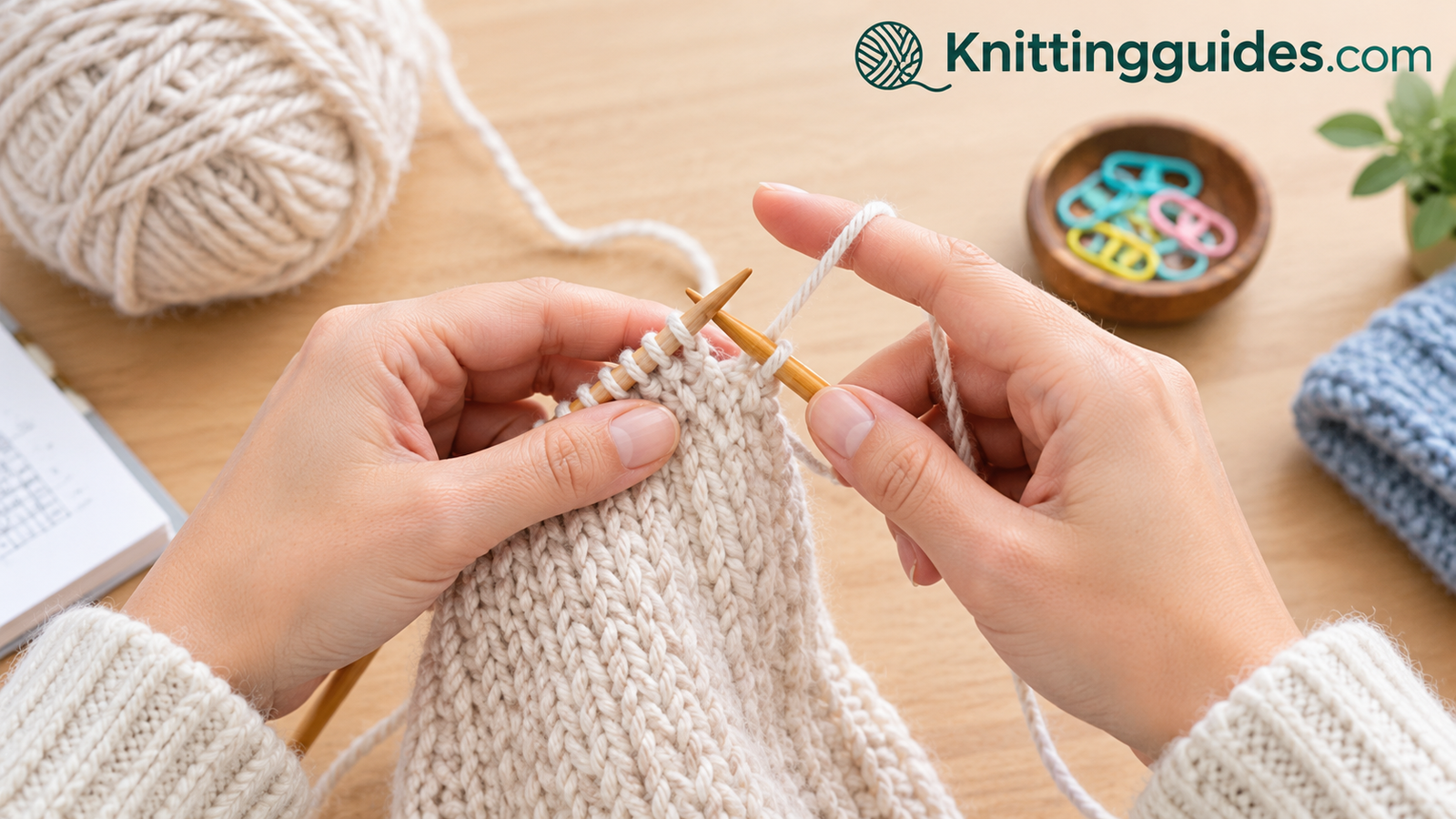
Every single stitch pulls on several neural systems simultaneously:
- Motor planning and execution. The primary motor cortex, premotor cortex, and cerebellum coordinate small, precise movements of both hands — usually in alternating roles. One hand tensions the yarn, the other manipulates the needle, and both must stay synchronised.
- Attention and working memory. Even a plain knit stitch requires you to hold a tiny instruction in mind (“insert, wrap, pull through, slide off”) and repeat it until the row is done. The moment you add a pattern, you are also tracking counts, repeats, and position.
- Visual-spatial processing. Your eyes track the working loop, judge the tension, and confirm the new stitch has formed correctly. Reading a pattern adds a further layer of symbol decoding.
- Sensory feedback. Touch, pressure, and proprioception from the fingers tell the brain whether the tension is right, whether the yarn split, and whether the needle tip is where it thinks it is.
That simultaneous engagement is the reason knitting is repeatedly described as “good for the brain” rather than merely relaxing. Many calming activities use one system at a time. Knitting uses several, and it does so in a repetitive, predictable rhythm — which is exactly the profile that appears to drive the stress-lowering effects discussed in the next section.
Rhythm, repetition and the brain’s reward system
Repetitive rhythmic movement has a long history in human life: walking, rocking a child, drumming, chanting, hand-weaving, spinning. There is a reasonable physiological basis for why these activities feel regulating. Rhythmic, predictable movement appears to support a shift toward the parasympathetic “rest and digest” state — slower heart rate, steadier breathing, reduced muscle tension.
Alongside that, knitting produces frequent, tiny completions. Each finished stitch is a micro-goal achieved. Each finished row is a slightly larger one. That steady drip of small accomplishments is a modest but real hit of progress signalling, which is one reason knitters describe the activity as satisfying in a way that purely passive relaxation — lying on a sofa, watching television — often is not.
Why the brain likes a task it can almost do
There is a useful principle in cognitive psychology: performance and engagement peak when a task is slightly beyond your current comfort zone but still achievable. Too easy and the mind wanders into rumination. Too hard and frustration spikes and you quit. Knitting is naturally self-tuning. As a beginner, plain garter stitch demands your full attention. As you improve, you can add texture, colour, shaping, or lace until you hit the level where you are absorbed but not overwhelmed.
Most research on knitting and the brain is observational — surveys of knitters, population studies of leisure activities, small physiological measures. That evidence is meaningful and consistent, but it is not the same as a randomised clinical trial. Treat strong claims about knitting “preventing” or “curing” anything with healthy scepticism.
None of this requires expensive equipment or a special talent. Two needles and a ball of affordable yarn are enough to produce the exact set of demands described above. If you want help choosing materials that feel good in the hand from day one, a curated list of beginner-friendly knitting needles is a sensible place to start, since comfortable tools keep you practising long enough for any benefit to accumulate.
Everything you need to make your first stitches
A simple set of needles and a smooth, forgiving yarn is all it takes to put this section into practice.
Knitting, Stress and the Relaxation Response
Ask a knitter what knitting does for them and “it calms me down” is by far the most common answer. That is not just sentiment. There is a plausible physiological mechanism, and it lines up neatly with what we know about how repetitive movement affects the nervous system.
The relaxation response
The term “relaxation response” describes the physiological opposite of the fight-or-flight stress response: reduced heart rate, lower blood pressure, slower breathing, relaxed muscles, and a subjective sense of calm. It is typically triggered by practices involving repetition and a quieting of competing thought — breathing exercises, meditation, prayer, and rhythmic movement.
Knitting fits that description surprisingly well. The hand movement is continuous and rhythmic. The task is absorbing enough to crowd out other thoughts. There is usually minimal noise, minimal decision-making, and a gentle sensory texture. Knitters frequently describe losing track of time and noticing, after half an hour, that their shoulders have dropped.
Why the rhythm matters more than the result
It is tempting to assume the benefit comes from producing something beautiful. It doesn’t. The calming effect appears to come from the process itself — the repetition, not the product. This is good news, because it means the benefit is available to anyone regardless of skill level. A beginner producing slightly wobbly garter stitch is doing the same rhythmic work as an expert producing lace.
This also explains why knitting so often outperforms other leisure activities for stress relief. Scrolling, streaming, and gaming absorb attention but tend to stimulate rather than settle the nervous system. Knitting absorbs attention and settles it.
Knitting as a rumination interrupter
Stress and anxiety are frequently maintained by rumination — the loop of repetitive, unresolved thought about what might go wrong. Rumination thrives in unstructured stillness. Knitting interrupts it by occupying exactly the right amount of attentional bandwidth: enough to displace the loop, not so much that it becomes a new source of strain.
Many people report that problems which felt unsolvable at their desk become manageable once they pick up their needles. That is a familiar pattern in psychology — moderate, engaging activity often loosens the grip of circular thinking.
Practical calibration for maximum calm
- Choose a simple stitch. Plain knit, garter stitch, or an easy rib. Save complex patterns for when you want stimulation, not sedation.
- Use larger needles and smooth yarn. Bigger stitches are slower and more meditative; fiddly, split-prone yarn breaks the rhythm.
- Reduce decision-making. Use one colour and one texture. Decision fatigue works against relaxation.
- Settle your environment. Quiet, warm, good light. Some people knit in silence precisely because it helps them drop into the rhythm.
- Match your breathing to your stitches. Inhale across one or two stitches, exhale across the next. This quietly converts knitting into a breathing exercise.
One practical note: chunky, quick-knitting projects are ideal for stress relief because they produce visible progress with minimal effort. If you want a first project engineered for exactly this, a straightforward beginner scarf pattern is hard to beat — it is repetitive by design and forgiving of mistakes.
Chunky needles make the rhythm effortless
Large-gauge tools create big, satisfying stitches — perfect for wind-down sessions.
Mood, Anxiety and Emotional Resilience
Stress reduction and mood improvement are related but not identical. Plenty of things relax you without lifting your mood — and plenty of mood-boosting activities leave you wired. Knitting appears to do both, which is one reason it has attracted attention from occupational therapists and wellbeing researchers.
What knitters report
The most frequently cited research in this area is a large survey of knitters published in an occupational therapy journal. It asked thousands of respondents about their mood before and after knitting. The overwhelming majority reported feeling happier afterwards, and among those who described symptoms of depression, a striking proportion said knitting made them feel better. Similar surveys in other countries have produced broadly consistent results.
Survey data is not proof. People who enjoy knitting are more likely to report benefits from it, and there is no control group. But the consistency across large samples is difficult to dismiss entirely, and it aligns with established principles in clinical psychology.
Behavioural activation: the mechanism underneath
One of the most effective psychological approaches for low mood is behavioural activation — the deliberate scheduling of activities that produce mastery (a sense of achievement), pleasure, or connection. Low mood tends to shrink a person’s world: fewer activities, less contact, fewer sources of reward, which deepens the low mood further.
Knitting is an unusually efficient behavioural activation tool because a single session delivers all three:
- Mastery. You finish rows. You finish objects. Visible evidence that you can complete things.
- Pleasure. Soft texture, pleasing colour, satisfying rhythm, a hobby you chose.
- Connection. Knitting groups, gift-giving, charity projects, online communities.
Anxiety and the “something to do with your hands” effect
Anyone who has sat in a waiting room understands that idle hands amplify anxious thoughts. Fidgeting, nail-biting, and restlessness are the body’s attempt to discharge nervous energy. Knitting channels that energy into something purposeful and self-soothing.
This is why many people find knitting particularly helpful in situations where they cannot control the outcome but must remain present: hospital waiting rooms, long journeys, difficult conversations, evenings when thoughts race. It gives the hands a job, and the mind follows.
A realistic boundary
Knitting is a supportive habit, not a substitute for professional mental health treatment. If you are experiencing persistent low mood, panic, or anxiety that interferes with daily life, please speak to a doctor or qualified mental health professional. Think of knitting as something that sits alongside good care — not instead of it.
The good news is that knitting plays well with other supportive habits. It is portable, quiet, inexpensive once you own needles, and it can be done alongside conversation, listening to audiobooks, or sitting outside. Resilience is built from many small, repeatable sources of regulation, and knitting slots into daily life more easily than most.
Soft, cheerful yarn keeps you coming back
Pleasant texture and colour are not luxuries — they are what make the habit stick.
Focus, Attention and Working Memory
If knitting is good for the brain, this is where the case is strongest on a moment-to-moment level. Holding a pattern in mind while your hands execute it is genuine cognitive work — and it is work that scales.
Sustained attention without strain
Modern life is full of attentional fragmentation: notifications, tabs, half-finished tasks. Sustained attention is the ability to stay with one thing for an extended period, and like any capacity, it responds to use. Knitting offers a structured, low-stakes way to practise staying present.
The key word is low-stakes. Concentration on a work deadline carries anxiety. Concentration on a row of stitches carries none. That makes knitting unusually good training ground for people whose attention feels scattered — you are building the muscle without the pressure.
Working memory: the count in your head
Working memory is the mental workspace that holds information temporarily while you use it. Knnitting exercises it constantly:
- Counting stitches in a row or repeats in a pattern
- Remembering where you are in a sequence (increase, decrease, yarn over)
- Tracking which row of a multi-row repeat you are on
- Monitoring tension while continuing to count
This is a mild but genuine working-memory load, performed for long stretches. Compare it with the typical evening activity — passive screen consumption — and the difference in cognitive engagement is considerable.
Pattern reading as cognitive cross-training
A written knitting pattern is essentially a compact code: abbreviations, symbols, brackets, repeats, and a small amount of arithmetic. Learning to read one fluently is a genuine literacy skill. It demands translation, sequencing, and error-checking.
This is one of the more underappreciated cognitive benefits of the craft, and it grows with you. If you want to move from simple scarves into real pattern work, a clear guide to how to read a knitting pattern will accelerate that jump considerably.
Why mistakes are part of the benefit
Knitting includes error detection as a built-in feature. You drop a stitch, you notice a hole, you find your count is wrong. Spotting and correcting these is a genuine executive-function exercise: identify the problem, locate it, plan a fix, execute it, verify.
It also builds a useful emotional skill — tolerating small failures without abandoning the project. Learning how to fix mistakes in knitting rather than ripping everything out turns a frustration into a competency, which is precisely the kind of micro-resilience that generalises.
Progression keeps the benefit alive
The brain habituates. A task that challenged you in month one becomes automatic by month six, and the cognitive load drops. To keep the attention benefits, you need to keep raising the difficulty slightly: new stitch patterns, colourwork, shaping, lace, circular knitting, or working from charts.
Learning how to knit in the round is a perfect example — it changes the geometry of the work and re-engages the spatial and planning systems that flat knitting may have stopped challenging.
Tools that make complex patterns easier to follow
Stitch markers, row counters, and good needles keep your attention on the pattern instead of the equipment.
Aging, Memory and Cognitive Reserve
This is the question that brings many readers here: does knitting protect the brain as we get older? The honest answer is that no single hobby has been proven to prevent dementia — but the surrounding evidence for hands-on, mentally engaging leisure activity is genuinely encouraging.
What population research shows
Several large studies on aging and leisure activity have found that people who regularly engage in crafts, games, reading, and similar mentally demanding pastimes tend to show better cognitive outcomes in later life than those who do not. Research from a major medical centre found that engaging in crafts such as knitting and quilting in middle and later life was associated with reduced odds of mild cognitive impairment compared with not doing those activities.
Other longitudinal studies of older adults have reported similar patterns: engagement in cognitively stimulating leisure activities tracks alongside better memory performance over time.
Cognitive reserve: the idea behind the headlines
The concept most relevant here is cognitive reserve. The theory is that a lifetime of mentally stimulating activity builds a buffer — denser neural connections, more efficient networks, better compensation when damage occurs. Two brains can show similar physical changes with very different functional outcomes; the one with greater reserve keeps functioning better for longer.
Knitting contributes to that reserve in a specific way: it is multi-domain. It combines motor skill, attention, memory, visuospatial processing, and often social engagement. Research on cognitive reserve tends to favour activities that are complex and sustained rather than narrow and occasional, which is exactly what a years-long knitting practice looks like.
| Activity Type | Cognitive Domains Engaged | Social Component | Sustainability | Typical Cost |
|---|---|---|---|---|
| Knitting & handcrafts | Motor, attention, memory, visuospatial, sequencing | Strong — groups, gifts, charity, online | High — projects give built-in continuity | Low after initial tools |
| Word & number puzzles | Language, working memory, logic | Usually low | Medium — habituation is common | Low or free |
| Learning a language | Memory, executive function, listening | Variable | High if practised consistently | Low to moderate |
| Musical instrument | Motor, auditory, memory, coordination | Variable | High but demanding | Moderate to high |
| Passive screen viewing | Minimal active engagement | Low | Very high | Variable |
Comparison based on general characteristics of each activity, not on clinical head-to-head trials.
Where the evidence thins out
It is important to state the limits clearly. Most studies find associations, not proven cause and effect. People who knit regularly may also be more socially active, more mobile, more affluent, or more health-conscious overall — and those factors independently affect cognitive ageing. Randomised controlled trials specifically testing knitting against cognitive decline are rare.
So the responsible framing is this: knitting is one of many activities that plausibly contributes to cognitive reserve, it is well supported by observational evidence, it is low risk, it is inexpensive, and it is enjoyable enough that people actually keep doing it. That last factor is not trivial. The best brain-protective habit is the one you will still be doing in a decade.
Practical implications
Start now rather than later. Keep the difficulty gradually increasing. Do it most days, even briefly. Combine it with physical activity and social contact where possible. And treat it as one strand of a broader healthy-lifestyle pattern rather than a magic bullet.
Good light protects your eyes and your posture
Older eyes need more light to knit comfortably — a dedicated craft light makes evening sessions possible.
Mindfulness, Flow and Present-Moment Awareness
Meditation is widely recommended and widely abandoned. The common complaint is that sitting still with nothing to do makes anxious thoughts louder, not quieter. Knitting offers an alternative route to many of the same mental states — with something for the hands to do.
Flow: the state where time disappears
Psychologists describe flow as a state of complete absorption in an activity: self-consciousness fades, time perception distorts, and the task provides immediate feedback. It is one of the most reliably positive human experiences and is strongly associated with wellbeing.
Knitting is a near-ideal flow trigger. It has clear goals (finish the row, finish the repeat), immediate feedback (you can see the stitch), a challenge level you control, and few external interruptions. Knitters routinely report looking up to find an hour has passed.
Present-moment anchoring
Mindfulness is essentially the practice of returning attention to the present moment. Knitting does this structurally. Your hands are engaged, your eyes are on the work, and your mind has a natural anchor. When attention drifts to worry, the next stitch gently brings it back — without any self-criticism about having drifted.
That repeated, non-judgemental return is exactly what meditation training aims to build. Knitting simply gives it a physical scaffold.
A simple knit-and-breathe practice
- Before you begin: take three slow breaths and consciously relax your shoulders and jaw.
- During: pick a simple stitch and let your breathing settle into the rhythm of the needles.
- When thoughts intrude: notice them, label them briefly (“planning”, “worrying”), and return to the stitch. No scoring, no restarting.
- Close: stop at the end of a row, take one breath, and notice how your body feels compared with ten minutes ago.
Knitting versus formal meditation
| Factor | Knitting | Formal Meditation |
|---|---|---|
| Accessibility for restless minds | High — hands are occupied | Can be difficult for beginners |
| Visible output | Yes — a tangible object | No |
| Depth of contemplative training | Supportive but indirect | Direct and well-studied |
| Portability | Excellent | Excellent |
| Learning curve | Short for basic stitches | Short to begin, long to deepen |
| Best combined use | Knit with breath awareness | Use alongside an active practice |
These are not competing options — many people benefit from doing both.
The most effective approach is usually combining them: a few minutes of quiet breathing, followed by a period of focused knitting. The breathing settles the nervous system; the knitting keeps it settled and prevents the mind from re-accelerating.
A quiet corner, soft light, one project
A simple project bag keeps everything in one place so your ritual is easy to repeat.
Neuroplasticity, Fine Motor Skills and Coordination
The brain changes in response to what it repeatedly does. That principle — neuroplasticity — is the foundation of rehabilitation, skill acquisition, and much of what we understand about healthy ageing. Knitting is a surprisingly rich stimulus for it.
Fine motor precision under feedback
Knitting demands small, precise movements of the fingers and wrists, executed thousands of times per session, with continuous sensory feedback. That combination is exactly what drives motor learning. The hands are disproportionately represented in the motor and sensory cortex, which means hand-dominant activities generate a large cortical footprint.
Bilateral coordination
Most daily tasks use one hand dominantly. Knitting requires both hands to perform different, complementary actions at the same time, coordinated to a shared rhythm. This bilateral demand engages interhemispheric communication and is one reason occupational therapists use craft-like tasks in rehabilitation after stroke or neurological injury.
Dexterity across the lifespan
Hand dexterity declines with age and disuse. Conditions like arthritis make fine movements uncomfortable, and reduced dexterity then leads to reduced hand use, which accelerates the decline. Regular knitting keeps the fingers moving through a wide range of motion under low load.
If you have arthritis, a hand injury, or a neurological condition, check with a healthcare professional or occupational therapist before starting, and stop if a movement causes sharp pain. Larger needles, lighter yarn, and shorter sessions usually help. Discomfort is a signal to adjust, not to push through.
Tool choice directly affects comfort
Because knitting is so repetitive, the ergonomics of your equipment matter enormously. Heavy, grippy, or poorly balanced needles increase hand fatigue and can turn a beneficial habit into an uncomfortable one. Options worth considering include:
- Comfortable-grip needles that sit lightly in the hand
- Lightweight materials that reduce strain over long sessions
- Smooth joins so the yarn flows without snagging
- The right length for your project — a short circular can be far easier on the wrists than a long straight pair
Choosing between circular and straight knitting needles is more consequential than beginners expect, since the weight distribution differs significantly. Similarly, an interchangeable needle set lets you match needle size and cable length to the project and your hands, which is a genuine comfort advantage over time. For those weighing specific premium systems, a direct comparison of Addi Click versus ChiaoGoo interchangeable needles covers the practical differences in the hand.
Protecting the hands and wrists
- Take a short break every 20–30 minutes to stretch the fingers and roll the shoulders.
- Keep wrists neutral rather than sharply bent; raise the work rather than dropping the head.
- Stop at the first sign of tingling, numbness, or persistent aching.
- Vary projects so you use different grips and needle sizes.
- Do not knit through fatigue — tired hands knit with poor form.
Lightweight needles that reduce wrist strain
Comfortable tools are the difference between a habit you keep and one you abandon.
Sleep, Routine and the Digital Wind-Down
Sleep problems are frequently downstream of an unsettled mind and a late-evening screen habit. Knitting does not directly cause sleep, but it is a remarkably good replacement for the behaviours that interfere with it.
The pre-sleep window matters most
The hour before bed sets the tone for sleep quality. Screens — with their bright light, unpredictable content, and emotional activation — are widely recognised as poor wind-down companions. Knitting occupies the same time slot with none of the drawbacks: no blue light, no notifications, no argument in the comments section, no cliffhanger.
Down-regulating rather than distracting
There is a meaningful difference between distraction and down-regulation. Television distracts; the nervous system often stays elevated. Rhythmic, repetitive, low-stimulation activity actively down-regulates. If you currently struggle to fall asleep because your mind races the moment your head hits the pillow, a 30-minute knitting session earlier in the evening is a plausible and low-risk thing to try.
Routine and cue consistency
Sleep responds well to consistent cues — same time, same sequence, same signals that the day is ending. Knitting is an excellent cue because it is unusual, sensory, and clearly not work. Over time the ritual itself becomes associated with winding down.
- Knit in a warm, dim room for the last stretch before bed.
- Use simple, repetitive stitches — nothing that requires counting.
- Keep sessions moderate in length; over-stimulation from a hard project can backfire.
- Stop at a natural stopping point, ideally at the end of a row.
- Pair it with a caffeine-free drink and low light to strengthen the cue.
Light matters more than people think
Poor lighting forces you to lean in and squint, which creates neck tension and eye strain — both of which work against relaxation. A dedicated task light positioned above and slightly in front of the work makes evening knitting comfortable without flooding the room. A dedicated round-up of the best knitting lights is helpful if you plan to knit at night regularly.
If a particular project makes you anxious or frustrated — a complicated pattern, a looming deadline — do not use it as your bedtime ritual. Save the demanding work for daytime and keep a simple “comfort project” for evenings.
Knitting also travels well, which matters if your sleep routine is disrupted by travel. Plenty of people knit on planes and in hotels to maintain their wind-down habit away from home; if you are planning to bring supplies on a trip, check the rules on taking knitting needles on a plane before you pack.
Comfortable evening knitting starts with good light
Reduce eye strain and keep your wind-down ritual easy on the body.
Pain, Chronic Illness and the Power of Distraction
One of the least discussed but most practically valuable aspects of knitting is its effect on how the brain perceives discomfort and manages long-term illness.
Attention and pain perception
Pain is not a simple readout of tissue damage; it is a constructed experience shaped heavily by attention. The well-established gate control idea in pain science explains why a child’s scraped knee stops hurting the moment something interesting happens, and why distraction reduces pain intensity for many people.
Knitting is an unusually effective distraction because it is continuous, absorbing, and manually engaging. Unlike a film, it keeps you actively occupied; unlike work, it carries no pressure. Research on activity-based distraction in chronic pain settings has generally supported the idea that engaging, pleasurable activity lowers perceived pain and reduces pain-related distress.
Pacing and energy management
People living with chronic fatigue, long-term illness, or recovery from surgery often struggle with the line between doing too much and doing nothing at all. Knitting sits neatly in the middle: it is an activity that can be done seated, in short bursts, and paused instantly without consequence. It provides a sense of purpose and productivity during periods when other activities are not possible.
Reported benefits in specific groups
- Recovery and hospital settings. Occupying the hands and mind during waiting, treatment, or convalescence.
- Chronic pain. Reducing time spent focusing on pain signals.
- Eating disorder recovery. Therapeutic knitting has been explored as a way to manage anxiety around meals and reduce anxious eating behaviour.
- Postnatal periods. Rhythmic handwork during feeding or night waking provides calm and structure.
- Bereavement and grief. Gentle routine, purposeful output, and a container for difficult time.
The flip side: protecting your body
Because knitting is repetitive, it can aggravate existing musculoskeletal issues if overdone. Repetitive strain, neck stiffness, and eye fatigue are the most common complaints. The answer is not to stop knitting but to knit well: good posture, proper lighting, comfortable tools, and regular breaks.
Why it helps
- Continuous attentional engagement shifts focus away from pain and worry.
- Rhythmic movement supports a calmer physiological state.
- Small, regular achievements restore a sense of control.
- Seated, pausable, and portable — adapts to fluctuating energy.
- Produces something tangible, which counters feelings of uselessness.
Where to be careful
- Overuse can strain wrists, hands, neck, and shoulders.
- Poor lighting causes eye strain and headaches.
- Frustrating projects can increase rather than reduce stress.
- It should never delay or replace necessary medical treatment.
- Some hand conditions make gripping needles genuinely painful.
If hand fatigue is the limiting factor, working with lighter-weight tools helps significantly. Some knitters also find that machine knitting on certain projects lets them keep the design and rhythm while reducing repetitive hand strain; if that interests you, a guide to the best knitting machines explains what the different types are realistically like to use.
Smooth, comfortable yarn for long relaxed sessions
Softer fibres and comfortable tools make it easier to knit without aggravating sore hands.
How Knitting Compares With Other Brain-Boosting Habits
Knitting is not the only activity that supports cognitive health, and pretending otherwise would be misleading. The question worth asking is not “which one is best” but “which combination suits your life.” Here is how knitting stacks up against the most common alternatives.
| Activity | Cognitive Load | Stress Relief | Physical Component | Social Potential | Visible Output |
|---|---|---|---|---|---|
| Knitting | Moderate to high, scales with skill | High — rhythmic and absorbing | Fine motor, seated | High | Yes |
| Crochet | Moderate to high | High | Fine motor, seated | High | Yes |
| Meditation | Low externally, high internally | Very high | Minimal | Low to moderate | No |
| Crossword & logic puzzles | High in specific domains | Moderate | Minimal | Low | No |
| Walking | Low to moderate | High | Cardiovascular, full body | Moderate | No |
| Adult colouring | Low | Moderate to high | Fine motor, seated | Low | Yes |
| Learning an instrument | Very high | Moderate | Fine motor, coordination | Moderate to high | Performance |
General characteristics compared, not clinical trial results.
Knitting versus crochet
These two are constantly compared and both deliver similar cognitive and calming benefits. Knitting uses two needles and tends to produce a lighter, more draped fabric; crochet uses one hook, works faster, and is often considered easier to fix when mistakes happen. Neither is objectively better for the brain. A detailed comparison of crochet versus knitting covers the learning curve in detail if you are choosing between them.
Knitting versus puzzles
Puzzles and brain-training apps target narrow cognitive skills and are usually done alone and in short bursts. They are fine, but they tend to produce habituation — the same puzzle type stops challenging you. Knitting has a built-in progression mechanism: there is always a harder technique to learn, and there is a finished object to show for it.
Knitting versus physical exercise
Exercise has a far stronger evidence base for brain health than any craft, and knitting is not a substitute for it. However, knitting can be done on days when exercise is not possible, and the two are complementary. Many people find knitting after exercise extends the calm that movement produces.
The honest pros and cons of knitting for brain health
Pros
- Engages multiple cognitive systems simultaneously.
- Reliable, low-risk stress reduction through rhythmic repetition.
- Scales from beginner to expert without losing challenge.
- Portable, quiet, and cheap once you own basic tools.
- Produces tangible results, reinforcing mastery and motivation.
- Strong social potential through groups and gift-making.
- Useful across the lifespan and adaptable to physical limitations.
Cons
- Repetitive strain risk if posture or duration is wrong.
- Evidence is largely observational rather than clinical.
- Frustrating projects can raise stress instead of lowering it.
- Cognitive benefits diminish if the task becomes fully automatic.
- Requires light, comfort, and a reasonable sitting position.
- Not a substitute for exercise, social life, or medical care.
The bottom line from the comparison: knitting is not the single most powerful brain habit available, but it is among the most sustainable, most enjoyable, and most multi-dimensional. Those qualities matter enormously in practice.
Try the craft that suits your hands and your life
Starter tools make it easy to experiment before committing to a full set.
Building a Brain-Friendly Knitting Practice
Knowing the benefits is one thing; actually extracting them is another. The research suggests three conditions for the cognitive and emotional benefits to appear: regularity, moderate challenge, and genuine enjoyment. Here is a practical way to get all three.
Week one: build the ritual, not the skill
Do not try to learn everything. Learn to cast on, knit, and bind off, and accept wobbly fabric. The point of week one is to establish a daily 15-minute slot at a consistent time. If you want the smoothest possible introduction, follow a structured beginner guide such as how to start knitting and work through how to cast on before anything else.
Week two: complete one small object
Finishing something is a powerful psychological event. A simple scarf is ideal — long enough to build the habit, simple enough to avoid frustration. A dedicated walkthrough on starting a scarf keeps you on a forgiving path. Learn how to cast off as soon as you need it, since finishing is what turns practice into reward.
Week three: introduce mild challenge
Add a texture stitch, a stripe, or simple shaping. This is where the cognitive engagement increases and the flow state becomes easier to reach. Keep one project easy and relaxing and one project slightly demanding — the contrast is useful.
Week four: make it social or purposeful
Join a group, knit for charity, or make something for a specific person. Purpose sustains motivation far longer than novelty.
Choosing the right beginner equipment
Equipment matters more than beginners expect. Uncomfortable tools create tension; tension creates pain; pain ends the habit. Prioritise the following:
- Needles suited to your hands. A curated list of the best knitting needles for beginners narrows the field considerably.
- The right needle size for your yarn. Getting this wrong is the most common beginner frustration — see what size knitting needles to use as a beginner.
- Forgiving yarn. Smooth, mid-weight, light-coloured yarn shows stitches clearly and is pleasant to handle. A guide to the best yarn for beginner knitting explains which fibres behave well.
- A kit if you want simplicity. Bundles remove the guesswork — see the best knitting kits for beginners.
Common myths, corrected
- “You have to be patient or artistic.” Knitting builds patience; it does not require it. Most people learn the basics far faster than they expect.
- “It’s only for older people.” Knitting is practised across every age group and is increasingly popular with younger makers.
- “It prevents dementia.” No activity has been proven to prevent dementia. Regular mentally engaging activity is associated with better cognitive outcomes — that is a different and more honest claim.
- “Expensive yarn is necessary.” Affordable yarn knits perfectly well. Comfort and ease of handling matter far more than price.
- “You need to knit daily for hours.” Short, regular sessions appear to be the pattern that supports wellbeing.
The single biggest predictor of whether knitting helps your brain is whether you keep doing it. Choose comfortable tools, easy projects at first, good light, and a fixed time of day. Everything else follows.
Once the basics are comfortable, the craft opens up quickly: working in the round, reading charts, colourwork, and eventually making garments. Those next steps double as genuine cognitive training, and there is real satisfaction in watching your own capability expand.
Start with a complete beginner kit
Needles, yarn, and instructions in one box — everything you need for the first four weeks.
Frequently Asked Questions
Is knitting really good for your brain, or is that just a popular myth?
It is supported by real, if limited, evidence. Knitting engages motor control, attention, memory, and visuospatial processing simultaneously, and the repetitive rhythm is associated with reduced stress and improved mood. Large surveys of knitters report consistent wellbeing benefits, and population studies link regular engagement in hands-on leisure activities with better cognitive outcomes in later life. What is not proven is that knitting prevents or cures any specific condition — so the accurate claim is that it supports brain health, not that it protects it absolutely.
How long do I need to knit each day to get any benefit?
There is no established threshold. Short, regular sessions appear to be more effective than occasional marathons. Many people report noticing a calming effect within 15 to 20 minutes, and most wellbeing research describes knitting as a regular practice rather than an occasional one. Aim for a consistent daily slot you can realistically maintain, even if it is brief.
Can knitting reduce anxiety and stress?
For many people, yes. The rhythmic, repetitive hand movement is thought to support the relaxation response — slower heart rate, steadier breathing, reduced muscle tension — while the task itself occupies attention and interrupts anxious rumination. Simple stitches work best for this purpose. If anxiety is persistent or overwhelming, knitting can sit alongside professional support, not replace it.
Does knitting help prevent dementia or Alzheimer’s disease?
No activity has been proven to prevent dementia. However, research on cognitive reserve suggests that a lifetime of mentally stimulating, multi-domain activity is associated with better cognitive function in later life, and craft activities such as knitting have been included in that category. Think of knitting as one contributing strand of a brain-healthy lifestyle alongside physical exercise, social connection, good sleep, and appropriate medical care.
Is knitting better than meditation for relaxation?
Different rather than better. Meditation trains attention directly and has a strong evidence base; knitting occupies restless hands and is easier for people who find sitting still difficult. Many people benefit from combining them: a few minutes of breathing followed by focused knitting. If you struggle with traditional meditation, knitting is often a more accessible entry point.
Can knitting improve memory and concentration?
Knitting requires sustained attention, counting, sequencing, and holding instructions in working memory while your hands execute them. That is genuine, repeated cognitive exercise. The benefits are strongest while the task remains moderately challenging, so progressively introducing new techniques — patterns, colourwork, knitting in the round — helps keep the cognitive load meaningful.
Is knitting helpful for people with ADHD or a busy mind?
Many people with attention difficulties find that knitting gives restless hands a job, which frees the mind to listen, sit still, or settle before sleep. It is a common informal strategy during meetings, lectures, and long journeys. It is not a treatment, and experiences vary, but the combination of tactile feedback and rhythmic repetition is widely reported as helpful.
Can knitting help with depression?
Knitting may support mood through behavioural activation — a sense of achievement, pleasurable sensory input, and social contact — and surveys of knitters frequently report feeling happier after knitting. However, it is not a treatment for clinical depression. If low mood is persistent, please seek professional help, and treat knitting as a supportive daily habit alongside appropriate care.
Is knitting good for older adults and seniors?
It is particularly well suited to older adults. It maintains fine motor dexterity, keeps attention and memory engaged, provides social connection through groups and gift-making, and is achievable seated and at any pace. Choose comfortable, lightweight needles, ensure good lighting, and take regular breaks to protect the hands and neck.
Are there any downsides to knitting?
The main risks are physical rather than mental: repetitive strain in the wrists and hands, neck and shoulder tension from poor posture, and eye strain in low light. These are largely preventable with comfortable tools, correct needle size, proper lighting, and short breaks. Frustrating projects can also increase stress, so keep a simple comfort project on hand.
Is crochet as good for the brain as knitting?
Very similar. Both use rhythmic repetitive movement, require counting and sequencing, produce a tangible result, and are strongly social. Crochet uses one hook and is often easier to correct when mistakes occur; knitting uses two needles and tends to produce a different fabric. Choose whichever feels more comfortable in your hands, since comfort determines consistency.
What is the best knitting project for stress relief?
Something simple, repetitive, and free of deadlines. Plain garter stitch, a straightforward scarf, or a simple blanket square in a comfortable yarn and slightly larger needles. Avoid complex patterns, colourwork, or counting-heavy designs when the goal is calm. Save those for when you want stimulating challenge instead.
Pick a project and let the rhythm do the rest
Beginner-friendly kits take the guesswork out of your first few weeks.
So, Is Knitting Good for the Brain?
Yes — and in more ways than most people expect. Knitting combines rhythmic movement, sustained attention, working memory, fine motor control, tactile feedback, and often social connection into a single low-cost activity that can be done almost anywhere. It reliably reduces stress for many people, supports mood through small regular achievements, keeps the hands and mind dexterous, and contributes to the kind of mentally engaging, multi-domain lifestyle associated with healthier cognitive ageing.
The evidence is strongest for stress reduction, mood improvement, attention, and dexterity, and most encouraging — though not conclusive — for cognitive reserve in later life. The limits are real: much of the research is observational, and knitting is not a substitute for exercise, social connection, sleep, or medical treatment.
But consider what it costs to try. Two needles, a ball of yarn, and fifteen quiet minutes. If there is a more efficient trade in everyday wellbeing, it is hard to think of one.
Start simple. Cast on a scarf, finish it even if it is imperfect, and notice how you feel afterwards. If the answer is “calmer,” you already have your answer to the question that brought you here.
Your first project is one click away
Everything you need to begin — needles, yarn, and clear instructions — in one beginner-friendly bundle.
A note on health information: This article is for general educational purposes and does not constitute medical advice. Research into crafts and cognitive health is ongoing, and findings described here reflect the current state of published evidence rather than guaranteed outcomes. If you have a health condition affecting your hands, vision, or mental wellbeing, consult an appropriate healthcare professional before starting a new activity.
Social Connection, Loneliness and the Knitting Group Effect
The brain is a social organ. Loneliness is associated with worse cognitive outcomes, poorer sleep, and lower mood — while regular, meaningful social contact is one of the most robust predictors of wellbeing in later life. Knitting has a distinctive advantage here.
Side-by-side conversation
Knitting groups solve a problem that face-to-face conversation often creates: what to do with yourself while talking. Because the hands are busy and the eyes are down, conversation flows more easily and feels less intense. This is sometimes called “side-by-side” socialising, and it is markedly easier for shy, anxious, or neurodivergent people than direct eye contact across a table.
Shared purpose beats forced socialising
A knitting group is not “socialising for the sake of it.” Everyone is there to make something. That shared purpose removes the pressure to perform and gives people something concrete to talk about. Charity knitting amplifies this further — blankets for hospitals, hats for premature babies, garments for shelters — adding meaning and contribution to the social element.
Loneliness across the lifespan
Loneliness is not limited to older adults. Young parents, remote workers, people who have moved cities, and those recovering from illness often experience it sharply. Knitting groups are widely available in libraries, community centres, places of worship, yarn shops, and online — and they tend to be genuinely welcoming to beginners.
Intergenerational transmission
Knitting is one of the few crafts still commonly passed between generations: a grandmother teaching a grandchild, a neighbour showing a teenager. Teaching a skill forces the teacher to organise and articulate knowledge — a genuinely demanding cognitive exercise — while creating strong relational bonds.
For those who want to spread the craft further, a spinning wheel is a natural next step in the fibre journey; a beginner’s guide to spinning wheels is useful if you plan to make your own yarn.
Building the social element in
Group knitting is easier with an all-in-one kit
Easy-to-share tools and yarn are perfect for beginners joining their first circle.