
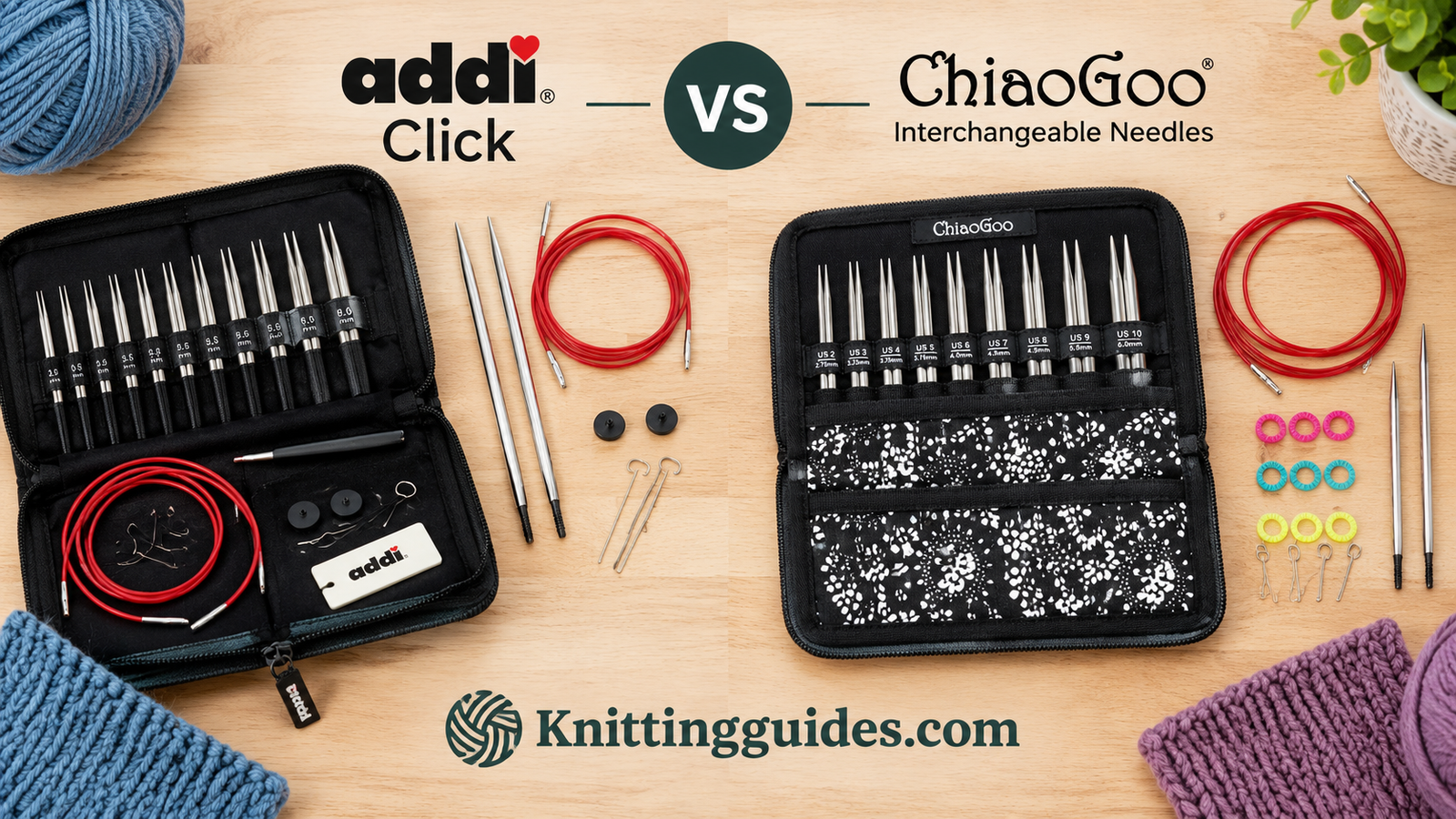
Addi Click vs ChiaoGoo Interchangeable Needles: Which System Deserves Your Hands?
Two of the most loved interchangeable systems in knitting could not be more different where it counts — the join, the tip, and the cable. Here is an honest, project-by-project breakdown.
Why This Comparison Keeps Coming Up in Almost Every Knitting Group
If you have spent more than a week in any knitting community, you have watched the same conversation unfold. Someone asks which interchangeable needle set to buy, and the room immediately splits into two camps: the Addi Click loyalists and the ChiaoGoo devotees. Both groups are passionate. Both are, in their own way, right. The reason the argument never resolves is that these two systems solve the same problem with genuinely different engineering, and the better choice depends entirely on how and what you knit.
Interchangeable needles are the closest thing knitting has to a power tool. Instead of owning a drawer full of fixed circulars in every length and size, you own a set of tips and a set of cables, and you build the needle you need on demand. A 4.5 mm circular for a sweater body becomes a 4.5 mm double-pointed alternative for a sleeve becomes a short circular for a hat brim — all from the same kit. Once you have used a good system, going back to fixed needles feels like going back to a cassette player.
The catch is that interchangeable needles live or die by their weakest link, and the join is that link. Every complaint anyone has ever had about interchangeable needles — the yarn catching, the tip unscrewing mid-row, the cable flopping, the connection loosening at the worst possible moment — traces back to how the tip locks to the cable. That is precisely the place where Addi and ChiaoGoo diverge most dramatically, and it is where this comparison starts.
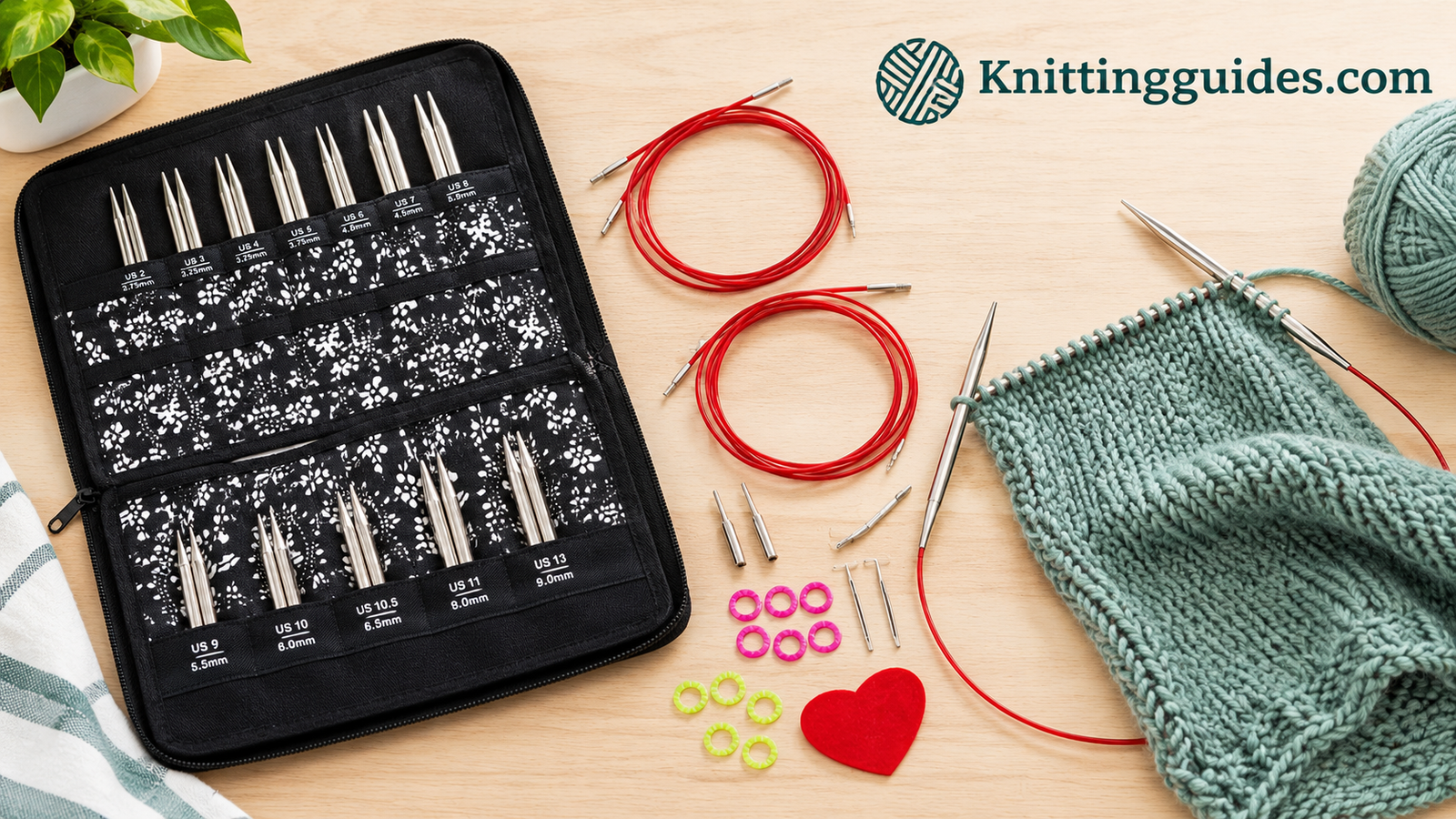
What follows is a deep, unhurried comparison — not a scoreboard with fake star ratings, but a practical walkthrough of how these needles behave in a real project bag. We will look at the join mechanisms in detail, compare tip materials and sharpness, talk honestly about cables (the part most buyers underestimate), examine how each system handles lace, cables, big sweaters and small-circumference work, and finish with a clear recommendation for different kinds of knitters. If you are still building your first setup, our guide to the best interchangeable knitting needle sets is a good companion read before you commit to a brand.
Quick Comparison: Our Top Picks
Here is the short version before the long one. Each of these four kits represents a different answer to the interchangeable question, and each earns its place for a specific reason. Specifications are described in practical terms rather than hard numbers, because availability and set contents vary by region and retailer.
Swipe to see more →
| # | Product | Product Name & Best For | Key Specs | Verdict | Where to Buy |
|---|---|---|---|---|---|
| 1 |

|
Top Pick ChiaoGoo Twist Red Lace Interchangeable Set Best Overall | Stainless steel lace-point tips Threaded screw-in join Memory-free red steel-core cable Wide range of sizes and cord lengths | The cable is the quiet hero here — it behaves itself on big projects and does not fight you mid-round. | Check Price on Amazon |
| 2 |

|
Addi Click Turbo Interchangeable Set Best for Speed & Convenience | Nickel-plated brass tips Tool-free click-lock join Smooth, rounded tip profile Soft, pliable cable | Switch sizes in seconds without hunting for a key. The system for knitters who hate fiddling. | Check Price on Amazon |
| 3 |

|
Addi Click Lace Long Tip Set Best for Lace & Precision | Nickel-plated brass with sharper taper Tool-free click-lock join Longer tip for better grip Flexible cable | If your knitting life is yarn-overs and decreases, the longer point earns its keep immediately. | Check Price on Amazon |
| 4 |

|
ChiaoGoo Spin Bamboo Interchangeable Set Best for Warm Grip & Bamboo Fans | Bamboo tips Threaded screw-in join Rotating clear nylon cable Lightweight, gentle surface grip | The answer for slippery yarns and knitters who want the needle to hold the stitches a little. | Check Price on Amazon |
Both brands make several interchangeable lines, and the sets shown here represent the most widely available versions of each system. Set contents, case styles, and included accessory packs change over time, so treat the table as a decision framework rather than a fixed inventory list.
The Two Systems at a Glance: Brand Philosophy and Build
Before we get into mechanics, it helps to understand what each company is trying to do, because design intent shows up everywhere in the finished product. These are not two versions of the same needle with different logos. They are two different theories of what a knitting needle should be.
Addi: the German engineering school
Addi comes out of a long-standing German needle-making tradition, and the personality of the product matches the stereotype in the best possible way. The engineering is confident and slightly over-built. The click-lock join is a patented mechanism, not a simplification — it is a real piece of precision hardware designed so that a knitter can connect a tip to a cable with one hand, without tools, and trust that it will stay connected through a whole project. There is no threading to cross-thread, no tiny key to lose, and no slow loosening over a hundred rounds.
That design choice tells you what Addi values: speed of setup, reliability of connection, and a knitting experience that asks nothing of you once you start. The tips are brass-based with a hard plating, which gives them a particular weight and warmth in the hand, and the cables are deliberately soft and pliable. Addi also leans toward a polished, low-friction surface, which is why so many knitters describe the needles as “fast” — stitches want to slide.
ChiaoGoo: the systems-thinking approach
ChiaoGoo’s philosophy is almost the opposite in execution but similar in ambition. Rather than one clever mechanism, ChiaoGoo builds a modular ecosystem. Threaded joins are standardised across tip lines and cables. Cord families are offered in different behaviours — the steel-core red cable most people know, plus alternative cords for knitters who want something softer or a rotating action. Tips come in different lengths so that the same system can handle a full sweater or a sock cuff. Everything is designed to interlock with everything else.
The stainless steel tips are machined and finished for a lace-grade point, laser-marked with sizing, and the red cable is the standout engineering achievement: a thin steel core wrapped in a smooth coating so the cord holds its shape without coiling memory. Where Addi says “trust the mechanism,” ChiaoGoo says “trust the system.”
The short version: Addi optimises for the moment you connect the needle. ChiaoGoo optimises for the hours you spend knitting on it. Which of those matters more to you is the real question this article is trying to answer.
What both get right
It is worth stating clearly, because comparison articles rarely do: these are both premium products, and neither is a bad purchase. Both brands produce tips that stay straight, joins that hold, and cables that survive being stuffed into project bags repeatedly. If you bought either system and never thought about it again, you would have a perfectly good knitting life. The differences below are about fit, not about one brand being defective.
- Consistency: both brands are known for tight tolerances across sizes, so a 4 mm tip matches its cable connection regardless of when it was made.
- Serviceability: both sell tips, cables and accessories separately, so a set can be extended rather than replaced.
- Longevity: both systems are the kind of purchase that outlasts a dozen projects and still feels new.
- Resale: interchangeable sets from either brand hold value well, because knitters who upgrade rarely downgrade away from a working system.
Click-Lock vs Screw-In: The Join Is the Whole Argument
If you take one thing from this entire comparison, make it this section. The join is where Addi and ChiaoGoo genuinely differ, and it is the difference you will notice every single time you sit down to knit.
How the Addi click-lock works
The Addi Click connection is a push-and-twist mechanism. You seat the tip onto the cable end and give it a short twist, and an internal spring-loaded lock engages. There is a distinct, tactile confirmation that the join is made. To release, you reverse the motion. No tools, no threading, no parts to drop behind the sofa.
The practical advantages are obvious. Changing from one size to another takes seconds. If you are a knitter who regularly discovers mid-swatch that the fabric is wrong and needs to restart on a different needle, this is transformative. There is also a psychological benefit that regular knitters will recognise: you never sit there worrying whether the join is coming unscrewed. Once clicked, it is locked, and it stays locked until you deliberately unlock it.
The trade-offs are real, though subtle. The mechanism occupies physical space, so the transition from tip to cable is more substantial than on a screw-in system. Very sensitive knitters notice a slight change in diameter or feel at the joint, especially when sliding a tight stitch across it. And because the system is proprietary, every tip and every cable must come from the same family — there is no cross-compatibility with other brands.
How the ChiaoGoo screw-in works
ChiaoGoo uses a threaded connection. The cable end has a threaded stud, the tip has a matching socket, and you screw them together by hand. The cable connector includes a small hole, and the set ships with a tiny tightening tool that slots into it so you can give the join a final snug turn. Many knitters also run a lifeline through that same hole, which is a genuinely thoughtful piece of design.
The advantage of a threaded join is that it is about as low-profile as a join can be. The transition from tip to cable is smooth and narrow, which matters when you are working tight stitches or small circumferences. It is also the industry-standard approach, which means the ecosystem is broad — tips, cords and accessories in different lengths and behaviours all connect through the same thread pattern.
The trade-off is the one everybody knows: if you do not tighten a screw-in join properly, it will work loose over time, and you will discover it at the least convenient moment. There is a small ritual involved — tighten with the key, check the joins before a long session, and occasionally re-snug during a project. Knitters who are conscientious about this never have a problem. Knitters who are not will eventually have a tip spin off mid-row.
Swipe to see more →
| Join Factor | Addi Click-Lock | ChiaoGoo Screw-In |
|---|---|---|
| Connection method | Push and twist; internal spring lock engages | Threaded stud screws into tip socket |
| Tools required | None | Hand-tightening; optional key for a snug finish |
| Speed of size change | Seconds | A little longer; becomes automatic with practice |
| Risk of coming undone | Very low once locked | Low if tightened; rises if neglected |
| Profile at the join | Slightly more substantial | Smooth and narrow |
| Cross-brand compatibility | Within the Addi Click family only | Across the same brand’s tip and cord families |
| Best for | Knitters who value speed and zero fuss | Knitters who value a slim join and modular options |
What this means in practice
Think about how you actually knit. If you are a monogamous project knitter who puts a set of tips on a cable and leaves them there for three weeks, the join matters far less — both systems will be fine. If you are a process knitter with six projects running, three swatches in progress, and a habit of reconfiguring needles constantly, the Addi click will save you a noticeable amount of time and irritation. If you knit a lot of small-circumference work where the join passes through your fingers constantly, the slimmer ChiaoGoo thread may feel better.
Get into the habit of giving each join a final snug turn before you start a session, and check them again after a long stretch of knitting. Ten seconds of attention eliminates the single most common complaint about threaded interchangeable needles. For more on catching problems early, see how to fix mistakes in knitting.
Tip Material and Surface Feel: Nickel-Plated Brass vs Stainless Steel vs Bamboo
Material is the second big split, and unlike the join debate, this one is genuinely about personal preference. There is no objectively correct answer here — only the answer that suits your hands and your yarn.
Nickel-plated brass: the Addi signature
Addi’s metal tips are brass-based and plated to create a hard, glassy-smooth surface. The most obvious characteristic is warmth. Brass conducts differently from steel in the hand, and many knitters describe Addi needles as feeling warmer and slightly heavier for their size. That mass is a feature, not a flaw: it gives the needle a settled, balanced feel and it means the needle does the work of holding its position.
The second characteristic is speed. A polished plated surface is about as frictionless as a knitting needle gets. Stockinette in a smooth wool or a superwash yarn will practically fly off the tips. For knitters who find metal needles “grabby” or slow, this is a revelation. The flip side is that very slippery yarns — silk blends, some mercerised cottons, certain plant fibres — can become almost too fast, especially if your tension is already loose.
Stainless steel: the ChiaoGoo signature
Stainless steel tips are machined, not cast, and the surface finish is clean and consistent. The feel is cooler and slightly lighter in the hand than plated brass, and there is a subtle difference in grip: steel is smooth but not glassy, so stitches slide reliably without skating. Knitters who find highly polished needles uncontrollable often prefer steel precisely for this reason.
Steel also takes a sharper point well, which is why the stainless lines are so popular with lace knitters. And because steel is a solid material rather than a plated construction, it resists surface wear extremely well over years of use.
Bamboo and wood: the warm alternative
Both brands offer non-metal options for knitters who want grip. Bamboo tips are light, warm, and gently textured enough to hold stitches in place. This is the material of choice for slippery yarns, for knitters whose hands get cold, for anyone knitting on public transport where a dropped stitch costs more than a minute, and for knitters with hands that fatigue quickly. The trade-off is speed — bamboo is slower, which some people experience as control and others experience as drag.
Swipe to see more →
| Tip Material | Feel in Hand | Stitch Speed | Best Matched To |
|---|---|---|---|
| Nickel-plated brass | Warm, weighty, ultra-smooth | Fastest | Wool and blended yarns; knitters who like momentum |
| Stainless steel | Cool, crisp, light and precise | Fast with control | Lace, colourwork, knitters who want a steady glide |
| Bamboo / wood | Warm, light, gentle grip | Slower and steadier | Slippery yarns, beginners, travel knitting |
The yarn question
Pairing needle material to yarn is one of the most useful skills a knitter can develop, and it is rarely taught. If you are working with a yarn that splits easily or slips constantly, a grippier tip will save your sanity. If you are working with a sticky, rustic wool that clings to everything, a slick metal tip will feel like freedom. Many experienced knitters end up owning both a metal set and a bamboo set for exactly this reason — it is not duplication, it is having the right tool.
If you are still working out which yarns behave in which way, our guide to the best yarn for beginner knitting walks through fibre behaviour in plain language, and our best knitting needles for beginners guide covers material choice from the ground up.
Tip Shape, Sharpness, and Point Profile: Where Lace Knitters Will Feel the Difference
Two needles can be the same size, the same length and the same material and still feel completely different, because the shape of the point changes how the needle enters a stitch. This is the difference between knitting comfortably and fighting your tools for an hour.
Rounded or “standard” points
Addi’s classic Turbo profile is deliberately rounded. The taper is short and gentle, and the point is smooth rather than sharp. This is excellent for general knitting: it is comfortable, it does not split plied yarn, it is forgiving on your fingers, and it is a very pleasant shape for stockinette, garter and basic textured stitches. If you knit mostly garments in worsted or aran weight, a rounded point will not slow you down at all.
Where a rounded point struggles is with dense stitch work. Multiple decreases, twisted stitches, intricate lace and tight colourwork all involve inserting the tip into a stitch that is already under tension, and a blunt point needs more force and more accuracy to get there. Over a long session, that extra effort accumulates.
Lace points
The lace profile — available across both brands’ premium lines — lengthens the taper and sharpens the tip. The point enters stitches with very little pressure, which makes complex decreases, small circumferences and dense charts dramatically easier. A good lace point also helps with picking up stitches along an edge, working into a tight selvedge, and executing fiddly manoeuvres like centred double decreases without splitting the yarn.
Addi’s lace version of the Click system keeps the same click-lock join but gives you the longer, sharper tip. ChiaoGoo’s stainless lines are essentially lace-tipped throughout, which is one reason they have become the default recommendation in lace-heavy knitting communities.
Long tips versus short tips
Tip length is the specification people forget to check. Longer tips give you more leverage and more working area on the needle, which helps if you have larger hands or if you knit with a lot of stitches on the needle at once. Shorter tips exist for a specific purpose: small-circumference knitting, where long tips would collide with each other before the cable has enough room to form a circle.
ChiaoGoo’s approach to tip length is modular — you can buy shorter tips in the same join family and use them with the same cords. That flexibility matters if your knitting swings between a full adult sweater and a baby hat in the same week.
Practical rule of thumb: if your projects involve charts, complex decreases or small circumferences, prioritise a sharper, longer point. If your projects are mostly simple fabric at a comfortable gauge, a rounded point is genuinely nicer to knit with and easier on your hands.
Point condition over time
One quiet advantage of quality tips is that the point does not degrade. Cheaper needles can blunt at the tip after a season of use, especially plated ones where the coating wears at the point of contact. Both brands under discussion here are made well enough that a set bought today should knit the same way years from now. If you are learning to read charts and recover from errors, a well-shaped point also makes tinking and unpicking far less painful — see how to read a knitting pattern for building that confidence.
Cables: Memory, Flex, and How They Actually Behave on the Needle
Beginners buy tips. Experienced knitters buy cables. If you have ever cursed at a circular needle that insisted on curling into a spring, you already understand why. The cable is the part of the system that you feel constantly and evaluate almost never, and it is arguably the single biggest quality-of-life difference between these two systems.
What “cable memory” means
When a cable is coiled for storage or packaging, it can retain that shape and keep trying to return to it. That is cable memory. On a circular needle, memory shows up as a cord that loops, twists, or fights you when you are trying to knit in the round. It can pull the stitches at the join, distort your gauge on small projects, and generally make knitting feel like wrestling.
The steel-core cable that ChiaoGoo is known for is engineered specifically to defeat this. The thin steel core gives the cord body and shape without elasticity, and the smooth coating means it lays flat and stays flat. Knitters describe it as the cable that “disappears” — you stop noticing it, which is exactly what a cable should do.
The softer, pliable approach
Addi’s cables are deliberately soft and flexible. They drape easily, they bend without resistance, and they feel light. For knitters who want a needle that feels like it is not there, this is a genuine pleasure. Soft cables are also forgiving when you are knitting with a lot of stitches, because they do not exert any outward pressure on the work.
The trade-off is body. A very soft cable has less structural memory in the good sense too — it may not hold a clean loop as crisply, and on small-circumference projects it can feel slightly less tidy than a cord with more body. Neither behaviour is wrong; they are different philosophies of what “flexible” should mean.
Rotating and alternative cord families
One of the strengths of a modular cord ecosystem is that you can change cable behaviour without changing tips. Some knitters prefer a cord that rotates freely at the join, which reduces twisting as you work around a project. Others want a grippier or softer cord for specific yarns. Having these options within one join family means you can tune the system to the project rather than buying a whole new set of needles.
Swipe to see more →
| Cable Behaviour | Addi Click Cords | ChiaoGoo Cords |
|---|---|---|
| Memory | Low; soft and relaxed out of the package | Very low; lays flat and holds shape |
| Flexibility | Extremely pliable, very light | Flexible with a bit more body |
| Feel during knitting | Soft drape, minimal presence | Smooth glide, tidy control |
| Small circumferences | Comfortable, slightly less structured | Excellent; popular for small-circumference work |
| Options within the family | Multiple cord lengths; one core behaviour | Multiple cord families and lengths |
Cable length planning
Before buying any set, make a list of the projects you actually intend to knit and note the circular lengths they require. A sweater body wants a long cable. A hat in the round wants something shorter. Socks and sleeves want either a very short cable with short tips or a long cable for magic loop. If you are curious about the broader debate on needle formats, our comparison of circular vs straight knitting needles explains why most experienced knitters eventually live on circulars, and our guide to how to knit in the round covers the techniques those cables enable.
Addi Click: Full Review and Who It Suits
The Addi Click system is one of those products that changes how you think about setup. The first time you click a tip onto a cable and start knitting within seconds, you understand why people are so loyal to it. Here is the detailed picture.
Addi Click Interchangeable Sets (Turbo & Lace Long Tip)
A tool-free click-lock system built for knitters who change configurations often and want the connection to simply work.
Key features
- Tool-free click-lock join: tips and cables connect with a push and a short twist, and stay locked until you deliberately release them.
- Brass-based plated tips: warm in the hand, balanced in weight, and extremely smooth for fast knitting.
- Two tip personalities: the rounded Turbo profile for general knitting and the sharper, longer Lace profile for precision work.
- Soft, pliable cables: light cords that drape easily and stay out of the way.
- Coordinated storage: sets come organised so tips, cables and accessories stay together between projects.
- Consistent sizing: tips are marked in the brand’s sizing convention and match reliably across the range.
What we love
- Genuinely fast to assemble and reconfigure
- Connection stays locked with no maintenance ritual
- Silky surface makes plain knitting feel effortless
- Comfortable weight and a settled balance in the hand
- Lace version delivers a properly sharp point
Worth knowing
- Join is more substantial than a screw-in transition
- Very fast surface can feel slippery with slick yarns
- System is self-contained — no mixing with other brands
- Premium positioning reflects the engineering involved
Living with the click system day to day
The click-lock is not just a convenience feature; it changes your relationship with your tools. With a screw-in system there is a small ongoing maintenance loop — tighten, check, re-tighten. With the click system that loop disappears. You set up and you knit. For knitters who sit down for short sessions, or who knit on the move, or who simply do not want to think about hardware, this is a meaningful quality-of-life upgrade.
The pliable cable complements this. There is almost no setup friction at all: the cable relaxes immediately, the tips click on, and you are working. Where the system asks something of you is at the join itself. It is a strong, well-engineered connection, but it is not invisible, and if you are the sort of knitter who is exquisitely sensitive to the feel of a stitch crossing a transition, you will notice it.
Who should choose the Turbo profile
If most of your knitting is worsted-weight garments, blankets, scarves and simple texture, the rounded Turbo point is a pleasure. It is comfortable, it does not split yarn, and the slick surface keeps plain knitting moving. This is the profile to choose if you have ever found sharp needles tiring on your fingers.
Who should choose the Lace profile
If you knit shawls, socks, intricate texture, colourwork or anything charted, the Lace Long Tip is the version to buy. The longer point gives you more control and more working area, and the sharper taper makes dense stitch work dramatically less effortful. Many knitters who own both describe the Lace profile as the one they reach for by default once they have used it.
Choosing between profiles is easier once you know what you like to knit. If you are still figuring that out, how to start knitting a scarf is a gentle way to test your preferences, and our interchangeable set guide covers how sets are typically laid out.
ChiaoGoo Interchangeables: Full Review and Who It Suits
ChiaoGoo has earned its reputation the unglamorous way: by making a cable that behaves itself and a join that stays tight. It is the system most likely to be recommended by a knitter who has owned everything else, and the reasons become obvious once you have knit a large project on one.
ChiaoGoo Twist & Spin Interchangeable Sets
A modular stainless steel system with a cable that lays flat, built for knitters who want precision and long-session comfort.
Key features
- Threaded screw-in join: a low-profile connection that tightens securely by hand and uses a small key for a final snug fit.
- Stainless steel lace-point tips: machined, precisely tapered and laser-marked for clear sizing.
- Steel-core cord family: designed to lay flat with minimal memory, so the cable stops fighting the work.
- Alternative cord options: softer or rotating cord behaviour available within the same join family.
- Multiple tip lengths: including shorter tips for small-circumference knitting.
- Lifeline-friendly connector: the connector hole doubles as a lifeline guide, which is quietly brilliant.
- Bamboo sibling line: the same join system with warm, grippy tips for slippery yarns.
What we love
- Excellent cable with almost no memory
- Slim, smooth join that barely interrupts the stitches
- Sharp, consistent points that make complex work easier
- Deeply modular — tips, cords, lengths and materials
- Great control on small circumferences
Worth knowing
- Joins need proper tightening and periodic checks
- The tiny key is easy to misplace if not stored carefully
- More pieces to manage than a single-profile set
- Fast steel tips are not for everyone’s grip preference
The cable is the reason people switch
Ask a knitter why they moved to ChiaoGoo and the answer is almost always the cable. It is not a dramatic feature, and it does not photograph well, but it transforms the experience of knitting in the round. A cable with no memory does not twist, does not curl into the work, and does not pull your stitches out of alignment at the join. On a blanket or a sweater body with hundreds of stitches, that is hours of accumulated ease.
Modularity as a long-term advantage
The other quiet strength is the ecosystem. Because the join family spans tip materials and cord behaviours, a ChiaoGoo setup can grow organically. You can start with one set, add short tips when you discover sock knitting, add a longer cord when you start a blanket, and add bamboo tips when a silk blend defeats you — all without ever leaving the system. That is a very different kind of value from a set you buy once and use as-is.
The maintenance habit
The one genuine requirement is tightening discipline. Screw-in joins are superb when snug and disappointing when neglected. The good news is that the habit takes about a week to build and then disappears into your routine. Tighten each join with the key before you begin, and give them a quick check after a long stretch of knitting. Done.
For knitters building toward bigger projects, understanding sizing decisions matters as much as the tools — see what size knitting needles for beginners for a grounding in gauge and needle choice.
Sizes, Lengths, and Set Configurations Compared
Spec sheets are where comparison articles usually go wrong, so let us be careful here. Set contents vary between retailers, regions and production runs, and neither brand publishes one universal configuration that holds forever. What we can compare honestly is how each system is structured and what that structure means for you.
How Addi sets are typically organised
Addi Click sets are built around a complete tip range in a single profile, paired with a selection of cables that create useful circular lengths, all stored together in a case. The philosophy is completeness: you buy one set and you are equipped for most ordinary projects. Because the join is proprietary to the Click family, the set is deliberately self-contained.
Sizing on Addi needles traditionally follows the metric convention in millimetres. This is worth checking before you buy, because patterns written in US sizing will require you to convert, and gauge swatching becomes more important than usual.
How ChiaoGoo sets are typically organised
ChiaoGoo sets are organised around a join family with interchangeable components. You buy a tip range paired with a cord selection, and you can expand either side independently. Tip lengths are offered in more than one option, which means the system can cover both a full sweater and a sock cuff without a second purchase.
Sizing is clearly marked on the tips, and the system’s strength is the freedom to mix and match components within the family as your knitting evolves.
Swipe to see more →
| Configuration Factor | Addi Click | ChiaoGoo Twist / Spin |
|---|---|---|
| Set philosophy | Complete, self-contained kit | Modular ecosystem you can expand |
| Tip profiles | Rounded and sharper lace profiles | Predominantly lace-tapered, plus bamboo line |
| Tip lengths | Standard lengths within each profile | Standard and shorter options in the same family |
| Cable options | Multiple lengths, one core behaviour | Multiple lengths and cord behaviours |
| Size marking | Traditionally metric | Clearly laser-marked on tips |
| Expansion path | Add components within the Click family | Wide range of tips, cords and lengths |
Planning a set around your actual projects
Before spending, write down five projects you genuinely intend to knit and note the needle sizes and circular lengths each needs. This takes ten minutes and saves years of buying the wrong thing. A garment knitter’s list will look completely different from a shawl knitter’s list or a sock knitter’s list, and the set that best covers your list is the right purchase — regardless of brand.
If you are new to reading pattern requirements, our guide to how to read a knitting pattern shows you exactly where to find size and length information, and our beginner needle guide covers which sizes are worth owning first.
Performance in Real Projects: Lace, Cables, Sweaters, and Big Circumferences
Specs describe tools. Projects reveal them. Here is how the two systems tend to behave across the knitting that most people actually do.
Lace and highly patterned knitting
This is where a sharp point pays for itself immediately. Lace involves constant yarn-overs, paired decreases and stitches worked under tension, and a blunt point turns every one of those into a small struggle. Both systems offer sharp options — Addi through its lace profile, ChiaoGoo as standard on the stainless lines — and both perform well here. The deciding factors are tip length and surface. Knitters who like momentum tend to prefer the slick plated finish; knitters who like deliberate control tend to prefer steel.
Cable knitting and texture
Cabled fabric puts stitches under more tension than plain knitting, and it rewards a sharp point and a reliable join. Both systems handle cables well. The ChiaoGoo cable’s flat, memory-free behaviour is a small advantage when the project is wide, because a coiling cord adds irritation to an already dense fabric. The Addi click-lock advantage is confidence: with a heavily cabled blanket on the needle, knowing the join cannot work loose is genuinely reassuring.
Garments and large flat pieces
Sweaters are where cable behaviour dominates the experience. A body with several hundred stitches on a long cable is a multi-hour commitment, and every annoyance multiplies. A cable that coils will fight you for the entire project. This is the use case where most knitters who switch to a memory-free cord say they immediately understood the difference.
The other garment consideration is tip weight. Long sessions with a heavy needle can tire your hands. Plated brass tips have a satisfying heft that some knitters love and others find tiring after a few hours. Steel and bamboo are lighter.
Small circumferences: socks, sleeves, hats
Small-circumference knitting is the most demanding test of an interchangeable system, because the join passes through your hands repeatedly and the cable has very little room to work. A slim, low-profile join is an advantage here, as is a cable with enough body to hold a clean loop. Knitters who work this way regularly often prefer shorter tips with a longer cable and magic loop, or a short cable with short tips.
If that technique is new to you, start with how to knit in the round for beginners, and make sure your first cast-on is tidy with how to cast on knitting. Finishing matters too — how to cast off knitting covers the edge that decides whether a project looks polished.
Colourwork and stranded knitting
Stranded colourwork creates a fabric with less stretch and stitches that are worked with slightly more force. A sharp point helps you separate and enter individual stitches cleanly, and a smooth surface prevents the yarn from snagging as you carry floats. Steel tips are particularly well regarded here, though knitted colourwork on slick plated needles is fast and satisfying once your tension settles.
Swipe to see more →
| Project Type | Addi Click | ChiaoGoo |
|---|---|---|
| Lace / charts | Excellent with the lace profile | Excellent; sharp by default |
| Cables & texture | Very good; locked join is reassuring | Very good; flat cable helps on wide pieces |
| Large garments | Comfortable, soft cable drapes well | Outstanding cable behaviour at scale |
| Small circumferences | Good; join is more noticeable | Excellent; slim join and tip length options |
| Colourwork | Fast and smooth | Precise and controlled |
| Beginner projects | Very easy setup | Easy once the tightening habit is learned |
Comfort, Ergonomics, and Hand Fatigue: Which Is Easier to Live With?
Comfort is subjective, but it is not random. There are identifiable physical properties that make one needle easier on your hands than another, and the differences between these systems map onto those properties clearly.
Weight and balance
Plated brass tips have more mass than stainless steel or bamboo. That weight settles the needle in your hand and reduces the effort needed to keep it positioned, which some knitters find genuinely restful. Others find that a heavier tip means more work at the wrist over a long session. If you have ever put down a project because your hands felt tired rather than because you were bored, weight is worth paying attention to.
Surface friction and grip
Slippery needles require a lighter grip, which is good for tension and bad for control if you are tired. Grippy needles allow a relaxed grip but demand more effort to move each stitch. Neither is healthier in absolute terms — the right choice is the one that lets your hands stay loose. If you notice your fingers cramping, try switching to a surface with slightly more grip before concluding that knitting is the problem.
Tip shape and finger contact
A sharp point pokes; a rounded point does not. If you hold your needles close to the tips, or if you have sensitive fingertips, a slightly blunter profile will be more comfortable. If you knit with your fingers well back from the points, a sharp tip costs you nothing and buys you a lot of precision.
Session length and mental load
Comfort is also cognitive. A system that needs periodic tightening adds a small background task to every session. A system with a click-lock removes that task but adds a slightly more present join. Neither is a burden, but over hundreds of hours, small frictions matter. Knitters who use knitting as a relaxation practice often gravitate toward whichever system requires the least thought.
If your hands get tired: try a lighter tip material, a slightly blunter point, and a shorter working length on the needle before assuming you need a completely different system. Small adjustments often solve the problem without a new purchase.
It is worth noting that knitting is widely used as a calming, focus-building practice in its own right. If that is part of why you knit, our piece on is knitting good for the brain covers the research and the lived experience. And if you tend to knit in the evenings, a good task light makes more difference than most needle upgrades — see our guide to the best knitting light.
Durability, Care, and Maintenance: A Side-by-Side Cheat Sheet
Both of these systems are buy-once products when treated normally. That said, they fail in different ways when treated badly, and a little care keeps either one performing like new for years.
What wears out first
On plated brass tips, the most vulnerable area is the point and the very end of the tip, where contact is constant. On quality needles this takes a very long time to show, but it is the first place to look if a set feels different than it used to. Stainless steel wears more evenly and is very hard to damage through knitting alone. Bamboo can chip or splinter if it is dropped onto a hard surface or forced into a tight stitch at a steep angle.
Cable care
Cables are the most mistreated part of any interchangeable system. Coiling them tightly for storage, knotting them in a project bag, or yanking them out at an angle all shorten their good behaviour. The fix is simple: store cables loosely coiled in a wide loop, detach them from tips before long storage if the system allows, and avoid sharp bends at the join.
Join care
Click-lock joins need almost nothing. Keep the mechanism clean and dry, and avoid forcing it if it resists — usually that means it is not fully seated, and a gentle repositioning solves it. Threaded joins need regular snug tightening and occasional inspection for thread wear or debris in the socket.
Swipe to see more →
| Care Task | Addi Click | ChiaoGoo |
|---|---|---|
| Before each session | Click tips on and go | Snug each join with the key |
| Cable storage | Loose wide loops; avoid tight coiling | Loose wide loops; avoid kinks at the connector |
| Tip cleaning | Soft dry cloth; avoid abrasives on plating | Soft dry cloth; steel tolerates more |
| Travel | Keep the case closed and avoid pressure on tips | Keep the key with the set so it is never lost |
| Common failure mode | Surface wear at the tip over heavy use | Loosening if joins are neglected |
Travel with your needles
If you knit on planes, trains or in waiting rooms, check current guidance before you fly, since policies differ by carrier and country. Our article on can you bring knitting needles on a plane covers the practical considerations knitters run into. Either system travels well — the click-lock has a small advantage here because there is nothing to work loose in transit, and the modular system has an advantage if you like to travel with only the tips and cables you need.
Keeping everything organised
The most common cause of “my interchangeable needles are broken” is actually a lost cable key, a mixed-up cable, or a tip that has rolled under the sofa. Both systems come with organised storage, and both are worth keeping tidy. If you like having a compact, self-contained kit, our review of the best knitting kits for beginners is useful for thinking about how tools and accessories should be stored.
Value and Buying Strategy: Getting the Most Needle for Your Money
Interchangeable sets sit in the premium tier of knitting tools, and prices vary widely by retailer, region and set contents. Rather than quote numbers that will be wrong by the time you read this, let us talk about how to think about value — because the cheapest set is rarely the best value in a tool you will use for years.
Cost per project, not cost per purchase
A set that replaces dozens of fixed circulars and lasts for years is not expensive compared with buying those needles individually. The real question is whether the set covers the projects you actually knit. A cheaper set that forces you to buy three extra cables and a second tip range in the first year is more expensive than a complete set bought once.
Buy the join you will enjoy using
This is the most useful purchasing advice in the whole article. The join is the one thing you cannot change later, and it is the thing you interact with every session. If you know you hate fiddly maintenance, the click-lock will make you happier even if it costs more. If you value a slim join and love modularity, the threaded system is the better long-term home. Optimise for the interaction, not the spec sheet.
Buy for the next two years, not the next project
Most knitters’ tastes evolve. A beginner who starts with scarves often moves to garments within a year. Choose a set with a size range and cable selection that supports where you are heading, not only where you are. If you are just starting out, our guides to how to start knitting and what size knitting needles for beginners will help you map that trajectory.
Expand instead of replacing
Both systems sell components separately, which means a set is a starting point rather than a finished box. The smart upgrade path is: buy the core set, use it hard, then add the one cable length or tip range that your knitting actually demands. Avoid buying an enormous configuration “just in case” — unused components end up in a drawer, and the money is better spent on the one you reach for constantly.
Pairing needles with the right yarn
Value also comes from how well your tools suit your materials. A grippy bamboo tip with a slippery yarn, or a slick metal tip with a rustic wool, will outperform an expensive mismatched pairing every time. Understanding fibre behaviour is half the battle, and our guide to the best yarn for beginner knitting is a good primer.
Our value rule: buy the join you will not resent, in a set that covers your next ten projects, from a system you can expand one cable at a time. Do that and the price question largely answers itself.
Which Should You Choose? A Decision Framework
After working through the join, the tips, the cables and the real-world performance, here is the honest answer: there is no universal winner, but there is absolutely a right winner for you. Use the framework below and you will land in the correct place in about thirty seconds.
You value speed, simplicity and a locked connection
You change needle sizes often, you dislike maintenance rituals, you enjoy a fast smooth surface, and you want a system that is set-and-forget. The click-lock removes an entire category of annoyance from your knitting, and the pliable cable keeps things light.
You value precision, cable behaviour and modularity
You knit large projects, lace, colourwork or small circumferences. You want a slim join, a cable that lays flat and disappears, sharp tips by default, and a system that can grow one component at a time across materials and lengths.
Choose by knitter type
- Absolute beginners: either works, but a system that minimises setup friction helps you spend your energy on technique. If you are brand new, our getting started guide is the place to begin.
- Garment knitters: prioritise cable behaviour at length. Long sessions on wide projects reward a memory-free cord.
- Lace and shawl knitters: prioritise point sharpness and tip length. The lace profiles on both systems shine here.
- Sock and sleeve knitters: prioritise slim joins and tip length options for small circumferences.
- Process knitters with many projects: the tool-free join pays dividends daily.
- Knitters with hand sensitivity: try a lighter material and a blunter point, whichever brand you choose.
What most experienced knitters end up doing
Here is an observation worth having: a lot of long-time knitters eventually own more than one system, and they use each for what it does best. That is not indecision — it is the same reason a workshop has more than one saw. But if you can only buy one, use the framework above and you will not regret it.
One last consideration: if you are choosing tools for someone else or building a first setup from scratch, our roundups of the best knitting needles for beginners and the best interchangeable sets are designed to answer that exact question with less noise.
Frequently Asked Questions
These are the questions knitters actually ask when they are standing in a shop with one system in each hand.
Are Addi and ChiaoGoo interchangeable parts compatible with each other?
No. The two systems use fundamentally different connection designs — one is a proprietary click-lock mechanism and the other is a threaded join — so tips from one brand will not connect to cables from the other. Each brand’s components are compatible within their own families, but not across brands. Buy into a system, not into individual pieces from both.
Which system is better for a beginner?
Both are beginner-friendly, but for different reasons. A click-lock system removes the need to learn a tightening ritual, which reduces early frustration. A threaded system introduces a habit that every knitter eventually needs anyway and gives you a slimmer join. If you are completely new, the deciding factor should really be which tip material and surface you find comfortable — that affects your learning far more than the join. Our beginner needle guide covers this in more detail.
Can Addi Click tips come apart while I am knitting?
Once the click-lock is properly engaged, the connection is designed to stay locked until you deliberately release it. Problems are almost always caused by a tip that was not fully seated before the lock engaged. If a join ever feels wrong, release it and reconnect rather than forcing it. The mechanism is a strength of the system, not a weak point.
Do ChiaoGoo cables have memory and coil up?
The steel-core cord family most knitters associate with the brand is designed to lay flat with very little memory, which is the main reason people switch to it. As with any cable, how you store it matters — tight coiling or sharp kinks will damage the cord over time regardless of brand. Store cables in loose, wide loops and they will behave for years.
How do I stop a screw-in join from working loose?
Tighten each join snugly before you begin — the small tightening key that comes with the set gives you the final turn that hand-tightening alone does not. Then give the joins a quick check after a long stretch of knitting. That habit takes seconds and completely eliminates the most common complaint about threaded interchangeable needles.
Which is better for lace knitting?
Both systems offer excellent lace performance when you choose the sharp-tipped option. The Addi lace profile and the ChiaoGoo stainless tips both give you long, precise points that make dense decreases and small stitches much easier. The tiebreaker is surface: knitters who like momentum tend to prefer the slicker plated feel, while knitters who like deliberate control often prefer steel.
Are these sets good for magic loop and small-circumference knitting?
Yes, both work, though cable behaviour matters more here than almost anywhere else. A cord that lays flat and has enough body to hold a clean loop makes magic loop far less fiddly. Some knitters also prefer shorter tips with a longer cord for this technique. If the technique is new to you, start with our guide to knitting in the round.
Which system is better if my hands get tired easily?
Look at tip material and weight before anything else. Heavier plated brass tips settle nicely in the hand but may tire some knitters over very long sessions; steel and bamboo are lighter. A slightly blunter point also reduces finger contact stress. Comfort is personal, so if possible, try one needle of each material before committing to a full set.
Can I buy extra cables and tips separately?
Yes, and you should plan on it. Both systems sell components separately, so a set can be extended rather than replaced. The smart approach is to buy a core set, knit with it, then add only the cable length or tip range your projects actually demand.
Which system holds up better after years of use?
Both are built to last when treated normally. Plated tips can show surface wear at the point after heavy long-term use; stainless steel wears very evenly; bamboo can chip if dropped or forced. Cables are the part most likely to need replacing eventually, and both brands sell them separately. Care habits — loose cable storage and correct join tightening — matter more than the brand.
Which system is better for slippery yarns?
For slippery yarns — silk blends, mercerised cotton, some plant fibres — a grippier tip is usually the answer, and bamboo is the classic choice. Both brands offer non-metal options, so you can often stay within your chosen join family and simply swap tip material for the project at hand. Understanding fibre behaviour helps too; see our beginner yarn guide.
Can I travel with interchangeable knitting needles?
Many knitters fly with their needles without trouble, but policies vary by carrier and country and can change, so check current guidance before you travel. Whichever system you carry, keep tips protected in a case and keep the tightening key with the set so it cannot be lost. Our article on bringing knitting needles on a plane covers the practical details.
Is it worth owning more than one interchangeable system?
Eventually, some knitters do — usually one system for general work and another material or profile for specific projects. But it is not necessary. One good set that matches your join preference and covers your size range will serve almost everything you want to knit. Buy a second system only when a specific project genuinely demands something your first set cannot do.
Conclusion: Two Excellent Systems, One Very Personal Choice
The Addi Click vs ChiaoGoo debate persists because both systems are genuinely excellent and they are excellent in different directions. Addi engineered a connection so good that you stop thinking about hardware entirely — click, knit, done. ChiaoGoo engineered a cable and a modular ecosystem so good that your needles disappear and your stitches behave. Neither approach is more correct. They simply optimise for different parts of the knitting experience.
Ask yourself one question: what annoys you most when you knit? If the answer is setup, tightening and fiddling, the click-lock system is designed precisely for you. If the answer is cables that coil, joins that interrupt the stitches, or a system that cannot grow with your knitting, the modular threaded system is the better home. Everything else — material, point shape, tip length — is a preference you can refine as you learn what your hands like.
Whichever you choose, you are buying a tool that will outlast a lot of projects and probably a lot of yarn stashes. Choose for the knitter you are becoming rather than the project you are starting, and you will be happy with it for years.
New to the craft entirely? Start with how to start knitting, then work through our guides to casting on and casting off, and you will be knitting confidently before your new needles have settled into their case.
You May Also Like
More from the knitting guides library to keep your skills — and your project list — growing.
Best Spinning Wheels for Beginners
Everything you need to know before you start spinning your own yarn from fibre to skein.
Equipment GuideBest Knitting Machines
When hand knitting meets mechanical speed — how to choose a machine that suits your projects.
Starter KitsBest Knitting Kits for Beginners
Compact, well-organised kits that give a new knitter everything they need in one box.
Craft ComparisonCrochet vs Knitting: Which Is Easier?
An honest comparison of learning curves, tools, projects and which craft suits your style.
Project GuideHow to Start Knitting a Scarf
The classic first project, broken down step by step from cast-on to finished edge.
Product names and brand references are used for descriptive comparison purposes. Availability, set contents and configurations vary by retailer and region, so always confirm current details before purchasing. This article contains affiliate links; if you buy through one of our links, we may earn a commission at no extra cost to you. This does not affect our recommendations, which are based on product design, materials and real-world knitting performance.