

Best Knitting Lights: 9 Neck Lights That Make Dark Yarn a Pleasure, Not a Puzzle
Hands-free, shadow-free, and gentle on tired eyes — here is how to choose the light that lets you knit comfortably long after the sun goes down.
Table of Contents
Every knitter knows the moment. The evening stretches out, the sofa is comfortable, the pattern is finally clicking into place — and then you realise you are squinting. The lamp across the room is throwing shadows over your stitches, the overhead light glares off your needles, and that gorgeous charcoal yarn has become an impenetrable wall of grey fuzz. You tink back three rows because you dropped a stitch you never saw.
Lighting is the single most underrated piece of knitting equipment. Most of us obsess over needles, yarn weight, and cable joins — and then knit by whatever light happens to be nearby. Yet the quality of the light hitting your work changes everything: how quickly you spot a mistake, how long your eyes stay comfortable, how true your colour choices look, and how relaxed your shoulders feel at the end of a session.
That is where a dedicated knitting light earns its place in your project bag. Unlike a fixed desk lamp, a neck light travels with you and follows your hands wherever they go. Unlike a headlamp, it does not put a hot, glaring beam directly in your line of sight. And unlike a phone flashlight propped against a cushion, it actually stays put while you work.
In this guide we have gathered nine of the most talked-about neck lights that knitters, crocheters, and hand-stitchers use every day. Some are built specifically for crafters. Some come from names you will recognise from the battery aisle. Some lean toward reading, others toward workshop duty. We look at what each one does well, where it is less convincing, and — most importantly — who it suits.
If you are completely new to the craft and still working out what to buy first, start with our guide to the best knitting kits for beginners, then come back here once you are ready to knit past sunset. And if you have been at it a while but have never thought about illumination, this may be the upgrade that makes your hobby feel new again.
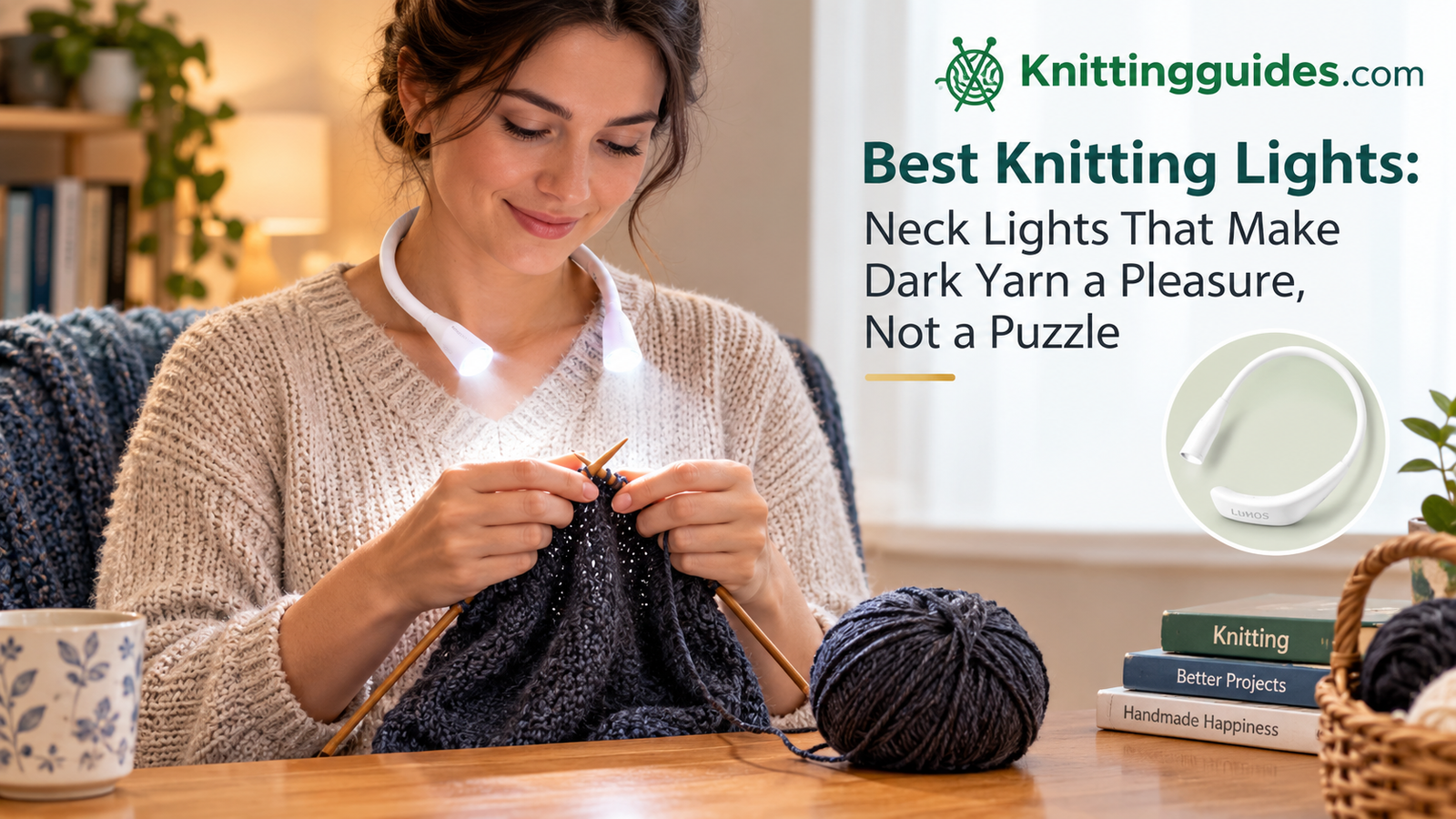
A good neck light keeps both hands on the needles and both beams exactly where your stitches are.
Before we get into individual reviews, here is the full line-up at a glance. Every product in this guide appears in the table below, so you can jump straight to whichever one sounds like your kind of knitting companion.
Quick Comparison: Our Top Picks
Swipe to see more →
| # | Image | Product | Key Details | Verdict | Where to Buy |
|---|---|---|---|---|---|
| 1 Top Pick |
 |
Glocusent Bendable Neck Reading LightBest Overall |
|
Set it once and forget it — the arms hold their angle while your hands stay busy. | Check Price on Amazon |
| 2 |  |
Gritin 4-Color Neck Reading LightBest for Colour Options |
|
Four colour choices make it easy to match the light to your yarn and the hour. | Check Price on Amazon |
| 3 |  |
Lumos & Lumos Knitting LightBest Knitter-Specific Pick |
|
When a brand designs purely for fibre artists, the little details show. | Check Price on Amazon |
| 4 |  |
Vekkia (LuxJet) Rechargeable LED Neck LightBest for Hands-Free Comfort |
|
A long-time favourite with readers who discovered it works beautifully for knitting. | Check Price on Amazon |
| 5 |  |
Radixium LED Neck LightBest for Long Crafting Sessions |
|
Two beams spread the light wide, which is exactly what a big project needs. | Check Price on Amazon |
| 6 |  |
Energizer Rechargeable Neck LightBest Familiar Brand |
|
Comes from a name built on portable power — reassuring if batteries worry you. | Check Price on Amazon |
| 7 |  |
EZRED Bright NK10 Neck Work LightBest for Tough Environments |
|
Overbuilt in the best way — ideal if your knitting travels to garages and campsites. | Check Price on Amazon |
| 8 |  |
EastPin Neck LightBest Lightweight Option |
|
Barely noticeable around the neck, which matters more than you would think at hour three. | Check Price on Amazon |
| 9 |  |
LALAKU LED Neck Reading and Knitting LightBest for Reading + Knitting |
|
Equally at home over a pattern page and over your needles — a true dual-purpose light. | Check Price on Amazon |
Now let us get into the details. The sections below explain what actually matters when you are choosing a knitting light, then walk through every product on the list with its strengths, its compromises, and the kind of knitter it suits best.
Why a Dedicated Knitting Light Is Worth the Space in Your Bag
Knitting is close work. Your eyes are constantly refocusing between the tips of your needles, the body of the fabric, and — if you are following a design — a printed or screen-based pattern. That is a surprisingly demanding visual task, and it is one that poor lighting makes dramatically harder. When the light is dim, uneven, or the wrong colour, your pupils widen, your focusing muscles work overtime, and fatigue sets in long before your hands get tired.
There is also a practical cost. In shadowy light you cannot read your stitches, and that means you cannot see where a yarn-over went wrong or where a decrease leans the wrong way. If you have read our guide on how to fix mistakes in knitting, you will know that the first step is always spotting the problem early — and spotting it early is purely a lighting question.
The problem with ordinary room lighting
A ceiling light illuminates a room, but it does not illuminate a lap. By the time the light reaches your hands it is weak, and your own body blocks much of what remains. That is why so many knitters unconsciously hunch toward the nearest lamp, and why neck and shoulder ache is so common among evening crafters. The tension comes from posture, and the posture comes from chasing the light.
A desk lamp helps, but only at a desk. The moment you move to the sofa, the bed, the train, or a friend’s kitchen table, you are back to squinting. Floor lamps have the same limitation. Table lamps with fabric shades create lovely ambience and almost no usable task light.
What a neck light actually changes
A neck light puts two adjustable beams on your collarbones, pointed down at whatever your hands are doing. Because the light travels with your body, the illumination stays constant no matter how you shift position. Because it comes from two sources on either side of your head, it fills in the shadows that a single lamp would cast between your fingers and your work.
- Consistent coverage. The light follows your hands instead of forcing your hands to follow the light.
- Reduced shadowing. Two beams mean fewer dark pockets under your fingers and needles.
- True portability. It works identically at home, on a train, in a waiting room, or at a craft night.
- Shared-space politeness. You get task lighting without flooding the whole room — perfect when someone else is watching television.
- Pattern readability. Point one arm at your stitches and the other at your pattern, and you never lose your place.
That last point deserves emphasis. So much knitting frustration is really pattern-reading frustration. Whether you are working from a printed chart or a tablet, being able to light the page and the project independently is a genuine quality-of-life upgrade. If charts still confuse you, our guide to how to read a knitting pattern pairs perfectly with better lighting.
It is not just about knitting
Neck lights are quietly beloved by crocheters, cross-stitchers, embroiderers, quilters, miniature painters, and model builders — anyone whose hobby happens within arm’s reach of their face. Readers use them in bed without disturbing a partner. Travellers use them in dark carriages and aeroplane cabins. Parents use them during late-night feeds. If you buy one for knitting, expect the rest of the household to borrow it.
The short version: if you knit for more than half an hour in the evening and you have ever caught yourself leaning toward a lamp, a neck light will change how the hobby feels. It is a small purchase with an outsized effect on comfort.
There is also a wellness angle that regulars on this site will recognise. Knitting is widely enjoyed for its calming, repetitive rhythm — something we explore in is knitting good for the brain. That meditative quality disappears quickly when you are straining to see. Good light protects the very thing you knit for.
Ready to Stop Squinting?
Browse the full range of rechargeable neck lights and compare the latest designs, colour settings, and battery options in one place.
Shop Neck Lights on AmazonHow We Picked These Lights: The Criteria That Actually Matter
Neck lights all look roughly similar in a product photo: a curved band with two little lamp heads at the ends. The differences that matter are far less visible, and they only reveal themselves after a few hours of use. These are the criteria we kept coming back to while evaluating the nine products in this guide.
Beam shape and adjustability
The single most important feature is how precisely you can aim the light. Knitting happens in a small area — often less than a foot across — and you want the beam exactly there, not spilling onto the ceiling or blinding the person next to you. Arms that bend and hold their position are what separate a genuinely useful knitting light from a novelty. Stiff arms that drift downward mid-project are a constant irritation.
Colour settings and warmth
Colour temperature changes how yarn looks and how your eyes feel. A cool, blue-white beam renders colours crisply and is excellent for counting stitches or checking for mistakes. A warm beam is easier on the eyes late at night and flatters the cosy mood most knitters are after. A neutral option sits between the two. Lights with three or four colour settings give you the freedom to choose based on the hour and the yarn — the Gritin in this guide offers four, while the Glocusent offers three.
Brightness range
More is not automatically better. If you knit with dark, dense yarn you will want a strong beam; if you knit with pale, fuzzy yarn, an overly bright light will blow out the texture and make stitch definition harder to read, not easier. Adjustable brightness matters more than maximum brightness, and it is worth checking whether each arm can be dimmed independently.
Weight and balance
A neck light sits on your shoulders and neck for the entire session. A few extra grams are easy to ignore at minute five and impossible to ignore at minute ninety. Lighter designs tend to be more comfortable over long evenings, while sturdier designs can feel reassuring but heavier. If you tend to knit for hours, prioritise comfort over specs.
Power and runtime
Most modern neck lights are rechargeable, which is far more convenient than hunting for disposable batteries mid-project. Runtime claims vary widely, and the way you use the light — full brightness versus low, one arm versus two — makes an enormous difference. The Glocusent advertises a notably long runtime figure in its product name, which makes it a strong candidate for anyone who hates frequent charging. Whatever model you choose, look for a light that lasts at least a couple of long sessions on a charge.
Versatility beyond knitting
The best purchase is one you use constantly. A neck light that also works for reading in bed, for hobby painting, for dog walks on dark evenings, and for rummaging in a poorly lit cupboard is better value than a single-purpose gadget. That is why we included lights from generalist brands alongside craft-specific ones.
It is also worth thinking about the rest of your setup. New knitters in particular often buy light and tools at once, so we compared these lights alongside the best knitting needles for beginners and typical starter kits to see which lights worked well in a real beginner’s hands — not just in a product studio.
What we deliberately ignored
We did not use star ratings, review counts, or headline price as ranking factors. Those numbers shift constantly, and they say more about marketing budgets than about how a light performs on your lap. Instead we focused on the design decisions you can evaluate yourself: how the arms behave, how the beam falls, how the light wears, and how much of a hassle it is to live with.
Compare the Full Range Yourself
Specs change fast in this category. Browse current neck reading lights side by side and check today’s options before deciding.
Browse Neck Reading LightsGlocusent & Gritin: The Colour-Controlled Pair
These two lights sit at the top of the list for the same reason: they give you genuine control over the character of the light. Both offer multiple colour settings, both are rechargeable neck-worn designs, and both have earned loyal followings among readers who turned out to be knitters. The difference is in emphasis.
Swipe to see more →
| # | Image | Product | Best For | Standout | Where to Buy |
|---|---|---|---|---|---|
| 1 Top Pick |
|
Glocusent Bendable Neck Reading LightBest Overall | Long evening sessions and precise aiming | Bendable arms that stay where you put them | Check Price on Amazon |
| 2 | |
Gritin 4-Color Neck Reading LightBest for Colour Options | Knitters who switch between dark and light yarns | Four colour settings to match mood and material | Check Price on Amazon |
Glocusent Bendable Neck Reading Light (80-hr, 3-color)
The Glocusent is the light most likely to make you stop thinking about lighting entirely — and that is the highest compliment you can pay a tool. Its defining feature is the pair of bendable arms, which hold their angle instead of slowly sagging toward your lap as the evening goes on. For a knitter, that means you set the beam once and then forget about it.
The three colour settings give you a warm option for relaxed evenings, a cooler option for detail work, and a middle setting for everything else. Combined with the notably long runtime figure stated in the product name, this is a light you can charge occasionally rather than constantly.
Key Features
- Bendable arms: position each beam independently and keep it exactly where you aimed it.
- Three colour settings: switch between warm, neutral, and cool light depending on the hour.
- Long stated runtime: the maker’s runtime figure is among the most generous in this category.
- Neck-worn, hands-free design: both hands stay on your needles from cast-on to bind-off.
- Rechargeable format: no disposable batteries to keep buying or hunting for.
What We Like
- Arms hold position without constant readjustment
- Colour choice covers warm and cool needs
- Excellent stamina between charges
- Comfortable enough to forget you are wearing it
Worth Knowing
- Three colours may feel limited if you want fine granularity
- Very large projects still benefit from some room lighting
- Arm tension needs an occasional tweak to stay crisp
Gritin 4-Color Neck Reading Light
If you have ever unpicked a section because you could not tell a dark stitch from its neighbour, you already understand why colour choice matters. The Gritin’s four colour settings let you match the light to the yarn in front of you — cooler light for deep charcoal and navy, warmer light for pale creams and pastels where glare is the enemy.
That flexibility is genuinely useful in a craft where the material changes every project. The neck-worn format keeps both hands free, and the rechargeable design means you are not forever replacing cells.
Key Features
- Four colour settings: the widest colour choice in this guide.
- Independent light heads: aim each beam separately at your work and your pattern.
- Rechargeable LED design: simple to top up between sessions.
- Comfortable neck band: sits lightly across the shoulders during long sessions.
- Reader-friendly controls: easy to change settings without putting your knitting down.
What We Like
- Four colour options cover almost every yarn situation
- Great at reducing glare on light-coloured fibre
- Comfortable for extended wear
- Useful for reading and craft work alike
Worth Knowing
- More settings means more buttons to learn at first
- Beam width is best for lap-sized projects
- Colour preference is personal — expect some trial and error
Which of these two should you choose?
Think about how you knit. If you tend to settle into one comfortable position and stay there for hours, the Glocusent’s steady arms and long runtime will serve you better. If you move between projects, yarns, and locations and want to adjust the character of the light each time, the Gritin’s four settings give you more to work with. Neither is a wrong answer; they simply optimise for different habits.
One practical note for beginners: good light pairs well with good tools. If you are still assembling your setup, take a look at our roundup of the best knitting needles for beginners and the best knitting kits for beginners, both of which include the kind of starter gear that works nicely alongside a neck light.
Our Top Pick for Most Knitters
The Glocusent’s bendable arms and long stated runtime make it the most effortless option for nightly knitting.
Check Price on AmazonLights Designed With Crafters in Mind: Lumos & Lumos and LALAKU
There is a subtle difference between a light designed for reading and a light designed for making things. Reading is a flat task: a page, a fixed distance, one direction of gaze. Knitting is dynamic — the work moves, your hands move, and the point of focus shifts constantly. Lights built for craft take that into account, shaping the beam to cover a working area rather than a single page.
Both products in this section are marketed explicitly with knitting in mind, and both show it in the way they aim and spread their light.
Lumos & Lumos Knitting Light
The Lumos & Lumos is the only light in this guide designed from the ground up for fibre artists, and that intent shows in the details. The light shape is built to cover a knitting area rather than a book page, which means less fiddling to keep the beam over your stitches as your project grows.
If you have ever improvised lighting with a clip lamp balanced on a cushion, this feels like the upgrade you were improvising toward. It understands the geometry of knitting — the arc of the needles, the spread of the fabric, the way your hands drift as you work.
Key Features
- Craft-focused light shape: shaped for working areas rather than pages.
- Neck-worn, hands-free format: nothing to clip, balance, or reposition.
- Designed for knitters: the whole concept assumes needles, yarn, and moving hands.
- Rechargeable LED design: ready for the next session with a simple top-up.
- Consistent coverage as projects grow: from a narrow scarf to a wide blanket.
What We Like
- Built around knitting rather than adapted to it
- Beam covers the whole working area evenly
- Excellent for wide or growing projects
- Feels purposeful rather than generic
Worth Knowing
- Craft-specific design means fewer general-purpose extras
- Best value when you actually knit regularly
- Availability can vary compared with mass-market brands
LALAKU LED Neck Reading and Knitting Light
The LALAKU is a dual-purpose light, and that is exactly its appeal. It is designed to serve both the reading half of your evening and the knitting half, which is how most crafters actually spend their time. Work a few rows, check the pattern, read a chapter, knit again — one light handles the whole rotation.
The flexible positioning arms give you the aiming control knitting demands, while the neck-worn form keeps everything hands-free. For anyone who hates owning three single-purpose gadgets, it is a tidy solution.
Key Features
- Reading and knitting modes of use: built for both flat pages and working fabric.
- Flexible positioning arms: aim the beams precisely at your hands or your book.
- Neck-worn LED format: comfortable, stable, and unobtrusive.
- Rechargeable design: convenient daily charging without disposable batteries.
- Good close-work focus: suited to detailed stitching and small stitches.
What We Like
- Genuinely useful for both reading and crafting
- Arms are easy to aim at small areas
- Simple, unfussy design
- Great for knitters who read patterns on paper
Worth Knowing
- Dual purpose means it is not specialised for either task
- Arms may need re-aiming as your project grows
- Fewer colour choices than dedicated colour-tuning lights
Craft-specific versus general-purpose
The honest answer is that a well-designed general-purpose neck light performs beautifully for knitting, while a craft-specific light removes a few small frictions you might never have noticed. If knitting is your primary hobby and you do it most days, the specialised option earns its keep. If you want one light for the whole household’s needs, a flexible generalist will give you more mileage.
Either way, your light should suit your projects. Bigger work like blankets and sweaters wants wider, more even coverage; smaller work like socks and mittens wants a tight, focused beam. If you are planning a first big project, our guide on how to start knitting a scarf is a good companion read.
See Craft-Focused Knitting Lights
Explore lights built specifically for knitters and makers, with beams shaped for working hands rather than reading pages.
Shop Knitting LightsVekkia & Radixium: Comfort and Coverage
Two things decide whether a neck light becomes a nightly habit or a drawer resident: whether you forget you are wearing it, and whether the beam covers everything you need. These two lights come at that pair of problems from opposite directions, and both do it convincingly.
Vekkia (LuxJet) Rechargeable LED Neck Light
The Vekkia has been a favourite among bedtime readers for years, and knitters arrived at it the same way — by realising that a light comfortable enough to read in is a light comfortable enough to knit in. The neck band sits lightly, the arms bend where you want them, and the whole thing feels unremarkable in the best possible way.
Comfort is not a soft, vague benefit. It is the reason you keep using a product. A light that pinches, tips forward, or presses on your neck will be abandoned no matter how good its beam is.
Key Features
- Rechargeable LED design: simple daily use with no disposable batteries.
- Flexible, positionable arms: aim each beam at your stitches independently.
- Lightweight neck band: comfortable for long, relaxed sessions.
- Reading and crafting use: equally good over a page or a project.
- Stable fit: stays put when you shift position or lean back.
What We Like
- Genuinely comfortable for long wear
- Well-proven design refined over time
- Easy to aim at small stitch areas
- Doubles as an excellent reading light
Worth Knowing
- Comfortable fit may not suit every neck shape equally
- Design is reading-led rather than craft-led
- Beam width is moderate for very large projects
Radixium LED Neck Light
Knitting a blanket or a sweater means covering a lot of fabric, and a narrow beam simply will not do it. The Radixium’s twin adjustable heads are designed to spread light wide and even, which is precisely what a growing project needs. Instead of constantly re-aiming as your work expands, you get consistent coverage across the whole lap.
That breadth also helps with colourwork and lace, where you need to see a broad section at once to keep track of the pattern rather than peering at one stitch at a time.
Key Features
- Dual adjustable heads: spread light across a wide working area.
- Neck-worn LED design: keeps both hands free throughout the project.
- Rechargeable power: ready for repeated long sessions.
- Even, broad coverage: ideal for blankets, shawls, and sweaters.
- Independent aiming: point one beam at the fabric and one at the pattern.
What We Like
- Excellent spread for large projects
- Reduces the need for constant re-aiming
- Strong choice for lace and colourwork
- Good for simultaneous pattern reading
Worth Knowing
- Broader coverage means less raw focus on tiny stitches
- Better suited to big projects than sock-sized work
- Wide beams spill more light into the room
Comfort versus coverage
These two qualities usually trade against each other: wider beams and sturdier housings add a little weight, while ultra-light designs tend to have smaller emitters. Your knitting style decides which matters more. If you knit small items for long stretches, choose the lighter option. If you knit big things and want to see them all at once, choose the wider beam.
Either way, thinking about coverage early saves frustration later. It is the same principle we apply when discussing circular versus straight knitting needles — the right tool depends entirely on the shape of the work in front of you.
Find the Right Beam Width
Browse rechargeable neck lights with dual heads and flexible arms to match the size of your projects.
Check Price on AmazonEnergizer, EZRED & EastPin: Rugged, Reliable, and Ready for Anything
Not every knitting session happens in a quiet living room. Some knitters work in workshops, on campsites, in shared spaces, or on the move. This trio covers the practical end of the market: lights built by brands that know portable power and durable hardware, plus a lightweight option for anyone who wants something barely there.
Swipe to see more →
| # | Image | Product | Best For | Standout | Where to Buy |
|---|---|---|---|---|---|
| 6 | |
Energizer Rechargeable Neck LightBest Familiar Brand | Everyday knitters who value reliability | From a brand built on portable power | Check Price on Amazon |
| 7 | |
EZRED Bright NK10 Neck Work LightBest for Tough Environments | Crafters who knit everywhere, not just at home | Work-light toughness in a neck-worn format | Check Price on Amazon |
| 8 | |
EastPin Neck LightBest Lightweight Option | Travellers and anyone sensitive to neck weight | Slim, unobtrusive profile | Check Price on Amazon |
Energizer Rechargeable Neck Light
There is genuine reassurance in buying a light from a company whose entire reputation rests on keeping things powered. The Energizer rechargeable neck light brings that confidence to the craft table: a straightforward, well-built neck-worn light from a name you already know.
For knitters who are not hobby-gadget people and simply want something that works reliably without research rabbit holes, brand familiarity is a legitimate reason to buy. This is a no-drama light that does the job it claims to do.
Key Features
- Rechargeable neck-worn design: convenient for regular, repeat use.
- Established power brand: backed by decades of portable-energy experience.
- Adjustable light direction: point the beams where your hands are working.
- Everyday hands-free use: suited to knitting, reading, and household tasks.
- Simple operation: minimal fuss and a short learning curve.
What We Like
- Trusted brand with a long power heritage
- Simple, dependable, unfussy design
- Easy to find accessories and support
- Good general-purpose choice
Worth Knowing
- Fewer craft-specific touches than dedicated designs
- Colour options may be more limited
- Brand premium is possible versus lesser-known makers
EZRED Bright NK10 Neck Work Light
The EZRED NK10 comes from the work-light world, and it wears that heritage openly. Where most neck lights are designed for bedrooms, this one is designed for people who need light in places where things get knocked about — garages, workshops, campsites, and travel bags.
For a knitter, that translates into durability and confidence. If your projects travel with you and your gear takes a beating, a work-light build is exactly right. It is also a natural fit for anyone who knits and does practical work with the same equipment.
Key Features
- Work-light build quality: made to survive a harder life than a bedside light.
- NK10 neck-worn format: hands-free light that stays with you.
- Rugged construction: handles being tossed into bags and toolboxes.
- Rechargeable LED: practical for repeated use away from home.
- Multi-purpose use: equally useful for repairs, camping, and crafting.
What We Like
- Exceptionally durable construction
- Excellent for travel and outdoor knitting
- Useful well beyond the craft room
- Confidence-inspiring hardware
Worth Knowing
- Rugged build can mean extra weight
- Work-light aesthetic is not to everyone’s taste
- May feel like overkill for sofa-only knitting
EastPin Neck Light
Weight is the feature nobody thinks about until hour two. The EastPin’s slim, low-profile design is built around the idea that the best neck light is the one you stop noticing. For knitters who settle in for long stretches, that is a meaningful advantage.
It also makes a superb travel companion. A light that takes up almost no room in a project bag is one you will actually carry — and the light you actually carry is the only one that helps.
Key Features
- Slim neck-worn profile: minimal bulk and minimal fatigue.
- LED beam for close work: focused light for stitch-level detail.
- Rechargeable design: easy to keep topped up.
- Travel-friendly: packs neatly into a project bag.
- Low-profile comfort: sits lightly across the shoulders.
What We Like
- Noticeably light during long sessions
- Easy to carry anywhere
- Unobtrusive design that suits shared spaces
- Good focus for detailed work
Worth Knowing
- Lighter designs can have smaller emitters
- Best for lap-sized projects
- May lack some heavier models’ extra settings
Choosing between rugged and lightweight
The decision here is genuinely about your life, not about specifications. Ask where your knitting actually happens. If it is always in the same chair, comfort and light quality win and the EastPin style of design makes sense. If it happens everywhere — on trains, at campsites, in cold sheds, at community groups — then durability matters more, and the EZRED approach earns its extra grams.
And if knitting regularly travels with you, our guide to bringing knitting needles on a plane will help you sort out the logistics before you fly.
Built to Travel With Your Knitting
Compare rugged, rechargeable neck lights that hold up to commutes, campsites, and craft nights away from home.
Check Price on AmazonNeck Lights vs Desk Lamps, Headlamps, and Clip Lights
Before you commit to a neck light, it is fair to ask whether the alternatives might work just as well. After all, plenty of knitters have managed perfectly well with a desk lamp for decades. Here is an honest comparison of the main options, including where each one genuinely wins.
Swipe to see more →
| Light Type | Best For | Strengths | Limitations for Knitters |
|---|---|---|---|
| Neck LightBest All-Round | Sofa, bed, travel, shared rooms | Travels with your hands; two beams reduce shadows; keeps both hands free | Limited total brightness compared with mains-powered lamps |
| Desk / Task LampBest at a Fixed Desk | Dedicated craft table or desk | Strong, stable light; adjustable arms; no battery concerns | Fixed position; useless once you leave the desk; can cast hand shadows |
| HeadlampBest for Total Darkness | Outdoor work, dark rooms, repairs | Very bright; points exactly where you look | Glare directly in your vision; uncomfortable for hours; heavy on the forehead |
| Clip / Book LightBest for Pattern Pages | Lighting a book or chart | Cheap, small, precise on flat pages | Needs something to clip to; awkward over fabric; single narrow beam |
| Overhead Room LightBest for General Ambience | Whole-room visibility | No gear required; lights everything | Body shadows the work; uneven; too dim at lap level |
Why headlamps disappoint knitters
Headlamps are superb for what they are built for — seeing in the dark while your hands do something else. But they shine directly into your field of vision, which causes glare and pupil constriction, and the beam is a small hot spot rather than a broad wash. For fine, repetitive close work that is close to the worst possible setup. Many knitters who tried headlamps report eye fatigue within an hour.
Why desk lamps are only half the answer
A good task lamp is a genuinely excellent investment if you knit at a desk or table. The light is strong, the arm is adjustable, and there is no battery to manage. The limitation is mobility: the moment you want to knit somewhere comfortable, the lamp stays behind. Many serious knitters own both — a task lamp at the craft table and a neck light everywhere else.
The strongest case for neck lights
Neck lights win on versatility and shadow control. Two beams from either side of your head fill in the shadows that a single source creates, which is a real advantage when your hands are constantly moving across the work. And because the light moves with you, it is the only option that works identically in every location.
Our recommendation: if you can only buy one lighting upgrade, buy the neck light. If you knit at a fixed desk daily, add a task lamp later for the extra brightness.
The same “what actually suits your habit” logic applies to your needles. If you are still deciding what to buy alongside your light, our comparison of circular versus straight knitting needles and our roundup of best interchangeable knitting needle sets both help you match tools to how and where you knit.
Upgrade Your Lighting Setup
See the full selection of craft and reading lights and find the format that fits the way you actually knit.
Browse Craft LightsHow to Light Your Knitting Without Tiring Your Eyes
Buying a good light is half the job. The other half is using it well — and the difference between a properly lit workspace and a poorly lit one is bigger than most people expect. Here is how to set up your light so that your eyes stay comfortable and your stitches stay readable.
Point the beams at the work, not at your face
It sounds obvious, but the most common mistake is aiming the light too high. Your needles and the fabric just below them are the target. Angle each arm so the beams cross slightly in front of you, creating an overlap of light exactly where your hands are. That overlap is what eliminates shadows.
Use two beams to cancel shadows
A single light source always casts a shadow from your fingers onto your work. Two sources from opposite sides cancel each other’s shadows. This is why neck lights with two independent heads are so effective for knitting — and why you should resist the urge to fold one arm away unless you are working on something tiny.
Match the colour to the yarn
Cool light improves contrast, which is what you want when working with dark, dense yarns where stitches blur together. Warm light is gentler at night and flatters light, creamy fibres without harsh glare. If your light offers several settings, try each one against the yarn you are using before you settle in — the right choice is often not the one you expected.
Colour judgement matters enormously when you are choosing yarn in the first place. If you are still learning how fibre behaves, our guide to the best yarn for beginner knitting explains what to look for and why lighter, smoother yarns are easier to read.
Keep some ambient light in the room
This is the counterintuitive one. Working in a pitch-dark room with only a bright task light creates extreme contrast between the lit work and the dark surroundings, and your eyes constantly adjust back and forth. That is genuinely tiring. A low level of ambient light — a distant lamp, a dimmed ceiling light — keeps your pupils stable and makes the whole session more comfortable.
Take visual breaks
Even with perfect lighting, close focus is demanding. Every twenty minutes or so, look up and across the room for a moment. It takes seconds and it resets your focusing muscles. Pair this with the natural rhythm of knitting — pausing at row ends, checking your pattern — and you can comfortably knit far longer.
Read the pattern as a lit document
Many knitting frustrations begin with misreading a pattern rather than mis-knitting a stitch. If you work from paper, aim one beam at the page and use a highlighter or magnetic board to track your row. If you work from a screen, reduce the screen brightness to match your task light so you are not switching between two very different light levels. Our guide on how to read a knitting pattern covers the notation side of the problem.
Match the light to the needle and the stitch
Reflective metal needles can create glare under a very bright, cool light. If you find yourself distracted by shine, switch to a warmer setting or reduce the brightness. Matte-finish needles are far less affected. Likewise, textured stitches and cables benefit from a slightly raking angle of light — point the beams a little more from the side to make the texture pop.
And if you are at the very beginning of your knitting journey, start with the basics first: how to start knitting, then how to cast on knitting, and then figure out the right needle size using our guide to what size knitting needles for beginners. Good lighting makes every one of those early steps easier.
Light Your Stitches Properly
Find a light with adjustable brightness and colour settings so you can tune it to every yarn in your stash.
Check Price on AmazonBattery Life, Charging, and What Runtime Figures Really Mean
Runtime is the headline specification for every rechargeable neck light, and it is also the most misunderstood. A light that promises long endurance on a single charge is genuinely valuable — the Glocusent’s stated runtime figure is a good example of why this matters — but the number on the box comes with conditions worth understanding.
Runtime depends on how you use the light
Almost every runtime figure is measured at a lower brightness setting, often with a single beam active. In real use you may run both arms at a higher brightness, which draws considerably more power. Think of the quoted figure as a ceiling rather than a guarantee: your actual experience will land somewhere below it depending on how brightly and how long you knit.
One beam or two?
If you are reading rather than knitting, using one arm at a time can dramatically stretch your battery. For knitting, though, two beams is usually the right call because of the shadow cancellation described above. A practical habit is to charge before a long session and use both arms freely, rather than nursing the battery through an evening of shadowy, second-rate light.
Charging habits that help
- Top up between sessions rather than running the battery completely flat every time.
- Use the cable supplied or a quality replacement — cheap, poorly made cables are a common failure point.
- Store with some charge if you are putting the light away for a season.
- Keep the charging port clean and free of yarn fibres and dust.
- Charge before craft nights so you are never caught out mid-project.
What about replaceable batteries?
Most lights in this guide are rechargeable, which is the most convenient format for daily use. If you knit somewhere without easy access to power — remote cabins, long travel days, camping trips — it is worth considering how you will recharge, and whether a light with broadly available charging hardware suits your situation better than one with a less common connector.
Signs your battery is ageing
Rechargeable cells gradually hold less capacity over years of use. If your light used to last an entire evening and now needs topping up mid-session, that is normal ageing rather than a defect. Keeping the light charged moderately rather than constantly at extremes tends to help it last longer overall.
Battery habits also matter for your wider craft kit. Anything rechargeable in your project bag — lights, row counters, tablet for patterns — benefits from a simple habit of charging the night before. It is the same logic we apply to planning a first project in how to start knitting a scarf: a little preparation prevents a lot of interruption.
Look for Long-Lasting Rechargeable Lights
Compare current rechargeable neck lights and see which models suit your knitting schedule.
Check Price on AmazonCare and Maintenance: Keeping Your Knitting Light in Good Shape
Neck lights are simple devices, which is exactly why they last — provided you treat them with a little care. Fibre dust, tension drift, and careless storage are the three things that gradually degrade an otherwise excellent light. Here is how to avoid all three.
Keep fibres out of the works
Knitting generates fibre. Fluff floats in the air and settles on everything, including the joints of your light arms and the edges of the emitters. Every few weeks, wipe the light down with a soft, dry cloth and gently clear any lint from the arm joints and light heads. Avoid wet cloths around the electronics and never spray cleaner directly onto the device.
Re-tension the arms
The arms on bendable lights are the part that shows wear first. If you notice them drooping mid-session, it is usually because they have been left bent in one position for long periods, or forced past their natural range. Store them in a neutral, gently curved position rather than folded sharply, and adjust them with both hands rather than yanking one side.
Store it properly
A project bag is the natural home of a neck light, but a bag full of needles, scissors, and notions is a hostile environment. Give the light its own small pocket or pouch so the emitter lenses do not get scratched and the arms do not get bent against metal needles. If you are travelling with a full kit, check our advice on bringing knitting needles on a plane so nothing gets confiscated at security.
Handle the charging port gently
Most charging problems come from rough handling rather than component failure. Insert and remove the cable straight, avoid bending it at sharp angles while plugged in, and keep the port free of dust. If a light suddenly refuses to charge, try a different cable before assuming the worst.
Know when it is time to replace
If the light has become dimmer despite full charges, if the arms no longer hold position, or if the housing has cracked, replacement is usually more sensible than repair. The good news is that this category evolves quickly, and each generation tends to be lighter and more comfortable than the last.
Looking after your eyes, too
Maintenance is not only about the equipment. If you knit daily, give your eyes regular breaks and make sure your prescription is current if you wear glasses. Crafters who knit for hours often find that a light with adjustable brightness solves problems they assumed were vision problems. If you are interested in the wider wellbeing side of the craft, our piece on is knitting good for the brain covers why so many people find knitting genuinely restorative.
Find a Light Built to Last
Browse well-made neck lights with durable arms and dependable rechargeable power.
Check Price on AmazonKnitting on the Go: Travel, Commutes, and Craft Nights
One of the great pleasures of knitting is that it travels beautifully. A project fits in a bag, requires no power, no internet, and no setup — which makes it the perfect companion for trains, waiting rooms, aeroplane cabins, and long evenings at someone else’s house. The only thing that travels less well is lighting. This is where a neck light earns its keep more than anywhere else.
On trains and buses
Carriage lighting is famously uneven, and evening services can be genuinely dim. A neck light gives you a consistent, private pool of light over your lap without disturbing the passenger beside you. Because the beams are directed downward, there is no glare spilling into anyone else’s space — a courtesy that matters in a crowded carriage.
On aeroplanes
Cabin lighting is designed for sleeping, not for detailed handwork, and the reading light in the overhead panel is a single harsh spot that casts shadows across your hands. A neck light solves this neatly and is small enough to live in your seat pocket. Do check the rules around your tools before flying — our guide on whether you can bring knitting needles on a plane covers what you need to know.
At craft nights and knitting groups
Group venues are usually lit for conversation rather than craft. Bringing your own light means you can actually see your stitches without begging for the good chair under the lamp. It also means you are not dependent on venue lighting that may be too warm, too dim, or directly overhead.
In shared spaces at home
This is the quiet superpower of a neck light. When someone else is watching television or sleeping nearby, turning on a bright room light is antisocial. A neck light gives you full task lighting while the room stays dim — which is why so many knitters describe it as the thing that let them knit again in the evenings.
Building a travel knitting kit
A good travel setup is small and self-contained. Beyond the light, think about a compact project bag, a small notions pouch, and a project that does not require constant pattern-checking. If you are choosing a project for travel, our tutorial on how to start knitting a scarf produces exactly the kind of rhythmic, low-attention work that suits a moving train.
If you are new enough to be weighing up crafts before committing, our comparison of crochet versus knitting is a useful read — and both crafts benefit equally from good portable lighting. For more advanced knitters who take tools on the road, our guide to knitting in the round covers a technique that travels particularly well.
Lighting for dark destinations
Campsites, cabins, and older houses with few power outlets are exactly where a rechargeable neck light proves its worth. If you travel to places with unreliable lighting, choose a light with generous stated endurance and charge it fully before departure. Rugged models like the EZRED in this guide are designed with exactly this kind of use in mind.
Take Your Knitting Anywhere
Pick up a compact, rechargeable neck light that slips into any project bag and works in any location.
Check Price on AmazonMistakes to Avoid When Buying a Knitting Light
Most disappointment with neck lights comes from buying the wrong type rather than a bad product. Here are the traps worth avoiding before you commit.
Buying purely on maximum brightness
Extremely bright sounds impressive and often feels terrible. Over-bright light on pale yarn creates glare, flattens texture, and tires your eyes quickly. What you want is a usable range of brightness levels, not the highest possible output. Adjustable is better than powerful.
Ignoring weight
It is easy to dismiss weight when you are reading a listing, but the light sits on your neck for hours. If you tend toward long sessions, choose a lighter design and prioritise comfort. This is the single most common reason people stop using a neck light they initially loved.
Assuming all arms behave the same
Arms that hold position are worth more than arms that simply bend. Cheap, floppy arms drift during use and force constant readjustment, which defeats the hands-free promise entirely. Look for arms described as holding their angle, and treat that as a headline feature.
Choosing a single-beam design
A single light source above one shoulder casts shadows from your hands onto your work. Two beams solve this properly. Single-beam designs are fine for reading; for knitting, the dual-beam format is far superior.
Forgetting about colour options
Colour temperature is not a marketing gimmick — it genuinely changes how you read your stitches. If you work with a variety of yarns, multiple colour settings give you the flexibility to match the light to the fibre. The Gritin’s four settings and the Glocusent’s three both handle this well.
Overlooking everyday comfort
The neck band, the balance of the device, and how it sits when you look down all matter enormously. Anything that presses, slips forward, or feels top-heavy will annoy you quickly. If possible, think about your own posture and habits before choosing.
Buying before you know your knitting habits
Where and when you knit determines the right light far more than any specification. Sofa knitters want comfort. Desk knitters want beam width. Travellers want durability and low weight. New knitters who are still working out what they enjoy should start with the basics — our guides on how to start knitting and the best knitting kits for beginners are the natural starting point — and then choose lighting once their habits are clear.
Expecting one light to do everything
A neck light is outstanding for close work on your lap. It is not designed to light an entire room, and it will not replace a good task lamp at a desk. Knowing what it does best — consistent, shadow-reduced, hands-free illumination exactly where you are working — is the key to being happy with the purchase.
Quick checklist before buying: dual beams, adjustable brightness, at least a couple of colour settings, arms that hold position, comfortable weight, and rechargeable power. If a light covers those six, you are unlikely to be disappointed.
And remember that lighting is part of a wider system. If your stitches are hard to read because of the yarn rather than the light, our guide to the best yarn for beginner knitting will help you choose a fibre that is easier to work with while you build confidence.
Get It Right the First Time
Use the checklist above and compare current neck lights side by side before you buy.
Shop Knitting Lights on AmazonFrequently Asked Questions About Knitting Lights
What kind of light is best for knitting?
A hands-free neck light with two adjustable beams is generally the best option for knitting. The dual beams reduce the shadows your hands cast over the work, and the neck-worn format keeps the light aimed at your stitches wherever you sit. Adjustable brightness and at least two colour settings are the features that matter most in everyday use.
Is a neck light better than a desk lamp for knitting?
For sofa, bed, and travel knitting, yes — a neck light is far more practical because it travels with your hands and works in any location. A desk lamp is brighter and better suited to a fixed craft table. Many experienced knitters own both: a task lamp at the desk and a neck light everywhere else.
How many colour settings do I need in a knitting light?
Two is the practical minimum — one warm and one cool. Three or four gives you useful flexibility, particularly if you work across a wide range of yarn colours. Cool light improves contrast on dark yarns, while warm light is gentler for late-night sessions and reduces glare on pale fibres. The Gritin offers four colour settings and the Glocusent offers three.
Will a neck light really help with dark yarn?
Yes, significantly. Dark yarn absorbs light, which is why stitches seem to merge into one another in dim rooms. A focused beam delivered close to the work improves stitch definition dramatically. Combine a bright, cool-toned setting with light coming from two directions and dark charcoal or navy yarn becomes much easier to read.
Are rechargeable neck lights reliable for long knitting sessions?
They are, provided you match the light to your habits. Runtime figures are usually measured at lower brightness, so expect shorter real-world endurance if you run both beams at high output. For most knitters, charging between sessions is more than enough. If you knit for many hours at a time, prioritise a model with a generous stated runtime.
Can I use a knitting light for reading and other crafts?
Absolutely — most neck lights are equally good for reading, crochet, embroidery, cross-stitch, model painting, and general close work. Lights designed for both reading and knitting, such as the LALAKU, are particularly versatile. Expect other people in your household to borrow it regularly.
Do neck lights disturb other people in the room?
Far less than room lighting does. Because the beams are directed downward at your lap, very little light spills outward. This makes neck lights ideal for shared spaces, shared bedrooms, and evenings when someone nearby is watching television or sleeping.
Are headlamps a good alternative for knitters?
Usually not. Headlamps shine directly into your field of vision, which causes glare and eye fatigue, and the beam is a small hot spot rather than a broad wash. They are excellent for outdoor work and repairs but poorly suited to sustained close handwork like knitting.
How do I stop the light arms from drooping during use?
Choose a light whose arms are designed to hold their position rather than simply bend. Adjust them with both hands rather than forcing one side, and store the light in a neutral curve rather than folded sharply. Occasional re-tensioning is normal; constant drooping usually means the design is not up to the task.
Can I take a neck light on a plane?
Yes, a small rechargeable neck light is straightforward to carry in hand luggage. The bigger travel question is your needles and tools — see our guide on bringing knitting needles on a plane for the details before you fly.
Should beginners buy a knitting light straight away?
If you plan to knit in the evening, yes — it is one of the most useful early purchases. Better light makes learning stitches, reading your fabric, and spotting mistakes far easier. If you are still choosing your first tools, start with our guide to the best knitting kits for beginners and add a light alongside it.
How do I choose between a lightweight light and a rugged one?
Ask where you knit. If it is always in the same comfortable spot, a lightweight, low-profile light will feel best over long sessions. If your knitting travels to workshops, campsites, or shared venues and gets knocked about in bags, a rugged work-light style build such as the EZRED is the better match.
Still Deciding?
Browse the current range and compare colour settings, arms, and battery formats side by side.
Browse Neck Lights on AmazonFinal Verdict: Which Knitting Light Should You Buy?
Lighting is one of those upgrades that looks small on paper and feels enormous in practice. Once you have knitted with a good neck light — beams aimed exactly at your stitches, shadows filled in, both hands free, and the room still dark and cosy — going back to a single lamp across the room feels almost absurd.
For most knitters, the Glocusent Bendable Neck Reading Light is the one to buy first. Its arms hold their position, its colour options cover the range of situations you will actually encounter, and its stated endurance means you charge it occasionally rather than constantly. It is the light you stop thinking about, which is exactly what a good tool should be.
If you want the widest choice of colour settings to match different yarns, the Gritin 4-Color Neck Reading Light is a superb alternative. If you want something designed explicitly for fibre artists, the Lumos & Lumos Knitting Light is the purpose-built choice. And if comfort over long reclined sessions is your priority, the Vekkia and EastPin are both wonderfully easy to wear.
Whichever you choose, buy for your habits rather than for a specification sheet. Comfort, beam shape, and adjustability will affect your enjoyment far more than any headline number. Then set it up properly, take visual breaks, and enjoy being able to knit whenever you like — not just whenever the light is good.
You May Also Like
How to Cast Off Knitting
Finish your projects cleanly and confidently with a bind-off that looks as good as the rest of your work.
Read the guide → Gear GuideBest Interchangeable Knitting Needle Sets
One case, endless combinations — the sets that give you every cable and needle size you will ever need.
Read the guide → Fibre CraftBest Spinning Wheels for Beginners
Take your fibre journey upstream and learn what to look for in a first spinning wheel.
Read the guide → ComparisonAddi Click vs ChiaoGoo Interchangeable Needles
Two of the most loved interchangeable systems, compared head to head on feel, join, and cables.
Read the guide → Gear GuideBest Knitting Machines
When hand-knitting speed is not enough, these machines take on the heavy lifting of bigger projects.
Read the guide →