
Beginner’s Guide · Realistic Timelines
How Long Does It Take to Learn Knitting? A Realistic Timeline for Beginners
The short answer: most people can learn the basic stitches in a few hours of practice, finish a simple scarf within a few weeks, and feel genuinely comfortable reading patterns over a few months. What changes the timeline is not talent — it is how often you sit down with the needles.
- Basics A few short practice sessions
- First project Usually 2–4 weeks
- Pattern confidence Roughly 2–3 months
- Biggest factor Consistency, not speed
Ask ten knitters how long it took them to learn and you will get ten different answers. One will say “an afternoon.” Another will say “a whole winter.” Both are telling the truth, because “learning knitting” is not a single event — it is a stack of small skills that arrive one after another: holding the needles without fighting them, making an even loop, reading what your own hands just did, and finally following a pattern without panicking.
If you have never picked up a needle before, the honest timeline looks like this: your first hour or two will feel clumsy and strange, and that is completely normal. By the end of your first week of short sessions you can cast on, knit a row, and bind off a small square. Within a few weeks you can complete a scarf or dishcloth that genuinely looks like something. Within a few months you are reading abbreviations, shaping fabric, and choosing projects on purpose instead of by accident.
Why does the range vary so much? Because practice frequency beats practice length, the way you learn matters (video, book, or a real person beside you), and the first project and yarn you choose either help you or quietly work against you. If you want the very first baby steps spelled out, our guide on how to start knitting walks through the same process from a more hands-on angle.
In this guide we will break down realistic time frames stage by stage, explain what “learning to knit” actually means, compare knitting with crochet for absolute beginners, give you a week-by-week practice plan for the first three months, and finish with the mistakes and frustrations that make most beginners quit — and how to get past them.
Ready to Cast On Today?
A simple starter kit removes the guesswork.
Needles, yarn, and the tools you actually use.
Watch: Knitting Basics, Step by Step
Reading about a stitch is useful; seeing a pair of hands make it is faster. This short walkthrough covers how the needles are held, how the yarn travels, and what a knit stitch actually looks like in slow motion — the three things that trip up almost every beginner in the first hour.
Takeaway: notice that the hands stay relaxed and the yarn is simply draped, never gripped. Most tension problems start with squeezing.
Follow Along With the Right Needles
Smooth, comfortable needles make the first stitches easier.
Start with a medium size in wood or bamboo.
1. How Long Does It Take to Learn Knitting? The Quick Answer
If you want one honest paragraph, here it is: most beginners can make a recognisable knit stitch within one to three hours of practice, finish a small project such as a dishcloth or narrow scarf within two to four weeks of casual evening knitting, and feel confident reading a written pattern and trying new techniques after two to three months. Those numbers assume a few short sessions per week — not eight-hour weekends and not one abandoned attempt in March.
Learning the basics: knit stitch, purl stitch, casting on and off
The four foundation skills are casting on (getting loops onto the needle), the knit stitch, the purl stitch, and binding off (closing the loops so the fabric does not unravel). Casting on is usually the first wall. It asks your fingers to hold tension, a needle, and a loop at the same time, and the first ten attempts often look like a knot that lost an argument. Then something clicks and your hands remember it.
The knit stitch typically follows within the same session or the next one. The purl stitch is the mirror image and tends to take an extra session or two because it feels backwards. Binding off is quick once knitting makes sense. In total, expect a handful of short sessions before all four feel familiar — and a few more before they feel smooth.
Making your first finished project
A finished object is a different skill from a finished stitch. It is about consistency over hundreds of rows, counting without losing your place, and resisting the urge to restart every time an edge wobbles. Beginners who choose a modest first project — a dishcloth, a simple garter stitch scarf, a small square — usually complete it in two to four weeks of relaxed knitting. Beginners who start with a cabled sweater in fine yarn are not slower learners; they simply picked a much longer road.
Reading patterns and learning new techniques
Pattern reading is the second big leap. Written patterns are a compact language of abbreviations and row repeats, and until that language feels familiar, every project takes twice as long as it should. Most knitters become comfortable reading straightforward patterns within two to three months of regular practice. Techniques like increases, decreases, simple shaping, and knitting in the round usually land in the same window.
Quick timeline table (general ranges, not promises)
| Stage | What You Can Do | Typical Range | What It Really Depends On |
|---|---|---|---|
| First contact | Hold needles and yarn, make a slip knot, cast a few loops | First 30–60 minutes | How relaxed your hands stay |
| Basic stitches | Knit stitch, purl stitch, cast on and bind off | A few hours of practice | Short, repeatable sessions |
| First finished project | Complete a dishcloth, scarf, or simple square | 2–4 weeks | Yarn and project choice |
| Pattern confidence | Read abbreviations, follow a simple written pattern | 2–3 months | How often you try new patterns |
| Comfortable knitter | Shape fabric, knit in the round, fix your own mistakes | 3–6 months | Willingness to undo and retry |
| Confident, independent | Choose yarn and needles for a project, adapt a pattern | 6–12 months | Variety of projects attempted |
Start With a Kit Built for First Stitches
Everything in one box, nothing extra to research.
A calm way to begin.
2. What “Learning to Knit” Actually Means
Most frustration with knitting timelines comes from comparing three different milestones as though they were one. “I can make a knit stitch” and “I can knit a sweater without help” are separated by months of small, ordinary improvements. When you name the milestone you are aiming at, the timeline suddenly stops feeling vague.
Beginner skills vs. comfortable knitter vs. advanced knitter
A beginner can cast on, knit, purl, and bind off. The fabric may be uneven, the edges may wander, and mistakes are found at the end of a row rather than as they happen — and that is fine. A comfortable knitter does all of that while also recognising what the fabric is doing, correcting a dropped stitch without panic, and following a written pattern for a hat or simple garment. An advanced knitter modifies patterns, substitutes yarns, adjusts fit, and solves problems they have never met before.
Notice that none of those definitions mention speed. They mention understanding. That is the real currency of knitting skill.
Knowing how vs. knitting smoothly
There is a gap between knowing the movement and performing it smoothly, and it closes only with repetition. The first time you make a knit stitch you are thinking about eleven things at once: needle angle, yarn position, tension, which way the loop points. After a few hundred stitches, your hands take over and your mind is free again. Beginners often misread that gap as a lack of ability, when it is really just the ordinary learning curve of a physical skill.
Why being fast isn’t the goal
Speed arrives on its own, and chasing it early usually creates tight, uneven stitches and sore hands. Fast knitting is a by-product of relaxed hands and familiarity, not a prerequisite for good knitting. Many lifelong knitters deliberately knit slowly in the evening precisely because the pace is the point. If your rows are neat and your shoulders are relaxed, you are doing it correctly — whatever the row counter says.
Skill level table
| Level | Signs You Are There | Typical Time In | What Usually Comes Next |
|---|---|---|---|
| First-timer | Casting on feels impossible; rows look like knots | First session | Slip knot and cast-on click |
| True beginner | Can knit and purl; edges are wobbly; counting is hard | Week 1–2 | A small finished project |
| Confident beginner | Reads simple patterns; fixes a dropped stitch; finishes projects | Month 2–3 | Shaping and knitting in the round |
| Comfortable | Chooses yarn and needles knowingly; adapts patterns | Month 4–6 | Garments and fitted projects |
| Advanced | Designs, modifies, teaches others, troubleshoots anything | A year and beyond | Whatever you invent |
Learn With a Good Beginner Book
A clear reference beside you saves hours.
Look for lots of photos and plain language.
3. Timeline by Skill Stage
Here is the same information in project form, because most people measure progress in things they have made rather than skills they can name. Think of these stages as a ladder: each one borrows a little from the stage before it, and none of them requires talent — only another few evenings.
First practice sessions
Your first session is about comfort, not quality. Get the feel of the needles, make a slip knot, cast on a modest number of stitches (twenty is plenty), and knit until your hands feel strange. Stop before you are annoyed. The goal is to end the session wanting a second one.
By session three or four, the knit stitch is usually recognisable and the tension is starting to settle. Nothing here should take more than a few hours in total, spread across the week.
The first three sessions build muscle memory, not a finished object.
First scarf or dishcloth
Once the knit stitch behaves, a simple rectangle is the perfect first project. A dishcloth in cotton or a narrow garter stitch scarf teaches you about row counts, edges, and finishing without asking for shaping. Expect two to four weeks of casual knitting, longer if the project is wide or the yarn is fine.
First hat or simple wearable
A hat introduces two new ideas at once: knitting in the round and simple decreases for the crown. Because it is small, a hat is a surprisingly forgiving way to learn both. Most beginners reach this stage around the two-to-three-month mark, and a hat usually takes one to three weeks of evening knitting once you know the steps.
First sweater or larger project
A sweater is not harder so much as longer. It adds shaping, seaming or picking up stitches, sleeve construction, and the psychological marathon of many hours with one object. Beginners who start a simple, chunky sweater around month four to six often finish within a few months of steady knitting — and that is a completely normal pace.
Learning stage table
| Stage | Typical Project | Skills Practised | Realistic Range |
|---|---|---|---|
| Practice | Small garter stitch square | Cast on, knit, bind off, even tension | A few hours total |
| First project | Dishcloth or narrow scarf | Counting, edges, finishing, patience | 2–4 weeks |
| Second project | Simple hat or cowl | Knitting in the round, ribbing, decreases | Month 2–3 |
| Growing project | Simple sweater or blanket panel | Shaping, gauge, seaming, reading long patterns | Month 4–6 |
| Independent | Anything you choose | Yarn substitution, adapting fit, teaching others | 6–12 months |
Choose a Forgiving First Yarn
Smooth, medium-weight wool shows your stitches clearly.
Perfect for practice rows.
4. What Affects How Fast You Learn
Two people following the identical tutorial can end up weeks apart in confidence. The difference is rarely raw ability. It is almost always a handful of practical factors, most of which you can control before you even cast on.
How often you practice
Frequency wins. Twenty focused minutes four times a week beats a single three-hour Sunday session, because your hands build memory through repetition and your brain consolidates it overnight. The other benefit is emotional: frequent short sessions keep the frustration low, since you never face a long, intimidating block of learning.
Whether you learn from videos, books, or in person
Each format teaches differently. Video shows the movement, which is exactly what a beginner needs. Books and written tutorials give you language and reference you can return to. A real person, in a class or at a kitchen table, spots your specific mistake in seconds and saves you hours of guessing. Most fast learners use at least two of the three.
| Method | Pros | Cons |
|---|---|---|
| Video tutorials | Shows hand movement and pace; replayable; free | Hard to rewind mid-stitch; no feedback on your own hands |
| Books and written guides | Great reference; teaches pattern language; works offline | Still images can hide the tricky part of a stitch |
| In-person class | Instant correction; social motivation; structured sequence | Costs money; fixed schedule; less flexibility |
| Knit night or group | Free help; accountability; a reason to keep going | Not beginner-structured; advice quality varies |
| Learning together at home | Relaxed; no cost; go at your own pace | Two beginners can reinforce the same mistake |
Prior craft experience (crochet, sewing, and others)
If you already crochet, sew, or play an instrument, parts of knitting will feel familiar: tension control, reading instructions in order, and the patience to repeat a movement until it is automatic. Crocheters in particular often progress quickly because they already understand fabric structure — even though the hand movements are quite different.
Hand coordination and patience
Knitting uses both hands at once and asks them to do different jobs, which is the real reason the first hour feels clumsy. Patience matters just as much: learners who accept a messy first square improve faster than learners who restart every ten rows. Your hands need volume of practice more than they need perfection.
Project and yarn choices
This one is quietly huge. Very fine yarn, dark colours, splitty fibres, and slippery needles all make the first stitches harder to see and control. A medium-weight, smooth, light-coloured yarn on needles with a little grip shortens the learning curve dramatically. If you want a shortcut, choose materials that help you see what you are doing.
Build a Simple Starter Supply Box
Medium yarn, comfortable needles, a few markers.
Nothing fancy required.
5. Knitting vs. Crochet: Which Is Faster to Learn?
This question comes up in almost every beginner conversation, and the honest answer is “it depends on the person.” Both crafts make fabric from yarn, both have a small number of foundation movements, and both reward repetition. But the early experience is different enough that one usually clicks first for any given learner.
Basic differences in learning curve
Knitting uses two needles and holds many live loops at once, so a mistake can unravel several rows. Crochet uses one hook and usually keeps a single live loop, which many beginners find less intimidating at the start. On the other hand, knitting fabric is often described as smoother and more elastic, and knitted garments are the classic outcome many people are aiming at from day one — which is motivation worth counting.
Which beginners often prefer and why it varies
People who like tidy, repetitive rhythm often take to knitting quickly. People who want to see a visible object within the first hour often prefer crochet, since single crochet grows fast and forgivingly. Neither preference is better. If you are unsure, try a session of each: your hands will usually vote within an hour.
Switching between the two
Learning one makes the other dramatically easier, because you already understand tension, yarn weight, reading instructions, and how fabric behaves. Plenty of makers use both deliberately — knitting for garments and scarves, crochet for edgings, toys, and quick gifts. There is no rule against it, and the combined skill set is genuinely useful.
Quick comparison table
| Aspect | Knitting | Crochet |
|---|---|---|
| Tools | Two needles (straight or circular) | One hook |
| Live stitches | Many held on the needle at once | Usually one active loop |
| First hour | Awkward hand coordination; loops feel strange | Often feels simpler to control early on |
| Fixing mistakes | Can unravel several rows; needs care | Usually easier to undo a single stitch |
| Fabric feel | Smooth, elastic, classic drape | Textured, sturdier, more structured |
| Speed of growth | Steady; builds with practice | Often visibly faster early on |
| Best first project | Scarf, dishcloth, simple hat | Dishcloth, granny square, simple scarf |
| Which to pick | If you want knitted garments and rhythm | If you want quick wins and one tool |
For a longer head-to-head on the learning curves, tools, and first projects, see our full breakdown of crochet vs. knitting: which is easier.
Try Both With a Two-Craft Starter Set
Needles and hooks in one kit.
Let your hands decide which you prefer.
6. The First Week: What to Practice
The first week is not about producing anything. It is about teaching your hands a new language. Keep sessions short — fifteen to thirty minutes — and stop before your grip tightens. Here is the exact sequence that works for most beginners.
Holding needles and yarn
Before any stitch, get comfortable. Sit with your arms supported and your shoulders down. Hold one needle in each hand with a relaxed grip, as though you were holding two pencils. The working yarn (the strand attached to the ball) drapes over the index finger of your dominant hand or sits behind the work, depending on the style you choose. Nothing should be gripped tightly. Tension comes from the yarn sliding through your fingers, not from squeezing.
Relaxed hands, a loose grip, and a strand that slides — that is the whole technique.
Casting on
Casting on creates the loops that become your first row. The long-tail cast on is the classic starting point: make a slip knot, place it on one needle, and use your thumb and index finger to form the loops you lift onto the needle. It feels like juggling for about ten minutes and then it does not.
Keep the loops the same size and the needle free to slide through them.
The knit stitch
Now the main event. Insert the right needle into the first loop on the left needle from front to back, wrap the working yarn around the right needle, pull that wrap through to form a new loop, and slide the old loop off. That is one knit stitch. Do it again, slowly, and again. Your first row will be uneven; your tenth will be recognisable.
Insert, wrap, pull through — three moves, repeated forever.
Binding off
Binding off closes the loops so your fabric cannot unravel. Knit two stitches, lift the first stitch over the second and off the needle, knit another, repeat. When one loop remains, cut the yarn and pull the tail through. It is the most satisfying thirty seconds in beginner knitting.
A relaxed bind-off keeps the finished edge flat and stretchy.
A simple practice swatch
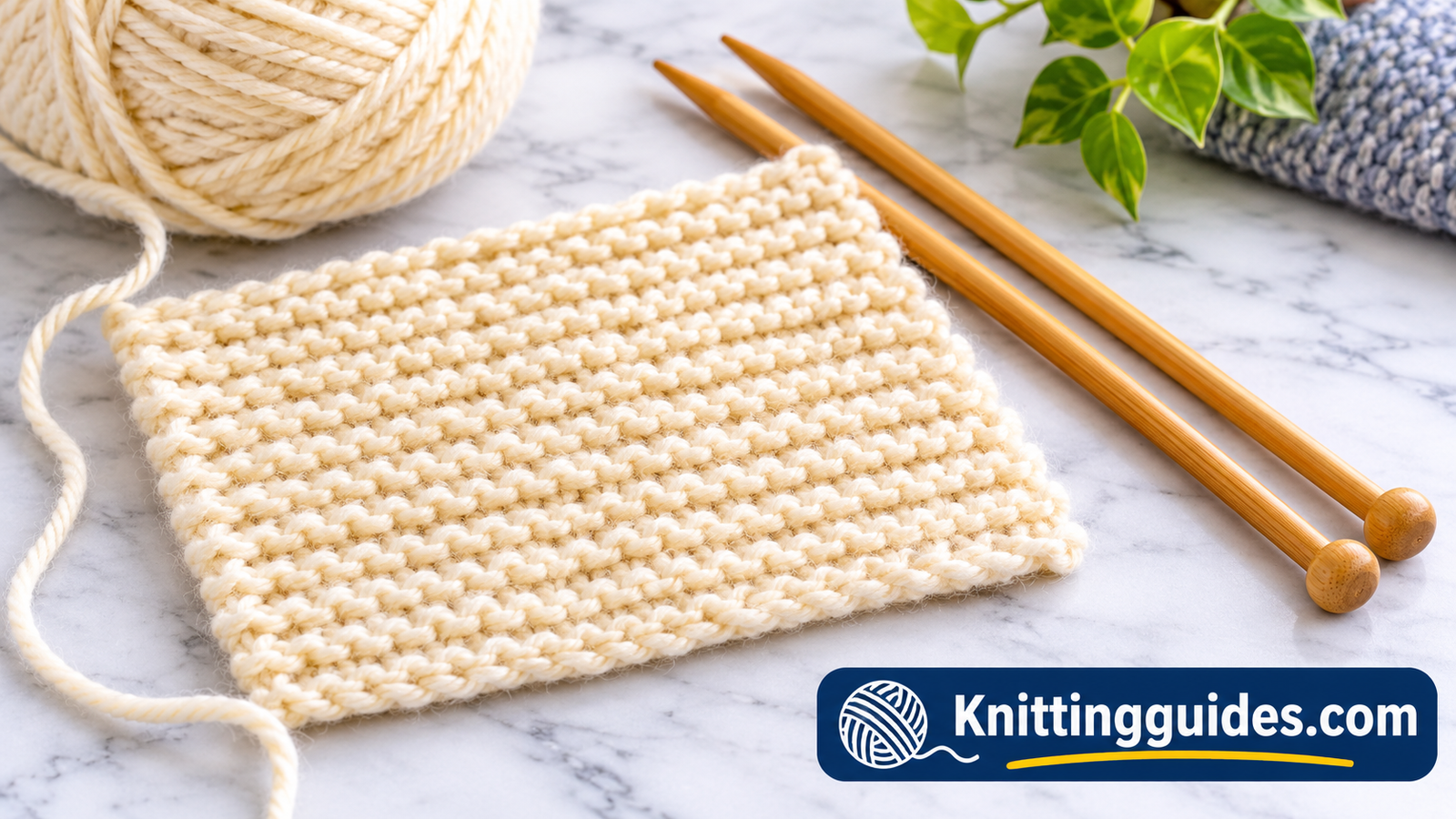
Finish the week by knitting a small square — roughly a hand’s width and height — in garter stitch (knitting every row). This swatch teaches tension, edges, and row counting all at once, and it gives you a physical record of your progress. Keep it. Compare it with a square you knit in three months and you will see exactly how far you have come.
A small swatch teaches tension, edges, and row counting in one project.
When the swatch feels comfortable, you are ready for a real project. The step-by-step for choosing yarn, needle size, and your first scarf pattern lives in our guide to starting a knitting scarf. And if you need the foundation movements in more detail, see how to cast on knitting and how to cast off knitting.
Practise With Comfortable Needles
A little grip helps the loops stay put.
Great for your first week of rows.
7. Weeks Two to Four: Building Real Skills
Week two is where knitting stops being a puzzle and starts being a hobby. The movements are familiar enough that your hands can repeat them, which frees your attention for the things that actually improve your fabric: evenness, counting, and catching mistakes early.
The purl stitch
The purl stitch is the mirror image of the knit stitch — the yarn sits in front of the work, and the needle enters the loop from the other direction. It feels awkward for a session or two because your hands are reversing a habit they just learned. Then, suddenly, it is fine. Once you can knit and purl, you can make almost any basic fabric.
Stockinette, garter, and ribbing
These three stitch patterns are the foundation of most knitting. Garter stitch is knitting every row; it produces a ridged, squishy, reversible fabric that lies flat. Stockinette stitch alternates knit and purl rows; it gives the classic smooth “V” face but curls at the edges — that curl is normal, not a mistake. Ribbing alternates knit and purl within a row, creating stretchy vertical columns used on cuffs, hems, and hats.
The three fabrics that make up most beginner knitting.
Fixing mistakes and dropped stitches
This is the single most valuable skill of month one. Learn to tink (undo stitches one at a time), learn to pick up a dropped stitch with a crochet hook or the needle tip, and learn to count your stitches at the end of every few rows. Nothing accelerates progress like the confidence that a mistake is fixable — because it almost always is.
A dropped stitch is not a ruined project — it is one loop waiting to be reworked.
Your first full project (scarf or dishcloth)
Now commit to finishing something. Pick a rectangle in garter or simple ribbing, choose a light, medium-weight yarn so you can see your stitches, and set a realistic expectation: this is practice that happens to end in a scarf. Work on it in short sessions, count your stitches every few rows, and resist restarting when the first six inches look wobbly — nobody else will see what you see.
When the last row is bound off and the ends are woven in, you have crossed the biggest psychological line in knitting: you are someone who finishes things.
Pick a Beginner-Friendly Yarn
Smooth, medium-weight wool or acrylic.
Easy to see, easy to work, easy to love.
8. Months Two and Three: Getting Comfortable
This is the stretch where knitting becomes genuinely enjoyable rather than merely interesting. The stitches are automatic, so your brain is free for the fun parts: choosing projects, understanding construction, and watching a garment take shape.
Reading patterns and abbreviations
Written patterns are dense but learnable. Almost all of them use the same small vocabulary — k for knit, p for purl, yo for yarn over, k2tog for decrease — plus row repeats in brackets or asterisks. Read the whole pattern before you start, circle anything unfamiliar, and keep a highlighter for repeats. Within a few projects the language stops being a barrier.
Our complete guide to reading a knitting pattern covers the abbreviations and symbols in detail.
Increases, decreases, and shaping
Shaping is what turns a rectangle into a garment. Increases add stitches for width; decreases remove them for slopes and necklines. There are several of each, and they all do the same job in slightly different ways. Practise them on a scrap square first — it removes the fear of “ruining” a project.
Knitting in the round
Knitting in the round uses circular or double-pointed needles to make a seamless tube. It is the technique behind hats, socks, sleeves, and cowls, and it is easier than it looks: you simply join your stitches and keep knitting, always on the right side of the fabric. Most beginners who try it in month two or three wonder why they waited so long.
Circular needles turn a flat rectangle into a seamless tube.
For the full method, including how to join without twisting, see how to knit in the round for beginners.
Trying a hat or simple wearable
A hat is the ideal first wearable: small, quick, and it teaches ribbing, knitting in the round, and crown decreases in one project. Choose a chunky yarn and a straightforward pattern, and expect it to take one to three weeks of relaxed evening knitting. When you pull it on for the first time, you will understand why people get hooked.
Move Up to Circular Needles
Seamless hats, cowls, and sleeves.
A great month-two upgrade.
9. How Much Time Should You Practice?
There is no required number of hours. But if you want a schedule that reliably moves you forward, here is what works for most beginners: short, frequent sessions with a small goal attached to each one.
Short daily sessions vs. long weekend sessions
Short sessions win for building skill; long sessions win for making progress on a project. The best routine combines both — a few twenty-minute weeknight sessions to keep your hands familiar, and one longer weekend session to move a project forward. If you can only choose one, choose short and often.
Setting small goals
Goals like “learn to knit” are too big to motivate. Goals like “cast on twenty stitches and knit four rows tonight” are perfect: specific, achievable, and finished in one sitting. Stack enough of those and the big goal takes care of itself.
Tracking progress
Keep a simple record — a note in your phone or a notebook in your project bag. Write down what you practised, what confused you, and what worked. A month later, reading back through it is the fastest confidence boost available: you will see problems you can no longer remember struggling with.
Practice schedule table (general suggestions only)
| Session Type | Length | Best For | Example Focus |
|---|---|---|---|
| Quick weeknight | 15–20 min | Building muscle memory | Ten rows of knit stitch |
| Standard evening | 30–45 min | Steady project progress | One section of a scarf |
| Weekend stretch | 1–2 hours | Learning a new technique | Practise a new stitch on a swatch |
| Learning session | 20–30 min | Pattern reading | Read a pattern before casting on |
| Social knitting | 1–2 hours | Motivation and troubleshooting | Bring one problem to ask about |
| Rest week | Minimal | Avoiding burnout | Finish nothing; browse patterns |
Keep Everything Together in a Project Bag
Needles, yarn, and pattern in one place.
Ready whenever you have ten minutes.
10. Common Beginner Hurdles and How to Get Past Them
Every knitter meets the same handful of problems in the first months. None of them mean you are not suited to knitting — they are simply the standard obstacles of the craft, and each one has a standard fix.
Tight stitches and tension problems
Tight stitches are the number one beginner complaint, and the cause is almost always grip. When you concentrate, your hands squeeze; the yarn stops sliding and the loops shrink. The fix is boring but reliable: relax your shoulders, hold the needles loosely, use needles a size or two larger than the yarn label suggests for practice, and consciously slow down. Tension evens out with volume — thousands of stitches, not dozens.
Dropped stitches and adding stitches by accident
Dropped stitches happen when a loop slips off the needle unnoticed; accidental increases happen when you wrap the yarn over the needle between stitches. Both are counting problems in disguise. Count your stitches at the end of every few rows until the habit becomes automatic, and learn to pick up a dropped stitch early — the ladder does not grow if you catch it in time.
Twisted stitches and counting errors
A twisted stitch is one mounted the wrong way on the needle, which makes the fabric look slightly off and feel less elastic. It usually comes from casting on or knitting through the back of a loop by habit. Slow down at the start of each row and look at the loop before you enter it; small attention here saves a lot of rework later.
Frustration and wanting to quit
Frustration peaks early, in that gap between knowing what to do and doing it smoothly. Practise in short sessions, choose a project you actually want, and give yourself permission to knit badly for a while. It also helps to remember that this stage is temporary and universally shared.
When to start over and when to keep going
Start over when the foundation is wrong — a twisted cast-on, the wrong number of stitches for a pattern, or a gauge so far off that the piece will not fit. Keep going when the flaw is cosmetic and near the beginning: a wobbly first inch on a scarf is a story, not a defect. A good test is to ask whether you would notice the flaw on someone else’s finished project. Usually, you would not.
When something does go wrong mid-row, our guide on how to fix knitting mistakes covers the common rescues step by step.
Keep the Small Tools Within Reach
Stitch markers and a tape measure prevent most errors.
Small cost, big difference.
11. Tools and Materials That Make Learning Easier
You can learn to knit with very little. But choosing beginner-friendly materials genuinely shortens the timeline, because good tools remove friction you would otherwise have to learn around.
Beginner-friendly yarn
Look for a smooth, medium-weight yarn in a light, solid colour. Smooth means you can see each stitch clearly and the plies do not split when the needle goes through. Light colour means you can read your own fabric. Medium weight means the project grows quickly enough to stay motivating. Wool blends and good acrylics are both excellent starting points.
Our full comparison of the best yarn for beginner knitting goes deeper into fibre, weight, and colour.
Needles: size, material, and grip
Needle material changes the feel of knitting. Wood and bamboo have a little grip, which stops slippery yarn from jumping off the needle — ideal for beginners. Metal is fast and smooth, which many knitters prefer once their tension is even. As for size, a medium-to-large needle paired with medium yarn gives you big, visible stitches to learn on.
Two useful references before you buy: the best knitting needles for beginners and a plain-English explanation of what size knitting needles to start with.
Stitch markers, a tape measure, and other basics
Stitch markers sit on the needle and mark repeats, pattern changes, or the beginning of a round — they turn counting from a memory task into a visual one. A tape measure helps you check progress and, later, gauge. Add a pair of small scissors, a blunt tapestry needle for weaving in ends, and a row counter, and you have everything most projects require.
Starter kits and tutorials
A starter kit bundles the essentials so you are not guessing at sizes and weights on your first trip to the shop. If you prefer to build your own collection, look for a small set of needles in the sizes you will actually use rather than a large set you will not. For curated options, see the best knitting kits for beginners.
Two more tools worth knowing about early: a good knitting light makes evening sessions far easier on the eyes, and understanding circular vs. straight knitting needles helps you buy once rather than twice. If you ever consider an upgrade, our comparison of interchangeable needle sets is a useful read.
Beginner supplies table
| Item | What to Look For | Why It Helps | When You Need It |
|---|---|---|---|
| Yarn | Medium weight, smooth, light solid colour | Stitches are easy to see and control | Day one |
| Needles | Medium-to-large size, wood or bamboo | Grip keeps loops from slipping | Day one |
| Stitch markers | Simple rings or locking clips | Marks repeats and reduces counting errors | Week one |
| Tape measure | Flexible, with clear markings | Tracks length and checks gauge later | Week two |
| Tapestry needle | Blunt tip, large eye | Weaves in ends neatly and safely | First finished project |
| Small scissors | Sharp, compact | Clean cuts for finishing | Week one |
| Row counter | Simple click or app-based | Removes the “which row am I on?” problem | First project |
| Project bag | Roomy, with a closure | Keeps everything ready to grab | Anytime |
Get the Whole Starter Set at Once
Yarn, needles, markers, and finishing tools.
One purchase, everything you need.
12. Tips to Learn Knitting Faster
If you want to compress the timeline without cutting corners, these are the habits that make the biggest difference. None of them require more talent — only smarter choices about how you practise.
Start with the right first project
Choose a small rectangle in one stitch pattern, in medium-weight yarn, in a colour you love. It teaches the fundamentals quickly and finishes before motivation fades. A first project that takes eight months is a first project that rarely gets finished.
Use video tutorials and a knitting community
Watch the movement once, then knit along in slow motion. When you get stuck, ask — online groups and forums answer beginner questions constantly, and the answer to your problem is almost always someone else’s solved problem.
Take classes or join a knit night
Nothing accelerates learning like a person watching your hands. A single class can correct a grip habit that would otherwise take months to notice on your own. And a regular knit night gives you a reason to keep going on the weeks when you would rather not.
Want to find or start one? We wrote about how to start a knitting group.
Keep a project journal
Note the yarn and needles used, the number of stitches, what you changed, and what you would do differently. It turns every project into a lesson instead of a one-off, and it makes your second project dramatically smoother than your first.
Stay patient and keep it enjoyable
Enjoyment is a genuine learning tool. If a project is making you miserable, put it down and start something small and fun. The knitters who progress fastest are consistently the ones still knitting in six months — and that has far more to do with pleasure than with pace.
Upgrade Your Knitting Comfort
Better light, better bags, better tools.
Small upgrades that keep you knitting.
Frequently Asked Questions
How long does it take to learn knitting?
Most beginners learn the foundational stitches — cast on, knit, purl, bind off — within a few hours of practice. A first finished project usually takes two to four weeks of casual knitting, and pattern confidence typically arrives after two to three months of regular sessions.
Can you learn to knit in a day?
You can learn the basics in a day: how to hold the needles, cast on, and make a knit stitch. What you cannot do in a day is develop even tension and smooth, reliable fabric — that comes from repetition over the following days and weeks.
How long does it take to knit a scarf as a beginner?
For a simple garter or ribbed scarf in medium-weight yarn, most beginners finish within two to four weeks of relaxed evening knitting. Wider scarves, finer yarn, or more complex stitch patterns take longer.
Is knitting hard to learn?
Knitting is not difficult, but it is fiddly at first. The main challenge is coordinating both hands at once while keeping the tension relaxed. Almost everyone finds the first hour awkward and the second week surprisingly comfortable.
How many hours a week should a beginner practice knitting?
Around three to five short sessions per week is plenty — roughly two to four hours in total. Short, frequent sessions build skill faster than one long block, because your hands and memory both benefit from repetition.
How long does it take to learn to read a knitting pattern?
Most beginners become comfortable with straightforward written patterns after two to three months of practice. The abbreviations form a small, consistent vocabulary, and once you recognise the common ones, reading patterns becomes quick.
Is knitting or crochet faster to learn?
Crochet often feels easier in the first hour because you manage only one live loop with one tool. Knitting usually takes slightly longer to feel natural but produces the smooth, elastic fabric many people want. Try both and let your hands decide.
How long does it take to knit a sweater as a beginner?
A simple sweater in chunky yarn is a realistic goal around month four to six, and finishing it usually takes several months of steady knitting. Sweaters are not technically hard so much as long, so plan for the marathon rather than the sprint.
Can I teach myself to knit?
Absolutely. Plenty of knitters are entirely self-taught using videos, written guides, and practice. The main advantage of a class is instant feedback on your hands — but patience and repetition will get you there on your own.
What is the easiest thing to knit first?
A small garter stitch square or dishcloth. It uses only the knit stitch, needs no shaping, and finishes quickly. A narrow scarf is the next step up and makes a satisfying first real project.
What are the most common beginner knitting mistakes?
Holding the yarn too tightly, losing or accidentally adding stitches, twisting stitches on the needle, and choosing yarn that is too fine or too dark to see. Counting rows and keeping a relaxed grip prevent most of them.
How do I get better at knitting quickly?
Practise often in short sessions, choose forgiving materials, learn to fix mistakes instead of restarting, and finish small projects to build confidence. Consistency beats intensity every single time.
Start Your Next Small Project
A fresh skein is the best motivation.
Choose a colour you cannot wait to use.
Conclusion: A Realistic Timeline, and Why Steady Beats Fast
Here is the timeline in one place: a few hours to learn the basic stitches, two to four weeks to finish a first project, two to three months to read patterns comfortably, and three to six months to feel like a knitter who can choose and complete almost anything you want to make. Those ranges are wide on purpose, because the honest answer to “how long does it take to learn knitting?” is always “it depends on how often you practise.”
And that is genuinely good news. It means the outcome is not decided by talent, age, or how clumsy your first cast on looked. It is decided by how many times you pick the needles back up. Steady practice beats speed in knitting exactly the way it does in every other skill: small, repeated effort compounds quietly, and one day you realise the stitches happen without you thinking about them.
So here is your first action. Today, not next week: cast on about twenty stitches and knit a small practice swatch. It does not have to be neat, it does not have to become anything, and it does not have to impress anyone. It just has to be the first square — the one you will compare against in three months and be quietly amazed by.
Cast On Your First Swatch Today
Everything you need is one simple kit away.
Needles, yarn, markers, and a tapestry needle.
You May Also Like
Can You Bring Knitting Needles on a Plane?
What to pack, how to store your project, and how to keep your knitting going at 30,000 feet.
Fibre PrepBest Spinning Wheels for Beginners
Where knitters go when they want to make their own yarn from the very start.
MachinesBest Knitting Machines
When you love the fabric but want the rows to move faster.
BudgetIs Knitting Expensive?
An honest look at what knitting really costs once the first skein is wound.
BudgetIs Knitting Cheaper Than Buying?
Homemade versus shop-bought, counted in yarn, time, and satisfaction.
ProjectsWhat to Knit for a Baby
Small, quick, deeply appreciated projects for the tiniest recipients.
ProjectsWhat to Knit With Chunky Yarn
Fast, satisfying patterns that grow on the needles in an evening.
StashSmall Projects With Leftover Yarn
Clever ways to turn a half-used skein into something useful.
FamilyKnitting Projects for Kids
Ideas to knit for children, and ideas children can learn to knit themselves.
GivingKnitting for Charity Ideas
Practical projects that go straight from your needles to someone who needs them.
BusinessHow Much to Charge for Knitted Items
How to price your work fairly, for you and for your customers.
BusinessHow to Sell Knitted Items on Etsy
Setting up a shop, photographing your work, and finding your first buyers.
BusinessKnitting Business Ideas
Ways to turn a hobby you love into something that earns.
WellbeingIs Knitting Good for the Brain?
What the repetitive rhythm of knitting does for focus, memory, and calm.
CommunityHow to Start a Knitting Group
Find your people, pick a time and place, and keep everyone knitting.