
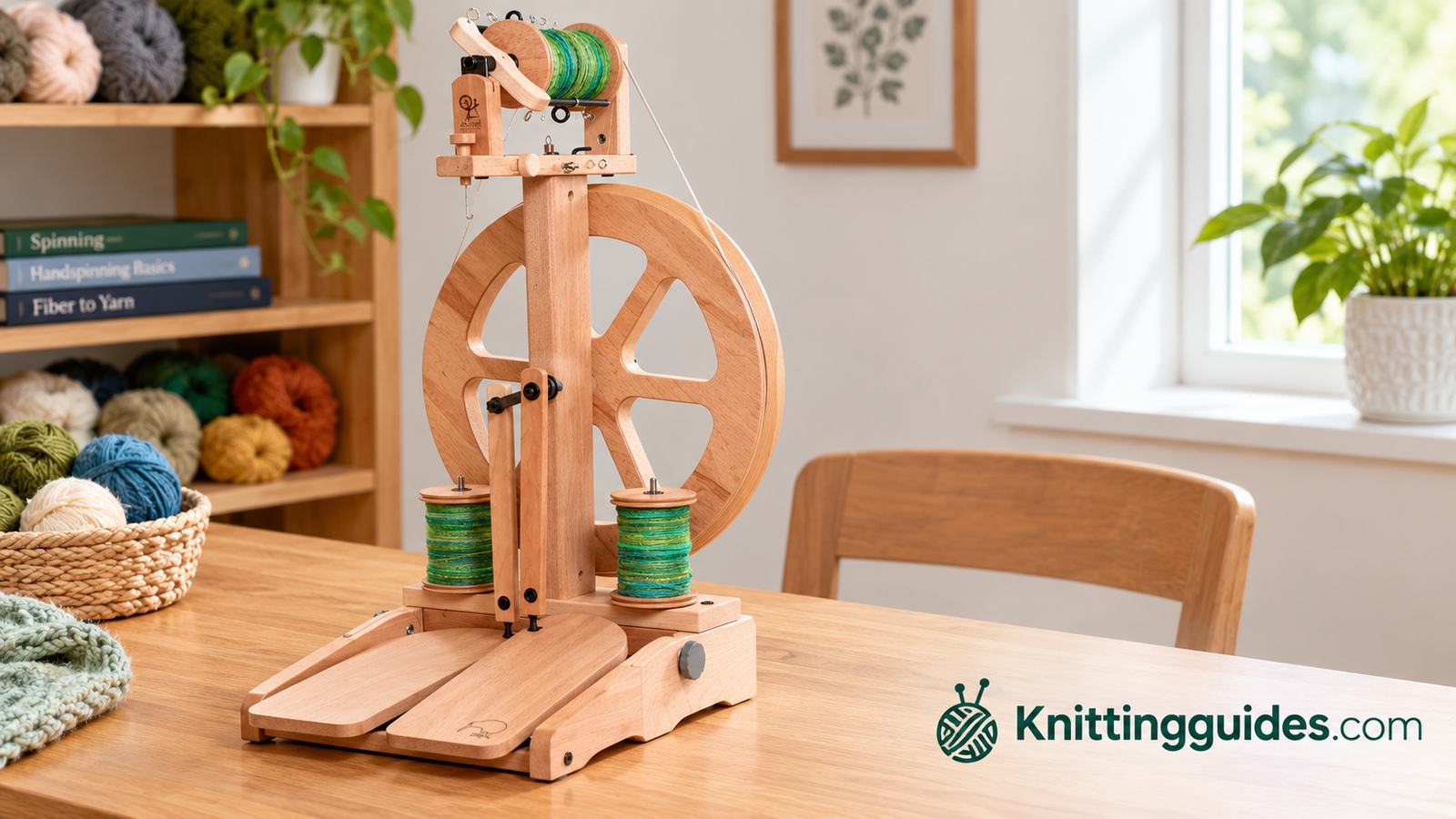
Best Spinning Wheels for Beginners: 8 Tools That Make Learning to Spin Genuinely Enjoyable
A hands-on comparison of the beginner spinning wheels, electric spinners, learn-to-spin kits, and drop spindles worth your money — and how to pick the right one for the way you actually craft.
Table of Contents
- What Makes a Setup Beginner-Friendly
- Wheels vs. Electric Spinners vs. Spindles
- Ashford Kiwi 3 Review
- Best Electric Spinners
- Best Learn-to-Spin Kits
- Best Drop Spindles
- Drive Systems Explained
- Choosing Your First Fibre
- Drafting, Treadling & Rhythm
- Maintenance & Troubleshooting
- Budgeting for the Hobby
- Safety, Storage & Shared Homes
- Frequently Asked Questions
- Final Verdict
Learning to Spin Your Own Yarn Is Easier Than It Has Ever Been
There is a specific moment that hooks almost everyone who tries hand spinning: the first time a cloud of fibre in one hand becomes a continuous, usable strand of yarn in the other. It is a small magic, and it is the reason people keep a spinning wheel in the corner of a living room for the next thirty years.
Getting to that moment, though, depends almost entirely on choosing the right beginner spinning wheel — or the right beginner spinning tool. A wheel that fights you, wobbles, or needs constant fiddling with tension will quietly convince you that spinning is harder than it is. A well-chosen starter wheel turns the same first week into a series of small wins: a first bobbin, a first skein, a first thing you actually knitted from yarn you made.
This guide is built around eight genuinely beginner-friendly options, ranging from a proper folding spinning wheel to compact electric spinners and honest, low-cost drop spindles. Some of these are wheels in the traditional sense. Some are spindles or electric yarn makers that solve the same problem — turning fibre into yarn — in a completely different way. For someone just starting out, that distinction matters more than any single specification, which is why we spend real time in this article explaining how the categories differ before we talk about individual products.
Throughout the guide, you will find honest trade-offs rather than marketing language. We deliberately avoid quoting exact specifications, prices, and star ratings, because those things change and because the numbers on a product page rarely explain how a tool actually feels in your hands. Where something matters — how a wheel feeds fibre, how steady a spindle spins, how forgiving a tension system is — we describe the experience instead.
How to read this guide
If you already know you want a treadled wheel, jump to the Ashford Kiwi 3 review and the drive-system section. If you want to test the hobby for the smallest possible commitment, start with the drop spindle comparison. If you have wrist, shoulder, or mobility concerns, the electric spinner section is written specifically for you.
One more thing before we start: spinning and knitting are deeply complementary skills. Plenty of spinners are knitters first, and plenty of knitters discover spinning because they want to control the exact yarn that goes into their stitches. Where it is useful, we link out to our knitting guides so you can follow the thread from fibre to finished fabric — for example, our overview of the best yarn for beginner knitting, which is a helpful companion when you start producing skeins of your own and want to understand how handspun behaves against commercial yarn.
Browse beginner spinning wheels and starter kits before the good starter models sell out.

A good starter kit removes the guesswork: fibre that drafts easily, a tool that behaves predictably, and instructions that assume you know nothing yet.
Quick Comparison: Our Top Picks
Here is every tool in this guide side by side. Read the “Best For” label first — it tells you instantly whether the tool matches how you want to spin — then scan the key traits and verdict for the detail that matters to you.
Swipe to see more →
| # | Image | Product | Key Traits | Verdict | Where to Buy |
|---|---|---|---|---|---|
| 1 |  |
Top Pick Ashford Kiwi 3 Spinning Wheel Best Overall |
|
The wheel most beginners should buy if they know they want to spin for years. | Check Price on Amazon |
| 2 |  |
Aredwhiterui Mini Electric Spinning Wheel Best Compact Electric |
|
A tiny footprint that turns almost any table into a spinning station. | Check Price on Amazon |
| 3 |  |
Electric Yarn Spinner Kit with Foot Controller Best Hands-Free Electric |
|
Foot control makes speed management feel intuitive from the first session. | Check Price on Amazon |
| 4 |  |
DICHA 3" Drop Spindle Kit Best Starter Spindle Kit |
|
The lowest-friction way to learn drafting before spending wheel money. | Check Price on Amazon |
| 5 | |
Living Dreams Yarn Learn to Spin Kit Best Complete Learn Kit |
|
If you want someone to hand you everything and say “start here”, this is it. | Check Price on Amazon |
| 6 |  |
SAVINA Wooden Top Whorl Drop Spindle Best Top Whorl Spindle |
|
A nicely balanced spindle that rewards a little daily practice. | Check Price on Amazon |
| 7 |  |
Yushen Turkish Spindle Best Budget Pick |
|
Under twenty dollars to find out whether spinning is for you. | Check Price on Amazon |
| 8 |  |
CUTBLAJAT Turkish Drop Spindle (8" Walnut) Best Premium Turkish |
|
For the spinner who wants their first spindle to be their favourite object. | Check Price on Amazon |
Start with the category comparison below — it takes about three minutes to read and will save you from buying the wrong kind of tool.
What Actually Makes a Spinning Setup Beginner-Friendly
Plenty of products are labelled “beginner friendly” and very few of them explain what that means. In practice, when we talk about a beginner spinning wheel or spindle, we are talking about four specific things: forgiving tension, predictable behaviour, easy setup, and a learning curve that rewards you quickly enough to keep going.
Forgiving tension beats clever tension
Beginners are not short of things to think about. You are coordinating fibre supply, drafting speed, twist, and — on a wheel — foot speed at the same time. A tension system that needs constant, precise adjustment adds a fifth variable and turns a relaxing craft into fiddling. The beginner-friendly approach is a tension system that works across a wide range of yarn thicknesses with only occasional adjustment, so you can concentrate on what your hands are doing with the fibre.
Predictable behaviour builds muscle memory
Learning to spin is largely about building feel: how much twist is enough, how fast to draft, how much to let the fibre feed. That feel develops fastest on a tool that behaves the same way every time you sit down. Wobbly spindles, wheels that drift in speed, or flyers that catch inconsistently all slow down the learning process, even if the tool is technically usable.
Setup should take minutes, not an afternoon
There is a real psychological cost to tools that require assembly and tuning before first use. Wheels arrive in varying states of readiness, and while some assembly is normal and even enjoyable, the ideal beginner setup means you can be spinning within a short session. Look for products that come with clear instructions and, ideally, the fibre and accessories needed to start — or choose a kit designed for that purpose.
Early wins matter more than long-term ceiling
It is tempting to buy for the spinner you hope to become. But the honest truth about new hobbies is that the first fortnight decides most outcomes. A tool that produces a rough, thick, enthusiastic first yarn within an hour is worth more to a beginner than a professional-grade instrument that demands perfect technique before it produces anything at all. You can always grow into finer yarns and fancier equipment later.
It is also worth thinking about the environment you will spin in. If you live in a small flat, a full-sized wheel that occupies a permanent corner is a genuine cost, and a folding or compact design changes the equation completely. If you plan to spin while travelling, on a commute, or in a craft group, portability stops being a nice-to-have and becomes the deciding factor. We touch on this again in the section on storage and shared living spaces.
Finally, remember that the beginner spinning world is bigger than wheels. Drop spindles and electric spinners solve the same problem with a completely different set of advantages, and for many people one of those is the genuinely better first purchase. Let us compare the three categories properly.
Filter for beginner kits and compact wheels so you are not paying for capability you will not use yet.
Spinning Wheels vs. Electric Spinners vs. Drop Spindles: Which Should You Start With?
This is the decision that shapes everything else, so it deserves more than a paragraph. All three categories produce yarn from fibre, and all three can produce beautiful yarn. They differ in cost, learning curve, physical demand, portability, and the kind of spinning they naturally encourage.
Traditional treadled spinning wheels
A treadled wheel is the classic image of spinning for a reason: it is fast, satisfying, and capable of producing a huge range of yarns. Your feet drive the wheel, your hands draft, and a bobbin-and-flyer system stores the finished yarn as you go. The learning curve is real but manageable, and most beginners are producing consistent singles within a few sessions.
The trade-offs are space, cost, and physical coordination. Wheels cost more than spindles, they need somewhere to live, and the first hour of foot-and-hand coordination can feel like patting your head and rubbing your stomach. For anyone who knows they want to spin regularly, though, a wheel is the tool that stays useful longest — which is why the Ashford Kiwi 3 sits at the top of this guide.
Electric spinners and electric yarn makers
Electric spinners remove the treadle entirely. A motor supplies the twist, and both of your hands stay on the fibre. For some people that is a convenience; for others it is the difference between being able to spin and not. If treadling is tiring or difficult, if you want to ply long lengths without a leg workout, or if you want a tool that lives in a drawer, an electric spinner deserves serious consideration.
The learning curve is often shorter than people expect, because the motor removes one coordination variable. The trade-offs are noise, dependence on a power source, and a different feel — you control speed by dial or foot pedal rather than by foot rhythm. The two electric options in this guide take different approaches to that control, which we cover in the review section.
Drop spindles
A drop spindle is the oldest spinning technology still in everyday use, and it remains the cheapest and most portable way to learn. You spin the spindle, let it hang, and draft fibre into yarn. There is nothing to plug in, nothing to assemble, and nothing to store. Thousands of people learn to draft on a spindle long before they ever touch a wheel.
The trade-offs are speed and length. Spinning a usable quantity of yarn on a spindle takes longer than on a wheel, and there is an unavoidable learning period where your spindle hits the floor. But the cost of entry is so low that a spindle is the ideal first purchase for the curious — and the drafting skills transfer directly to a wheel later.
Swipe to see more →
| Factor | Treadled Wheel | Electric Spinner | Drop Spindle |
|---|---|---|---|
| Learning curve | Moderate — foot and hand coordination | Gentle — hands focus on drafting only | Moderate — managing spin and gravity |
| Speed of output | Fast once comfortable | Fast, with consistent twist | Slow but very controllable |
| Portability | Limited, though folding models help | Excellent — small and lightweight | Best — fits in a bag pocket |
| Cost to start | Higher | Moderate | Lowest |
| Physical demand | Uses legs and posture | Minimal physical effort | Arm and shoulder movement |
| Best for | Committed new spinners | Comfort, travel, and plying | Testing the hobby cheaply |
If you are still unsure, here is the simple version. Buy a drop spindle if you want to find out whether you enjoy drafting fibre. Buy an electric spinner if comfort, space, or travel is your main constraint. Buy a treadled wheel if you already know spinning is going to be your thing and you want the tool that will grow with you.
Whichever route you take, the skills overlap heavily. Someone who learned to draft on a spindle picks up wheel spinning faster than a complete beginner, and someone who learned on a wheel finds spindling intuitive within an afternoon. It is not a one-way door — plenty of experienced spinners keep a spindle in their bag alongside a wheel at home. If you like understanding how your crafts compare, our look at crochet versus knitting takes the same approach to another craft decision.
Search drop spindles and starter fibre bundles — you can test the craft for the price of a takeaway.
Ashford Kiwi 3 Review: The Best Overall Spinning Wheel for Beginners
When people ask experienced spinners what wheel to buy first, one name comes up again and again, and it is the Kiwi. The Ashford Kiwi 3 is a compact, folding wooden spinning wheel designed from the ground up for people who are learning, and it shows in almost every design choice.
Ashford Kiwi 3 Spinning Wheel
A compact, foldable treadled wheel from a long-established spinning wheel manufacturer — the tool most beginners should buy if they intend to keep spinning.
Key Features
- Beginner-scaled proportions. The wheel sits at a comfortable height for most users and does not overwhelm a small room or a first-time spinner.
- Folding design. It collapses for storage and transport, which solves the single biggest objection people have to owning a wheel in a shared or small home.
- Bobbin-and-flyer system. Yarn winds onto the bobbin as you spin, so you can produce a meaningful amount of yarn without stopping to wind off.
- Adjustable tension. Forgiving enough for thick, slubby first yarns and adjustable enough for the more even singles you will be making within weeks.
- Trusted maker. Ashford has been making spinning equipment for generations, and that matters for spare bobbins, accessories, and community knowledge.
What We Like
- Folds away instead of owning a corner of your room
- Stable, predictable treadling that builds good habits
- Forgiving across a wide range of yarn thicknesses
- Strong accessory and spare-part ecosystem
- Comfortable for long, relaxed spinning sessions
Worth Knowing
- It is a real investment compared with a spindle kit
- Some assembly and initial tuning is expected
- Still needs floor space while in use
- Overkill if you only want to try spinning once
Our top overall pick for beginners who want a proper wheel.
What it is like to learn on
The first session on a Kiwi is usually about discovering that your feet can do something on their own. Because the treadling is smooth and the drive is predictable, most beginners move past that stage faster than they expect. The wheel does not punish small inconsistencies in treadling speed, which is exactly what you want when your brain is fully occupied with drafting.
By the second or third session, the usual progression is a noticeable improvement in yarn evenness — not because your technique has transformed, but because the tool is consistent enough for you to see what your hands are doing wrong. That feedback loop is what makes a beginner wheel genuinely beginner-friendly, and it is the main reason we rank this wheel first.
The folding design deserves a second mention because it changes ownership. A wheel that can be folded and put behind a door or in a closet is a wheel you can own in a flat, a shared house, or a home with small children and pets. If you are curious about how spinning compares with other textile crafts as a first skill, our guide to how to start knitting is a natural next read.
See how the Kiwi stacks up against electric and spindle-based options before you decide.
Best Electric Spinners for Beginners: Portable, Low-Effort Yarn Making
Electric spinners are the quiet revolution in hand spinning. By replacing the treadle with a motor, they free both hands for drafting and remove the physical element of spinning entirely. That makes them genuinely accessible to people who cannot treadle comfortably, and genuinely convenient for anyone who wants to spin on a desk, at a kitchen table, or while travelling.
The two options below take different approaches to speed control, and that difference matters more than any other feature. One is a compact unit designed for lightness and simplicity; the other gives you a foot controller so you can manage speed without lifting a hand from the fibre.
Swipe to see more →
| Feature | Aredwhiterui Mini Electric | Electric Spinner Kit + Foot Controller |
|---|---|---|
| Speed control | Simple on-unit control | Foot controller for hands-free adjustment |
| Best at | Everyday light spinning and travel | Longer sessions and plying |
| Format | Compact single unit | Kit with the parts to start immediately |
| Choose it if | Space and simplicity matter most | You want intuitive, hands-free control |
Aredwhiterui Mini Electric Spinning Wheel
A compact electric spinner that turns any flat surface into a spinning station, with a footprint small enough to live in a drawer between sessions.
Key Features
- Ultra-compact format. Small enough to leave set up on a desk corner or pack into a project bag without rearranging your life.
- Motor-driven twist. Both hands stay on the fibre, so you can focus entirely on drafting and yarn thickness.
- Simple operation. Turn it on, set a comfortable speed, and spin — no assembly marathon or tuning session first.
- Useful beyond beginners. Many experienced spinners keep a compact electric spinner specifically for plying, where speed and consistency matter more than anything else.
What We Like
- Extremely small storage footprint
- Minimal physical effort to use
- Consistent twist makes even yarn easier
- Easy to take to craft groups or on trips
Worth Knowing
- Requires a power source, so it is not a park-and-spin tool
- Motor noise is noticeable in a quiet room
- Speed control is less nuanced than a foot pedal
- Does not teach treadling technique
Best compact electric spinner for small spaces and travel.
Electric Yarn Spinner Kit with Foot Controller
An electric yarn maker that puts speed control at your foot, so your hands never leave the fibre mid-draft.
Key Features
- Foot controller. Speed up, slow down, or stop without moving your hands — which is exactly when you need to adjust.
- Kit format. Arrives as a complete starting package so you can begin spinning without hunting for compatible parts.
- Consistent twist delivery. Great for longer spinning sessions where fatigue would otherwise creep in.
- Strong for plying. The steady, controllable speed makes plying singles into balanced yarn far less tedious.
What We Like
- Hands-free speed control feels natural quickly
- Reduces fatigue in long sessions
- Kit format removes compatibility guesswork
- Excellent for plying quantities of singles
Worth Knowing
- The foot controller needs floor space nearby
- Motorised tools make some sound while running
- Requires a nearby outlet
- Less portable than a spindle
Best hands-free electric option for effortless speed control.
A note on expectations: an electric spinner does not make yarn for you. It supplies twist at a steady rate, and everything else — how thick the yarn is, how consistent it is, how much texture you leave in — is still your hands and your judgement. That is genuinely good news, because it means the skills you build transfer directly to a wheel or a spindle later. And when your first handspun skeins are ready for needles, our round-up of beginner knitting needles is the right place to go next.
Compare compact spinners and foot-controlled kits before choosing your speed control style.
Best Learn-to-Spin Kits for Absolute Beginners
If there is one recurring frustration among self-taught spinners, it is this: they bought a tool, then discovered they also needed fibre, a way to store yarn, instructions, and something to do with the finished singles. A good learn-to-spin kit solves that in one purchase. Everything is chosen to work together, so you spend your first evening spinning rather than researching.
Both options in this section are kit-based, but they sit at different ends of the learning spectrum. One is a curated spinning kit built around learning to make yarn; the other is a compact spindle kit that teaches drafting at a very low cost.
Swipe to see more →
| Feature | Living Dreams Yarn Learn to Spin Kit | DICHA 3" Drop Spindle Kit |
|---|---|---|
| Focus | Complete learning experience | Learning drafting on a spindle |
| Best for | Guided, structured beginners | Low-cost experimentation |
| Portability | Good — everything in one bundle | Excellent — fits in a bag |
| Choose it if | You want to be told exactly how to start | You want to test spinning for very little |
Living Dreams Yarn Learn to Spin Kit
A curated starter bundle for people who want someone to hand them everything they need and say “start here”.
Key Features
- Complete starting bundle. The pieces are selected to work together, so there is no compatibility guesswork and no mid-project shopping trip.
- Includes spinning fibre. Practising on fibre that drafts well is one of the biggest accelerators for new spinners.
- Learning-oriented. Designed around building skill progressively rather than just supplying hardware.
- Gift-ready. One of the few spinning gifts that a total beginner can open and use the same day.
What We Like
- Everything in one purchase, no missing pieces
- Beginner-friendly fibre that is pleasant to draft
- Structured learning builds confidence fast
- An excellent gift for a curious crafter
Worth Knowing
- Kit quantities of fibre run out as you practise
- You will eventually want additional fibre
- Not a substitute for a full spinning wheel
The best complete starter bundle for guided learning.
DICHA 3" Drop Spindle Kit
A compact drop spindle sold as a kit — the lowest-friction way to learn drafting before committing to a wheel.
Key Features
- Compact 3" format. A small, light spindle that is easy to control while your hands learn what drafting feels like.
- Kit-based. You can begin practising immediately without sourcing fibre or extras separately.
- Zero setup. No power, no assembly bench, no tuning — pick it up and spin.
- Teaches transferable skill. The drafting technique you learn here is exactly the technique you will use on a wheel.
What We Like
- Very low cost to try the craft
- Extremely portable — spins anywhere
- Builds excellent drafting fundamentals
- No power source or dedicated space required
Worth Knowing
- Expect a learning period before yarn looks even
- Producing a full skein takes time
- Light spindles suit finer yarns better than heavy ones
Best starter spindle kit for learning drafting on a budget.
Kit-based learning also pairs beautifully with other structured craft starts. If the person you are buying for turns out to prefer needles to fibre, our guide to the best knitting kits for beginners is the natural follow-up — same idea, different craft.
Search learn-to-spin kits that include fibre, tools, and instructions in one box.
Best Drop Spindles for New Spinners: Top Whorl and Turkish Styles
Drop spindles are where most of the world learned to spin, and they remain the most forgiving classroom there is. They are inexpensive, indestructible in normal use, and small enough that practicing while the kettle boils is a realistic plan. The three below cover the two most common beginner styles: top whorl and Turkish.
Swipe to see more →
| Feature | SAVINA Top Whorl | Yushen Turkish | CUTBLAJAT Turkish (8" Walnut) |
|---|---|---|---|
| Style | Top whorl | Turkish cross-arm | Turkish cross-arm |
| Spins best | Finer, more even singles | Everyday practice yarns | Steady, longer spins |
| Signature trait | Lively, fast rotation | Centre-pull ball as you spin | Generous size, warm walnut finish |
| Choose it if | You want to work towards fine yarn | Budget is tight | You want a tool you will keep forever |
SAVINA Wooden Top Whorl Drop Spindle
A well-balanced top whorl spindle that rewards daily practice and naturally pushes you towards finer, more even yarn.
Key Features
- Top-whorl balance. With the weight high on the shaft, the spindle spins up quickly and carries momentum nicely for its size.
- Wooden construction. Warm to the hand, quiet in use, and comfortable for long practice sessions.
- Encourages finer yarn. Top whorl spindles are the classic choice as your drafting gets finer and more controlled.
- Pocketable. Slips into a project bag so practice fits around everything else in your day.
What We Like
- Lively spin that feels satisfying quickly
- Natural progression towards finer yarns
- Quiet, tactile, and pleasant to use
- Trivial to store and carry
Worth Knowing
- Faster spin can feel lively at first
- Very light spindles hold less yarn per length
- Yield per hour is lower than a wheel
Best top whorl spindle for developing even, fine singles.
Yushen Turkish Spindle
A budget-friendly Turkish spindle that makes trying hand spinning one of the cheapest craft experiments you can do.
Key Features
- Exceptional value. A genuinely affordable way to find out whether spinning is for you.
- Turkish cross-arm design. Yarn winds onto the cross arms as you spin, forming a usable centre-pull ball when you slide it off.
- Compact and travel-ready. Small enough for a coat pocket and robust enough to live in a bag.
- Beginner-friendly output. The wound ball is ready to ply or knit without extra winding equipment.
What We Like
- Under twenty dollars to test the hobby
- Builds a centre-pull ball automatically
- Lightweight and easy to learn on
- A perfect small gift for a curious crafter
Worth Knowing
- Light spindles suit lighter yarns best
- Expect practice before your yarn looks smooth
- Not intended for heavy or textured art yarns
Our budget pick — the cheapest honest way into hand spinning.
CUTBLAJAT Turkish Drop Spindle (8" Walnut)
A generous 8" walnut Turkish spindle for the spinner who wants their first tool to also be their favourite object.
Key Features
- Generous 8" proportions. A larger cross-arm span means more yarn wound per length and a longer, steadier spin.
- Walnut construction. A rich, warm wood that looks as good resting on a shelf as it does in use.
- Turkish centre-pull winding. Slide the finished ball off the arms and you have a ready-to-use centre-pull ball.
- Feels substantial. The kind of tool that makes a practice session feel like an occasion.
What We Like
- Longer spin time per push
- Beautiful walnut finish and build
- Winds a generous, usable ball of yarn
- Feels like a keepsake rather than a starter item
Worth Knowing
- Larger size is slightly less pocketable
- Costs more than an entry-level spindle
- Still slower than spinning on a wheel
A premium Turkish spindle that earns its place on the shelf.
Spindles are also the perfect travel craft. If you are planning a project to take with you, our guide to bringing knitting needles on a plane covers the same question for the needle side of your bag — and a spindle plus a small knitting project makes an excellent travel pairing.
Browse top whorl, bottom whorl, and Turkish spindles to find the balance that suits you.
Understanding Drive Systems: Single Drive, Double Drive, and Scotch Tension
Nothing confuses a new spinner faster than the vocabulary around drive systems. Yet the underlying idea is simple: the wheel turns the flyer and the bobbin, and the difference between systems is which one gets driven and how you control the take-up — the pull that draws finished yarn onto the bobbin.
Single drive with Scotch tension
In this arrangement, the drive band turns one element and a brake band applies adjustable friction to the other. Adjusting that brake band changes how strongly the yarn is pulled onto the bobbin. It is the most widely recommended setup for beginners because the adjustment is intuitive: more brake means more take-up, less brake means less. When your yarn keeps breaking near the orifice, you almost always have too much take-up, and one small adjustment fixes it.
Double drive
Here a single long band loops twice, driving both the flyer and the bobbin at slightly different speeds. The result is a smooth, gentle take-up that many experienced spinners love for finer yarns. It is a little less immediately adjustable than Scotch tension, which is why it is often described as a system you grow into rather than one you learn on.
Bobbin lead
The third common arrangement drives the bobbin directly and lets the flyer be dragged around by the yarn. Take-up tends to be stronger, which suits thicker yarns and textured spinning. Some beginners find it aggressive at first, but it is a genuinely useful system to understand.
For a first wheel, the honest advice is this: do not agonise. Any of these systems will teach you to spin, and the wheel’s overall stability and your own consistency matter far more than the configuration on the spec sheet. If you are the sort of person who enjoys understanding the mechanics before buying, this section gives you the vocabulary; if you would rather just start, the Kiwi 3 or an electric spinner removes the decision entirely.
The beginner’s rule of thumb
If the yarn keeps breaking, reduce take-up. If the yarn keeps backing up and never winds on, increase take-up. Almost every first-week problem is one of these two, and almost every fix takes ten seconds.
Understanding these systems also helps when you eventually look at used wheels or an upgrade model, because you will know what the descriptions mean. And when your handspun yarn is ready for its first real project, our guide to how to read a knitting pattern will help you choose something that flatters an uneven, charming, handspun yarn.
Look at tension design and adjustability before you settle on your first wheel.
Choosing Your First Fibre: What to Spin Before You Invest More
Here is the part of spinning that nobody warns you about: the fibre matters as much as the tool. A brilliant wheel loaded with a sticky, felted, or overly short-stapled fibre will frustrate a beginner, while a cheap spindle loaded with a soft, well-prepared wool will produce surprisingly lovely yarn on the first attempt.
Start with a soft, medium-staple wool
The classic beginner advice is to start with a soft, easy-drafting wool prepared as roving or top. It is forgiving of uneven drafting, it takes twist readily, and it produces yarn that is pleasant to handle. Very fine or very slippery fibres are wonderful later but demand technique you do not have yet.
Understand preparation: roving, top, and batts
Fibre preparation describes how the fibres are aligned before you spin them. Roving and top are long, continuous strips that draft smoothly and predictably — ideal for learning. Batts come off a drum carder and contain fibres in a more open, textured arrangement, producing loftier, more characterful yarn. Both are wonderful; roving and top are simply easier to start with.
How much fibre to buy first
More than you think, less than you fear. Beginners use fibre quickly while practising drafting, and there is nothing worse than running out mid-experiment. At the same time, you do not want to invest heavily in a fibre before you know what you like. A modest amount of a well-prepared soft wool gives you enough practice to form real opinions.
From handspun skein to knitted fabric
Once you have a small skein, knit something forgiving. Garter stitch hides a multitude of sins, and a simple square or scarf lets you see how your yarn behaves in fabric. If you have not knitted before, our guide to how to start knitting a scarf is a friendly first project, and the companion pieces on casting on and casting off cover the two techniques you need at either end.
Choosing fibre is also where spinning stops being an equipment question and becomes a taste question. Some people love the smooth, consistent yarns that come from carefully prepared top. Some people fall for thick-and-thin art yarns with texture and personality. Your first fibre is a way to find out which kind of spinner you are.
Soft wool roving and top are the easiest materials to learn drafting on.
Beginner Spinning Techniques: Drafting, Treadling, and Finding Your Rhythm
Spinning is one of those crafts that is easier to show than to describe, but the fundamentals are simple enough to write down. Most beginners benefit from understanding the three core skills separately before trying to combine them.
Drafting: controlling how much fibre enters the yarn
Drafting is the act of thinning the supply of fibre before twist enters it. Pinch the fibre supply with one hand, pull back a short distance with the other to thin it, then let twist run into the thinned section. The thickness of your yarn is decided almost entirely here, and everything else is in service of this motion.
Two beginner methods are worth knowing. Short draw keeps your hands close together and produces a firm, smooth, consistent yarn — the best starting point. Long draw pulls the fibre out over a longer distance and produces a softer, loftier yarn with more air in it. Learn short draw first; add long draw later.
Treadling: steady beats fast
If you are on a wheel, treadling is the skill that makes everything else possible. The goal is not speed — it is consistency. A steady, unhurried rhythm gives you predictable twist, and predictable twist is what allows you to judge your drafting accurately. New spinners who treadle too fast spend their first week chasing breaks.
Joining: the skill that changes everything
Nothing marks the transition from nervous beginner to confident spinner like a smooth join. When you run out of fibre, overlap the end of your yarn with the new fibre supply, let twist run into the overlap, and continue. A good join is invisible in the finished yarn and instantly makes spinning feel limitless rather than fragile.
Practise deliberately, not endlessly
Twenty focused minutes beats two distracted hours. Practise one thing per session — drafting thickness one day, joins the next, treadling consistency the third — and you will improve faster than if you simply spin and hope. This is also true of the crafts that use your finished yarn; our article on whether knitting is good for the brain explores why this kind of rhythmic, focused practice feels so good.
What to do with your first yarn
Do not save it. Knit it, crochet it, weave it, or use it as a gift-bag tie. Your first yarn is a record of a specific stage of learning, and using it is far more motivating than admiring it in a drawer. Choose a project that forgives uneven yarn — a simple garter-stitch piece, a woven square, or a small bag.
A drop spindle and a small fibre bundle make practice possible almost anywhere.
Maintenance, Care, and Troubleshooting Your First Spinning Tool
Spinning tools are pleasantly low-maintenance, but they are not maintenance-free. A few minutes of care keeps a wheel or spindle performing like new for years, and most beginner problems have simple fixes.
Keeping a wooden wheel happy
Wood responds to its environment. Avoid storing a wheel near radiators, in direct sun, or somewhere with dramatic humidity swings, and it will stay true and quiet. Occasional light oiling of moving parts keeps treadling smooth, and a quick check that drive bands and screws are properly seated avoids most surprises mid-session.
Drive bands and tension
Drive bands stretch and wear with use. If the wheel starts slipping or the take-up feels inconsistent before you have changed anything else, inspect the band first. Keeping a spare is inexpensive insurance. Tension systems also behave differently as a bobbin fills, so learning to make small adjustments as you go is part of the craft rather than a fault in the tool.
Common beginner problems and quick fixes
- Yarn keeps breaking. Usually too much take-up or too much twist. Ease off both.
- Yarn will not wind onto the bobbin. Usually too little take-up. Increase tension slightly and make sure the yarn is correctly routed through the orifice and hooks.
- Yarn is wildly uneven. Slow down. Uneven treadling and fast drafting are almost always the cause.
- The spindle keeps falling. Give it a firmer, more level spin and check that the yarn is securely attached at the centre.
- Fibre feels hard to draft. Try a softer, better-prepared fibre before assuming your technique is at fault.
Storing handspun yarn
Wind finished singles or plied yarn onto a niddy-noddy or the back of a chair, tie it loosely in a few places, and wash it to set the twist. Store skeins somewhere dry and out of direct light. If you later knit with your handspun, you will already understand how much yarn relaxes after washing — which is exactly why swatching and blocking matter in knitting too.
Good habits here save money. Tools that are looked after rarely need replacing, which means your beginner wheel can stay in service long after you have outgrown the word beginner. And when your skills outgrow your equipment in other crafts, our comparison of circular versus straight knitting needles takes the same practical approach to upgrading.
Replacement drive bands, bobbins, and spinning accessories keep a beginner wheel performing well.
Budgeting for Your New Hobby: Wheels, Fibre, and the Accessories That Matter
Spinning can be as cheap or as expensive as you like, and the honest advice is to spend in stages. The worst outcome is an expensive wheel sitting unused; the best outcome is a modest start that grows because you genuinely enjoy it.
Stage one: find out if you love it
A drop spindle kit or a learn-to-spin bundle is the ideal first spend. It teaches you drafting and twist at minimal cost, and the skills transfer to everything else in spinning. If you enjoy it — most people do — you have lost very little and learned a great deal.
Stage two: commit to a tool
If spinning sticks, this is where a proper wheel or a quality electric spinner earns its keep. Buy for the spinner you actually are. A compact folder suits someone in a small home; an electric spinner suits someone with comfort or space constraints; a traditional wheel suits someone who wants the classic spinning experience and has room for it.
Stage three: fibre and finishing
Once the tool is sorted, the recurring cost is fibre. This is where spinning gets genuinely fun, because fibre is where colour and texture live. Budget for a steady trickle rather than one big haul, and give yourself permission to experiment with different preparations and breeds.
Accessories worth owning early
- Extra bobbins. Nothing interrupts momentum like a full bobbin and no spare.
- A lazy kate. Makes plying far easier and better controlled.
- A niddy-noddy or swift. For winding skeins off the bobbin neatly.
- A small fibre supply. Enough to practise without rationing yourself.
- Storage. A simple project bag keeps fibre clean and tools together.
It is worth saying that the same staged approach works beautifully in knitting. Rather than buying an enormous needle collection on day one, start with what your first project needs — our guide to what size knitting needles beginners should use is written in exactly that spirit.
Start with a spindle or starter kit, then add fibre and accessories as your skills grow.
Safety, Storage, and Spinning in a Shared Home
Spinning is a calm, low-risk craft, which is precisely why a few practical habits are worth establishing early. They protect your tools, your floors, your pets, and the harmony of anyone you live with.
Setting up a safe spinning spot
Choose a spot with a stable floor, a comfortable seat at the right height, and enough clear space that the drive band and flyer cannot catch on anything. A wheel works best when you can sit upright with your feet comfortably reaching the treadle and your hands resting naturally at the level of the orifice. Rugs and uneven floors are the enemy of smooth treadling.
Children, pets, and moving parts
Wheels and electric spinners have moving parts and long bands that are endlessly fascinating to small hands and curious cats. Spin when the room is calm, store bobbins and fibre out of reach, and never leave a running electric spinner unattended. Drop spindles are the safest option around very young children, since there is nothing powered and nothing to get caught in.
Storage that actually works
The reason folding and compact designs matter is simple: tools that are easy to put away get used more. If a wheel lives permanently in the middle of a room, it becomes furniture; if it folds into a closet and comes out in ten seconds, it becomes a habit. Keep fibre in sealed bags or bins to protect it from moths and dust, and keep your bobbins together with the wheel so nothing goes missing between sessions.
Travelling with your craft
Drop spindles and compact electric spinners travel easily, and a wheel that folds can be moved in a car without drama. If you are heading away and want to take a project alongside your spinning, it is worth checking our guide to travelling with knitting needles so you are not caught out at security.
Noise and shared spaces
Treadled wheels are quiet — a soft, rhythmic whir that most people find pleasant. Electric spinners produce more noticeable motor sound, which is worth considering if you plan to spin in the evenings in a shared home. A small mat under a wheel also protects wooden floors and dampens sound further.
None of this is complicated, and all of it makes spinning a craft that fits into ordinary life rather than requiring a dedicated studio. That is a large part of why hand spinning has stayed popular for as long as it has.
Look for compact, foldable, or motorised tools that store away cleanly between sessions.
Frequently Asked Questions About Beginner Spinning
What is the best spinning wheel for a complete beginner?
For most beginners who know they want to keep spinning, a compact, folding wooden wheel like the Ashford Kiwi 3 is the strongest starting point. It is designed for learners, it folds away for storage, and it grows with your skills. If you are not yet sure spinning is for you, start with a drop spindle kit instead and decide later.
Should I learn on a drop spindle before buying a spinning wheel?
You do not have to, but it helps. A drop spindle teaches drafting and twist at very low cost, and those skills transfer directly to a wheel. Many spinners learn on a spindle first and pick up wheel spinning noticeably faster because of it. Others go straight to a wheel and do just fine — it depends on how you prefer to learn.
Are electric spinners easier than traditional wheels?
In one important sense, yes: the motor removes treadling, so both hands stay on the fibre and you only manage drafting and speed. That makes them easier to start with and much less physically demanding. Traditional wheels teach you a rhythm and feel that many spinners love, so “easier” and “more satisfying” are not always the same answer.
How long does it take to learn to spin yarn?
Most people produce their first rough yarn within an hour of practice and noticeably more even yarn after a few sessions. Consistency comes with regular short practice rather than marathon sessions. Nobody starts out making perfect yarn, and the lumpy early skeins are part of the fun.
What fibre should a beginner spin first?
Start with a soft, easy-drafting wool prepared as roving or top. It is forgiving, takes twist readily, and produces yarn that feels good in the hands. Save very fine, very slippery, or very textured fibres until your drafting is confident.
Can I knit with handspun yarn as a beginner?
Absolutely. Choose a simple project that flatters slightly uneven yarn — garter stitch is wonderfully forgiving. If you are new to knitting as well, start with our guide to how to start knitting and pair it with a beginner-friendly pattern.
How much does it cost to get started with spinning?
Less than most people expect. A drop spindle kit or learn-to-spin bundle gives you a genuine start for very little. A quality beginner spinning wheel costs considerably more, but it is a long-term tool that stays useful for years. Fibre is the ongoing cost, and it is easy to buy in small amounts.
Do I need special needles to knit with handspun yarn?
Not especially, but needle choice should match the yarn weight you have produced. Handspun is often a little thicker or more textured than commercial yarn, so a needle size that suits the fabric you want matters more than the brand. Our guide to needle sizes for beginners explains the relationship between yarn and needle clearly.
Is a spinning wheel difficult to assemble?
Most wheels require some assembly and a little initial tuning, which is a normal part of ownership rather than a sign of a problem. Plan for a relaxed first session where you set up and test rather than expecting to spin immediately. Kits and compact electric tools usually need far less setup.
What is the difference between a top whorl and a Turkish spindle?
A top whorl spindle carries its weight near the top of the shaft and tends to spin fast and lively, which suits finer yarn. A Turkish spindle has cross-shaped arms that the yarn winds onto directly, forming a centre-pull ball when removed. Both are excellent for beginners; the choice comes down to the yarn you want to make and how you like the tool to feel.
Can children learn to spin safely?
Yes, with supervision. A drop spindle is the safest starting point since it has no powered or moving parts. With a wheel or an electric spinner, adult supervision matters around the drive band and any motorised component, and tools should be stored out of reach between sessions.
Will spinning skills help me become a better knitter?
Often, yes. Understanding twist, fibre, and yarn structure helps you choose and use commercial yarn more thoughtfully. Plenty of spinners find that their knitting improves because they finally understand what makes a yarn behave the way it does.
Browse beginner spinning tools and read what other crafters are using for their first yarn.
Final Verdict: Which Beginner Spinning Tool Should You Buy?
After living with all eight of these tools, the answer genuinely depends on one question: how sure are you that spinning is going to be part of your life?
If the answer is “very”, buy the Ashford Kiwi 3. It is a proper wheel that folds away, teaches good habits, and stays useful long after the word beginner applies to you. If comfort, space, or travel is the deciding factor, the electric spinners remove the physical barrier entirely and produce lovely, consistent yarn with both hands free to draft. If you simply want to find out whether you love it, a drop spindle kit — the DICHA, the SAVINA, the Yushen, or the walnut CUTBLAJAT — costs almost nothing and teaches the exact skill everything else is built on.
Whichever you choose, the important part is the same: fibre in one hand, yarn in the other, and the first moment it clicks. Everything after that is practice and pleasure.
Once your first skeins are off the bobbin, the natural next step is putting them to work. A simple scarf is the classic first project for handspun, and our walkthrough of how to start knitting a scarf takes you from the first stitch to a finished piece without any assumed knowledge.